


Wydawcy
Katalog tematyczny
- Archeologia (109)
- Ekonomia, finanse, business (13704)
- Filozofia (1445)
- Historia (3040)
- Języki i językoznawstwo (2356)
- Lifestyle, hobby i rozrywka (475)
- Medycyna (9704)
- Nauki humanistyczne (4)
- Nauki o Ziemi i środowisku (2638)
- Nauki ścisłe (20412)
- Nauki społeczne (8486)
- Nauki techniczne (13450)
- Budownictwo lądowe (1045)
- Chemia przemysłowa (2258)
- Elektronika i telekomunikacja (3287)
- Energetyka (1122)
- Inne nauki stosowane (363)
- Inżynieria biochemiczna (507)
- Inżynieria transportu (232)
- Mechanika i materiały (3316)
- Nauka o środowisku (321)
- Rolnictwo (507)
- Technika, ogólnie (475)
- Prawo (1696)
- Publikacje informacyjne i interdyscyplinarne (1288)
- Religia i wierzenia (917)
- Technika komputerowa (4067)
- Zdrowie, relacje międzyludzkie i rozwój osobisty (657)





Informacje szczegółowe o książce
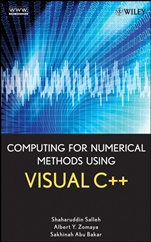
Computing for Numerical Methods Using Visual C++
ISBN 9780470127957
Autor: Shaharuddin Salleh, Albert Y. Zomaya, Sakhinah A. Bakar
Wydawca: Wiley
Dostępność: 3-6 tygodni
Cena: 714,00 zł
Przed złożeniem zamówienia prosimy o kontakt mailowy celem potwierdzenia ceny.
ISBN13: |
9780470127957 |
ISBN10: |
0470127953 |
Autor: |
Shaharuddin Salleh, Albert Y. Zomaya, Sakhinah A. Bakar |
Oprawa: |
Hardback |
Rok Wydania: |
2008-01-11 |
Ilość stron: |
472 |
Wymiary: |
235x163 |
Tematy: |
TJ |
A visual, interdisciplinary approach to solving problems in numerical methods
Computing for Numerical Methods Using Visual C++ fills the need for a complete, authoritative book on the visual solutions to problems in numerical methods using C++. In an age of boundless research, there is a need for a programming language that can successfully bridge the communication gap between a problem and its computing elements through the use of visual–ization for engineers and members of varying disciplines, such as biologists, medical doctors, mathematicians, economists, and politicians. This book takes an interdisciplinary approach to the subject and demonstrates how solving problems in numerical methods using C++ is dominant and practical for implementation due to its flexible language format, object–oriented methodology, and support for high numerical precisions.
In an accessible, easy–to–follow style, the authors cover:
Numerical modeling using C++
Fundamental mathematical tools
MFC interfaces
Curve visualization
Systems of linear equations
Nonlinear equations
Interpolation and approximation
Differentiation and integration
Eigenvalues and Eigenvectors
Ordinary differential equations
Partial differential equations
This reader–friendly book includes a companion Web site, giving readers free access to all of the codes discussed in the book as well as an equation parser called "MyParser" that can be used to develop various numerical applications on Windows. Computing for Numerical Methods Using Visual C++ serves as an excellent reference for students in upper undergraduate– and graduate–level courses in engineering, science, and mathematics. It is also an ideal resource for practitioners using Microsoft Visual C++.
Spis treści:
Chapter 1: Overview of C++.
Language style and organization.
Data types, variables.
Loops and branches.
Array, pointer, function, structure.
Classes and objects.
Inheritance, polymorphism, encapsulation.
Complexity analysis.
Chapter 2: Visual C++ Methods.
MFC library .
Fundamental interface tools.
Text displays.
Graphics and images.
Writing the first program.
Chapter 3: Fundamental Mathematical Tools.
C++ for High–Performance Computing.
Dynamic memory allocation.
Allocation for one–dimensional arrays.
Allocation for higher–dimensional arrays.
Case Study: Matrix multiplication problem.
Matrix elimination problems.
Vector and matrix norms.
Row operations.
Matrix reduction to triangular form.
Computing the determinant of a matrix.
Computing the inverse of a matrix.
Matrix algebra.
Data passing between functions.
Matrix addition and subtraction.
Matrix multiplication.
Matrix inverse.
Putting the pieces together.
Algebra of complex numbers.
Addition and subtraction.
Multiplication.
Conjugate.
Division.
Inverse of a complex number.
Putting the pieces together.
Number Sorting.
Programming Exercises.
Chapter 4: System of Linear Equations.
Systems of Linear Systems.
Existence of Solutions.
Elimination Techniques.
Gauss Elimination Method.
Gauss Elimination with Partial Pivoting.
Gauss–Jordan Method.
LU Factorization Techniques.
Crout Method.
Doolittle Method.
Cholesky Method.
Thomas Algorithm.
Iterative Techniques.
Jacobi Method.
Gauss–Seidel Method.
Visual C++ Solution Interface.
Summary.
Programming Exercises.
Chapter 5: Nonlinear Equations.
Iterative methods: convergence, stability.
Background: existence of solution, MVT, errors, etc..
Bisection method.
False–point position method.
Newton method.
Secant method.
Fixed–point iterative
method.
Visual C++ Solution Interface.
Summary.
Programming Exercises.
Chapter 6: Interpolation and Approximation.
Concepts, existence, stability.
Lagrange.
Newton methods: forward, backward.
Stirling method.
Cubic spline interpolation.
Least–square approximation.
Visual C++ Solution Interface.
Summary.
Programming Exercises.
Chapter 7: Differentiation and Integration.
Taylor series.
Newton methods (forward, backward, central).
Trapezium method.
Simpson method.
Simpson 3/8 method.
Gauss quadrature.
Visual C++ Solution Interface.
Summary.
Programming Exercises.
Chapter 8: Eigenvalues and Eigenvectors.
Characteristic polynomials.
Power method.
Power method with shifting.
Visual C++ Solution Interface.
Summary.
Programming Exercises.
Chapter 9: Ordinary Differential Equations.
Existence, uniqueness, stability, convergence.
IVP: Taylor method.
Euler method.
Runge–Kutta of order 2 method.
Runge–Kutta of order 4 method.
Higher dimensional orders.
Multistep methods: Adams–Bashforth method.
Boundary Value Problems: finite–difference method.
Visual C++ Solution Interface.
Summary.
Programming Exercises.
Chapter 10: Partial Differential Equations.
Existence, uniqueness, stability, convergence.
Elliptic problem: Laplace equation.
Elliptic problem: Poisson equation.
Parabolic problem: heat equation.
Hyperbolic problem: wave equation.
Visual C++ Solution Interface.
Summary.
Programming Exercises.
Chapter 11: Finite Element Methods.
One–dimensional heat problem.
Linear approximation.
Quadratic approximation.
Two–dimensional problem: triangulation method.
Visual C++ Solution Interface.
Summary.
Programming Exercises.
Nota biograficzna:
Shaharuddin Salleh, PhD, is Professor in Computational Mathematics,
Faculty of Science (Mathematics), Universiti Teknologi, Malaysia (UTM). Dr. Salleh′s research is in parallel computing algorithms and scheduling, mobile computing, intelligent systems, and numerical/combinatorial optimization problems. He is also an IT Manager at the Research Management Centre, UTM.
Albert Y. Zomaya, PhD, is the Head of School and CISCO Systems Chair Professor of Internetworking in the School of Information Technologies at the University of Sydney. He is the author or coauthor of several books and more than 300 publications. He is an IEEE Fellow.
Sakhinah Abu Bakar is Lecturer in Computational Mathematics at the School of Mathematical Sciences, Faculty of Science and Technology, National University of Malaysia. She is currently pursuing her PhD degree at the University of Sydney.
Okładka tylna:
A visual, interdisciplinary approach to solving problems in numerical methods
Computing for Numerical Methods Using Visual C++ fills the need for a complete, authoritative book on the visual solutions to problems in numerical methods using C++. In an age of boundless research, there is a need for a programming language that can successfully bridge the communication gap between a problem and its computing elements through the use of visual–ization for engineers and members of varying disciplines, such as biologists, medical doctors, mathematicians, economists, and politicians. This book takes an interdisciplinary approach to the subject and demonstrates how solving problems in numerical methods using C++ is dominant and practical for implementation due to its flexible language format, object–oriented methodology, and support for high numerical precisions.
In an accessible, easy–to–follow style, the authors cover:
Numerical modeling using C++
Fundamental mathematical tools
MFC interfaces
Curve visualization
Systems of linear equatio
Koszyk
Książek w koszyku: 0 szt.
Wartość zakupów: 0,00 zł
Informacje


Kontakt
Gambit
Centrum Oprogramowania
i Szkoleń Sp. z o.o.
Al. Pokoju 29b/22-24
31-564 Kraków
Siedziba Księgarni
ul. Kordylewskiego 1
31-542 Kraków
+48 12 410 5991
+48 12 410 5987
+48 12 410 5989
Subskrypcje
Administratorem danych osobowych jest firma Gambit COiS Sp. z o.o. Na podany adres będzie wysyłany wyłącznie biuletyn informacyjny.
Autoryzacja płatności

Informacje na temat autoryzacji płatności poprzez PayU.

© Copyright 2012: GAMBIT COiS Sp. z o.o. Wszelkie prawa zastrzeżone.
Projekt i wykonanie: Alchemia Studio Reklamy