


Wydawcy
Katalog tematyczny
- Archeologia (109)
- Ekonomia, finanse, business (13704)
- Filozofia (1445)
- Historia (3040)
- Języki i językoznawstwo (2356)
- Lifestyle, hobby i rozrywka (475)
- Medycyna (9704)
- Chirurgia (272)
- Inne gałęzie medycyny (1871)
- Medycyna kliniczna (4187)
- Choroby wewnętrzne (514)
- Dermatologia (51)
- Diagnostyka medyczna (3)
- Endokrynologia (144)
- Gastroenterologia (27)
- Geriatria (50)
- Ginekologia i położnictwo (134)
- Hematologia (46)
- Hepatologia (10)
- Kardiologia (71)
- Laryngologia (12)
- Nefrologia (10)
- Neurologia (500)
- Oftalmologia (50)
- Pediatria (33)
- Pulmunologia (32)
- Reumatologia (14)
- Terapia genowa (1)
- Układ mięśniowo-szkieletowy (1)
- Urologia (14)
- Medycyna niekonwencjonalna (14)
- Medycyna przedkliniczna (269)
- Medycyna, ogólnie (1740)
- Medyczne służby pomocnicze (745)
- Studia medyczne (16)
- Weterynaria (548)
- Nauki humanistyczne (4)
- Nauki o Ziemi i środowisku (2638)
- Nauki ścisłe (20412)
- Nauki społeczne (8486)
- Nauki techniczne (13450)
- Prawo (1696)
- Publikacje informacyjne i interdyscyplinarne (1288)
- Religia i wierzenia (917)
- Technika komputerowa (4067)
- Zdrowie, relacje międzyludzkie i rozwój osobisty (657)





Informacje szczegółowe o książce
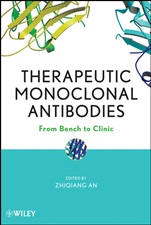
Therapeutic Monoclonal Antibodies: From Bench to Clinic
ISBN 9780470117910
Autor: Zhiqiang An
Wydawca: Wiley
Dostępność: 3-6 tygodni
Cena: 1 000,65 zł
Przed złożeniem zamówienia prosimy o kontakt mailowy celem potwierdzenia ceny.
ISBN13: |
9780470117910 |
ISBN10: |
0470117915 |
Autor: |
Zhiqiang An |
Oprawa: |
Hardback |
Rok Wydania: |
2009-10-27 |
Ilość stron: |
896 |
Wymiary: |
263x182 |
Tematy: |
MJ |
Brings together the state of knowledge and practice in therapeutic monoclonal antibodies
The first therapeutic antibody, murine–derived Muromonab OKT3®, was approved by the FDA in 1986 to treat acute organ rejection. Since then, monoclonal antibody therapeutics have played an increasing role in combating human diseases. To discover the state of the science and where this burgeoning field is heading, readers should turn to this 35–chapter work. It is the first book that draws together all the latest findings, tools, and practices that span the entire process of discovery, development, and clinical application of therapeutic monoclonal antibodies.
Therapeutic Monoclonal Antibodies reviews:
Basic antibody biology and antibody sources
Antibody engineering
Physiology and in vivo biology
Antibody production and delivery
Antibody therapeutic targets
Therapeutic monoclonal antibodies in clinical use and in clinical trial
Biogenerics/biosimilars
Chapters are written by one or more leading practitioners with hands–on experience in the area. The authors have provided not only theories but also methodologies that readers can use in their own laboratories. Moreover, experimental data is offered in most chapters to illustrate key principles.
Therapeutic Monoclonal Antibodies is recommended for biotechnologists, immunologists, medicinal and pharmaceutical chemists, bioengineers, bioprocess technologists, biochemists, and students. It will help them advance their own basic and clinical research by taking advantage of the latest findings in the discovery, development, and clinical application of therapeutic monoclonal antibodies.
Spis treści:
FOREWORD.
PREFACE.
CONTRIBUTORS.
PART I ANTIBODY BASICS.
1. Therapeutic Monoclonal Antibodies: Past, Present, and Future (William R. Strohl).
2. Antibody Molecular Structure (Ro
byn L. Stanfield and Ian A. Wilson).
3. Glycosylation of Therapeutic IgGs (Yusuke Mimura, Roy Jefferis, Yuka Mimura–Kimura, Jodie Abrahams, and Pauline M. Rudd).
4. Antibody Databases and Tools: The IMGT® Experience (Marie–Paule Lefranc).
PART II ANTIBODY SOURCES.
5. Human Antibodies from Transgenic Mice (Nils Lonberg).
6. Rabbit Hybridoma (Weimin Zhu and Guo–Liang Yu).
7. Human Antibody Repertoire Libraries (David Lowe and Tristan J. Vaughan).
PART III IN VITRO DISPLAY TECHNOLOGY.
8. Antibody Phage Display (Michael Hust, Holger Thie, Thomas Schirrmann, and Stefan Dübel).
9. Yeast Surface Display (Jennifer L. Lahti and Jennifer R. Cochran).
10. Ribosomal Display (George Thom).
11. Bacterial Display of Antibodies (Thomas J. Van Blarcom and Barrett R. Harvey).
12. Antibody Selection from Immunoglobulin Libraries Expressed in Mammalian Cells (Ernest S. Smith and Maurice Zauderer).
PART IV ANTIBODY ENGINEERING.
13. Antibody Engineering: Humanization, Affinity Maturation, and Selection Techniques (Juan C. Almagro and William R. Strohl).
14. Modulation of Serum Protein Homeostasis and Transcytosis by the Neonatal Fc Receptor (William F. Dall’Acqua and Herren Wu).
15. Engineering the Antibody Fc Region for Optimal Effector Function (Greg A. Lazar and John R. Desjarlais).
PART V PHYSIOLOGY AND IN VIVO BIOLOGY.
16. Antibody–Complement Interaction (Kileen L. Mershon and Sherie L. Morrison).
17. Bacteria Immunoglobulin–Binding Proteins: Biology and Practical Applications (Leslie Cope and Tessie McNeely).
18. Immunogenicity Screening Using in Silico Methods: Correlation between T–Cell Epitope Content and Clinical Immunogenicity of Monoclonal Antibodies (Si–Han Hai, Julie A. McMurry, Paul M. Knopf
, William Martin, and Anne S. De Groot).
19. Monoclonal Antibody Pharmacokinetics and Pharmacodynamics (Christopher R. Gibson, Punam Sandhu, and William D. Hanley).
20. Biodistribution and Imaging (Tove Olafsen and Anna M. Wu).
21. Antibodies and the Blood–Brain Barrier (Angela R. Jones and Eric V. Shusta).
PART VI ANTIBODY CHARACTERIZATION.
22. Determination of Equilibrium Dissociation Constants (Robin E. Ernst, Katrina N. High, Tom R. Glass, and Qinjian Zhao).
23. Molecular and Functional Characterization of Monoclonal Antibodies (Qinjian Zhao, Terrance A. Stadheim, Lorenzo Chen, and Michael W. Washabaugh).
24. Characterization of Heterogeneity in Monoclonal Antibody Products (Yang Wang, Michael W. Washabaugh, and Qinjian Zhao).
PART VII ANTIBODY EXPRESSION.
25. Antibody Expression in Mammalian Cells (Fubao Wang, Lorenzo Chen, Neal Connors, and Henryk Mach).
26. Production of Antibodies in Pichia pastoris (Juergen H. Nett).
27. Production of Antibody Fab Fragments in E. coli (David P. Humphreys and Leigh Bowering).
28. Production of Human Therapeutic Monoclonal Antibodies in Chicken Eggs (Lei Zhu and Robert J. Etches).
29. Production of Antibodies in Plants (Kevin M. Cox, Jeffrey T. Regan, Jason D. Sterling, Vincent P. M. Wingate, and Lynn F. Dickey).
PART VIII THERAPEUTIC ANTIBODIES.
30. The Formulation and Delivery of Monoclonal Antibodies (Vikas K. Sharma, Hung–Wei Chih, Randall J. Mrsny, and Ann L. Daugherty).
31. Therapeutic Antibodies in Clinical Use and Leading Clinical Candidates (Ningyan Zhang, Brent R. Williams, Ping Lu, Zhiqiang An, and Chen–Ni Chin).
32. Follow–On Protein Products: What, Where, When, How? (Brent R. Williams and William R. Strohl).
33. Monomeric Fc Fusion Molecules (Jennifer A. Dumont, Susan C. Low, Robert T
. Peters, and Alan J. Bitonti).
34. Radioimmunotherapy: Current Status and Future Directions (Neeta Pandit–Taskar and Chaitanya R. Divgi).
35. Antibody–Drug Conjugate Therapy (Stephen C. Alley, Dennis Benjamin, and Che–Leung Law).
ABBREVIATIONS.
INDEX.
Nota biograficzna:
Zhiqiang An, PhD, is the Chief Scientific Officer of Epitomics, Inc., in Burlingame, California. Previously, he was Director of Biologics Research at Merck Research Laboratories, West Point, Pennsylvania. Dr. An started his biotech/pharmaceutical career at Millennium Pharmaceuticals, Inc., Cambridge, Massachusetts. He received a doctor of philosophy degree from the University of Kentucky, Lexington, followed by postdoctoral training at the University of Wisconsin–Madison.
Okładka tylna:
Brings together the state of knowledge and practice in therapeutic monoclonal antibodies
The first therapeutic antibody, murine–derived Muromonab OKT3®, was approved by the FDA in 1986 to treat acute organ rejection. Since then, monoclonal antibody therapeutics have played an increasing role in combating human diseases. To discover the state of the science and where this burgeoning field is heading, readers should turn to this 35–chapter work. It is the first book that draws together all the latest findings, tools, and practices that span the entire process of discovery, development, and clinical application of therapeutic monoclonal antibodies.
Therapeutic Monoclonal Antibodies reviews:
Basic antibody biology and antibody sources
Antibody engineering
Physiology and in vivo biology
Antibody production and delivery
Antibody therapeutic targets
Therapeutic monoclonal antibodies in clinical use and in clinical trial
Biogenerics/biosimilars
Chapters are written by one or more leading practitioners with hands–on experien
ce in the area. The authors have provided not only theories but also methodologies that readers can use in their own laboratories. Moreover, experimental data is offered in most chapters to illustrate key principles.
Therapeutic Monoclonal Antibodies is recommended for biotechnologists, immunologists, medicinal and pharmaceutical chemists, bioengineers, bioprocess technologists, biochemists, and students. It will help them advance their own basic and clinical research by taking advantage of the latest findings in the discovery, development, and clinical application of therapeutic monoclonal antibodies.
Koszyk
Książek w koszyku: 0 szt.
Wartość zakupów: 0,00 zł
Informacje


Kontakt
Gambit
Centrum Oprogramowania
i Szkoleń Sp. z o.o.
Al. Pokoju 29b/22-24
31-564 Kraków
Siedziba Księgarni
ul. Kordylewskiego 1
31-542 Kraków
+48 12 410 5991
+48 12 410 5987
+48 12 410 5989
Subskrypcje
Administratorem danych osobowych jest firma Gambit COiS Sp. z o.o. Na podany adres będzie wysyłany wyłącznie biuletyn informacyjny.
Autoryzacja płatności

Informacje na temat autoryzacji płatności poprzez PayU.

© Copyright 2012: GAMBIT COiS Sp. z o.o. Wszelkie prawa zastrzeżone.
Projekt i wykonanie: Alchemia Studio Reklamy