


Wydawcy
Katalog tematyczny
- Archeologia (109)
- Ekonomia, finanse, business (13704)
- Filozofia (1445)
- Historia (3040)
- Języki i językoznawstwo (2356)
- Lifestyle, hobby i rozrywka (475)
- Medycyna (9704)
- Nauki humanistyczne (4)
- Nauki o Ziemi i środowisku (2638)
- Nauki ścisłe (20412)
- Astronomia (294)
- Biologia (5119)
- Biochemia (575)
- Biologia człowieka (14)
- Biologia komórkowa (377)
- Biologia molekularna (398)
- Biologia rozwoju (130)
- Biologia, ogólnie (1277)
- Botanika (280)
- Hydrobiologia (92)
- Mikrobiologia (363)
- Mykologia (22)
- Zoologia (303)
- Chemia (6540)
- Fizyka (3309)
- Matematyka (4574)
- Nauki ścisłe, ogólnie (503)
- Nauki społeczne (8486)
- Nauki techniczne (13450)
- Prawo (1696)
- Publikacje informacyjne i interdyscyplinarne (1288)
- Religia i wierzenia (917)
- Technika komputerowa (4067)
- Zdrowie, relacje międzyludzkie i rozwój osobisty (657)





Informacje szczegółowe o książce
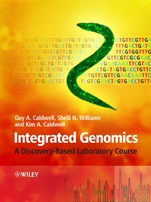
Integrated Genomics: A Discovery–Based Laboratory Course
ISBN 9780470095010
Autor: Guy A. Caldwell, Shelli N. Williams, Kim A. Caldwell
Wydawca: Wiley
Dostępność: 3-6 tygodni
Cena: 971,25 zł
Przed złożeniem zamówienia prosimy o kontakt mailowy celem potwierdzenia ceny.
ISBN13: |
9780470095010 |
ISBN10: |
0470095016 |
Autor: |
Guy A. Caldwell, Shelli N. Williams, Kim A. Caldwell |
Oprawa: |
Hardback |
Rok Wydania: |
2006-07-28 |
Ilość stron: |
246 |
Wymiary: |
287x220 |
Tematy: |
PS |
Integrated Genomics
A discovery–Based Laboratory Course.
Integrated Genomics: A Discovery–Based Laboratory Course introduces the excitement of discovery to the basic molecular biology laboratory. Utilizing up–to–date molecular biology protocols and a basic experimental design, this text offers experience with three different model systems. Students will become familiar with the simplicity and power of single–celled organisms, E. coli and S. cerevisiae, as they search for genes that interact and function within the nematode C.elegans. They will also begin to explore the wealth of bioinformatics data available on the Internet via numerous exercises incorporated throughout the book.
Using simple and inexpensive techniques, the concluding chapters enable students to examine the phenotypic consequences of reducing gene function within C. elegans. The authors have included a range of alternative experiments that offer flexibility in determining the end date or goal of the laboratory, as well as working within the available budget and resources of most classroom environments.
Key FeaturesProvides training with multiple inexpensive and popular model organisms including C. elegans and S. cerevisiaeAdopts a student–tested, discovery–based format.Integrates basic bioinformatics within an experimental contextInclusive of modern molecular genomic/proteomic technologies such as the yeast two–hybrid system and RNAiAccompanying website includes easy access to instructional materials and experimental reagents including all strains and plasmids used in the course
An invaluable text for advanced undergraduate and postgraduate students studying cell and molecular biology, genetics, microbiology, biochemistry, proteomics, genomics and bioinformatics.
Spis treści:
Preface.
Author biographies.
Acknowledgments.
List
of figures.
1 Introduction to basic laboratory genetics.
1.1 Transferring and handling C. elegans.
1.2 Introduction to laboratory genetics.
2 Gene expression analysis using transgenic animals.
2.1 Transgenic gene expression analysis in C. elegans: lacZ staining.
2.2 Transgenic gene expression analysis in C. elegans: GFP analysis.
3 Creation and testing of transgenic yeast for use in protein–protein interaction screening.
3.1 Small–scale transformation of S. cerevisiae.
3.2 Transformation of S. cerevisiae to test for non–specific interaction.
3.3 Assaying for protein–protein interaction by reporter gene expression.
4 Yeast two–hybrid screening.
4.1 Protein–protein interaction screening of a C. elegans cDNA library.
4.2 Assaying for protein–protein interaction by reporter gene expression.
5 Isolation and identification of interacting proteins.
5.1 Preparation of electrocompetent E. coli.
5.2 Isolation of DNA from yeast and electroporation of E. coli.
5.3 Small–scale isolation of plasmid DNA from E. coli: the mini–prep.
5.4 Sequencing of two–hybrid library plasmid DNA vectors.
6 Using bioinformatics in modern science.
6.1 DNA sequence chromatogram.
6.2 BLASTing your sequence.
6.3 Evaluating sequence results and choosing an RNAi target.
6.4 Bioinformatics practice questions.
7 Generation of an RNAi vector.
7.1 Small–scale isolation of genomic DNA from C. elegans.
7.2 PCR amplification of target gene sequence from C. elegans genomic DNA.
7.3 Preparations for cloning to generate RNAi vector.
7.3.1 Agarose gel electrophoresis.
7.3.2 Removal of dNTPs from PCR reaction.
7.3.3 Restriction enzyme digestion of PCR product and C. elegans RNAi vector.
7.4 Gel purification of DNA and ligat
ion of vector and PCR–amplified DNA.
7.4.1 Preparative agarose gel electrophoresis.
7.4.2 Gel purification of DNA from agarose gel.
7.4.3 Ligation of vector and PCR–amplified DNA.
7.5 Transformation of ligation reactions.
7.6 PCR screening of transformation colonies.
7.7 Small–scale isolation of plasmid DNA from E. coli: the mini–prep.
7.8 Verifying successful ligation by restriction digestion.
8 RNA–mediated interference by bacterial feeding.
8.1 Preparation of RNAi–feeding bacteria for transformation.
8.2 Media preparation for RNAi feeding.
8.3 Transformation of RNAi–feeding strain HT115(DE3).
8.4 RNA interference by bacterial feeding of C. elegans.
8.5 Analyzing effects of dsRNAi.
8.5.1 Assaying for sterility (Ste) or embryonic lethality (Emb).
8.5.2 Assaying for growth effect.
8.5.3 Assaying for morphological effects.
8.5.4 Assaying for general neuromuscular effects.
8.5.5 Assaying for specific neuronal effects.
8.5.6 Assaying for dauer formation.
Appendix I Recombinational cloning.
AI.1 Isolation of genomic DNA from C. elegans.
AI.2 PCR amplification of target gene sequence from C. elegans genomic DNA.
AI.3 Agarose gel electrophoresis and clean–up of PCR reaction.
AI.4 Entry vector cloning.
AI.5 Small–scale isolation of plasmid DNA from E. coli: the mini–prep.
AI.6 Destination vector cloning.
AI.7 Small–scale isolation of plasmid DNA from E. coli: the mini–prep.
Appendix II Recipes and media preparation.
Solution recipes.
Media preparation.
Appendix III Sterile techniques and worm protocols.
Sterile techniques.
Worm protocols.
Appendix IV Mutant C. elegans phenotypes.
Appendix V Vector maps.
Subject index.
Nota biograficzna:
Guy A. Caldwell, PhD, is an Associate P
rofessor in the Department of Biological Sciences at the University of Alabama, where since 1999 he has held an undergraduate professorial appointment from the Howard Hughes Medical Institute. He holds an adjunct appointment at the University of Alabama at Birmingham, as an Assistant research Professor of Neurology. In 2001, Dr Caldwell was named a Bail O′ Connor Scholar of The March of Dimes Birth Defects Foundation for his research into the molecular basis of childhood birth defects of the brain. Dr Caldwell is a recipient of grants from The March of Dimes, National Institutes of Health, Dystonia Medical Research Foundation, Parkinson′s Disease Foundation, National Parkinson Foundation, and the Bachmann–Strauss Dystonia & Parkinson Foundation. In 2003, The Caldwell Laboratory was selected as 1 0f 11 groups worldwide to represent the research goals of the Michael J. Fox Foundation for Parkinson′s research in their Protein Degradation Grant Initiative. For his combines teaching and research efforts, Dr Caldwell was also chosen as the recipient of a 2003 CAREER Award from the National Science Foundation. In 2005, he was named Alabama Professor of the Year by the Carnegie Foundation for the Advancement of Teaching and Council for Advancement and Support of Education. Dr Caldwell, a native of the New York City area, received his undergraduate degree in Biology from Washington & Lee University in 1986 and his PhD in Cell, Molecular & Developmental Biology from The University of Tennessee in 1993. Following receipt of his doctorate, he moved to Columbia University in New York where he was twice named the recipient of fellowships from the National Institute of Neurological Disease and Stroke. He is the author of two editions of a widely adopted textbook, Biotechnology: A Laboratory Course, published worldwide in three languages. He teaches courses in Integrated Genomics, Neuronal Signaling, General biology, and an acclaimed
Koszyk
Książek w koszyku: 0 szt.
Wartość zakupów: 0,00 zł
Informacje


Kontakt
Gambit
Centrum Oprogramowania
i Szkoleń Sp. z o.o.
Al. Pokoju 29b/22-24
31-564 Kraków
Siedziba Księgarni
ul. Kordylewskiego 1
31-542 Kraków
+48 12 410 5991
+48 12 410 5987
+48 12 410 5989
Subskrypcje
Administratorem danych osobowych jest firma Gambit COiS Sp. z o.o. Na podany adres będzie wysyłany wyłącznie biuletyn informacyjny.
Autoryzacja płatności

Informacje na temat autoryzacji płatności poprzez PayU.

© Copyright 2012: GAMBIT COiS Sp. z o.o. Wszelkie prawa zastrzeżone.
Projekt i wykonanie: Alchemia Studio Reklamy