


Wydawcy
Katalog tematyczny
- Archeologia (109)
- Ekonomia, finanse, business (13704)
- Filozofia (1445)
- Historia (3040)
- Języki i językoznawstwo (2356)
- Lifestyle, hobby i rozrywka (475)
- Medycyna (9704)
- Nauki humanistyczne (4)
- Nauki o Ziemi i środowisku (2638)
- Nauki ścisłe (20412)
- Astronomia (294)
- Biologia (5119)
- Chemia (6540)
- Chemia analityczna (361)
- Chemia fizyczna (346)
- Chemia nieorganiczna (137)
- Chemia organiczna (535)
- Krystalografia (27)
- Minerologia (46)
- Fizyka (3309)
- Matematyka (4574)
- Nauki ścisłe, ogólnie (503)
- Nauki społeczne (8486)
- Nauki techniczne (13450)
- Prawo (1696)
- Publikacje informacyjne i interdyscyplinarne (1288)
- Religia i wierzenia (917)
- Technika komputerowa (4067)
- Zdrowie, relacje międzyludzkie i rozwój osobisty (657)





Informacje szczegółowe o książce
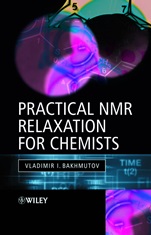
Practical Nuclear Magnetic Resonance Relaxation for Chemists
ISBN 9780470094457
Autor: Vladimir I. Bakhmutov
Wydawca: Wiley
Dostępność: 3-6 tygodni
Cena: 943,95 zł
Przed złożeniem zamówienia prosimy o kontakt mailowy celem potwierdzenia ceny.
ISBN13: |
9780470094457 |
ISBN10: |
0470094451 |
Autor: |
Vladimir I. Bakhmutov |
Oprawa: |
Hardback |
Rok Wydania: |
2004-11-26 |
Ilość stron: |
218 |
Wymiary: |
239x156 |
Tematy: |
PN |
This book was written by an expert with long researching and teaching experience and is based on University NMR courses given in Russia, France, Spain, Switzerland and the USA. It is suitable both as a textbook for advanced undergraduate students and graduate students encountering nuclear magnetic relaxation for the first time, and also for professional researchers already actively using NMR spectroscopy in synthetic, physical, biological, pharmaceutical and industrial chemistry.
The book can be divided into two sections: chapters 1–6 teaching the basics and chapters 7–12 dealing with applications. Each chapter is referenced and includes well–organized illustrative material. The chapters in the first section deal with the basic theory of nuclear relaxation as physical phenomenon and are written in a simple and accessible form, thus readers do not need specialist knowledge of physics and NMR. As well as the theory behind nuclear relaxation this section considers important methodical aspects of relaxation experiments and analyzes their typical errors and problems. The aim of section is to overcome a situation where NMR is regarded by chemists as a ‘black box’. Chapters 7–11 provide practical examples of 1D and 2D NMR relaxation experiments and show how nuclear relaxation can be applied to qualitative structural diagnostics in solutions, quantitative structural investigations of diamagnetic and paramagnetic molecular systems, studies of weak intermolecular interactions, molecular mobility and chemical exchanges.
Spis treści:
Preface.
Chapter 1. How and why nuclei relax.
1.1. Nucleus in the magnetic field.
1.2. Spin–lattice and spin–spin nuclear relaxation.
1.2.1. Macroscopic magnetization: relaxation times T1 and T2.
1.3. Molecular motions as reason of nuclear relaxation.
1.3.1. Correlation times and activation energies of Molecular Motions.
1.3.2. Isotropic and anisot
ropic molecular motions.
1.4. Bibliography for Chapter 1.
Chapter 2. How to measure the NMR relaxation times.
2.1. Exponential and non–exponential nuclear relaxation.
2.2. Measurements of spin–lattice relaxation times.
2.3. Measurements of selective and bi–selective T1 times.
2.4. Determinations of T1( and T2 times.
2.5. Preparation of samples for relaxation experiments.
2.6. Bibliography to Chapter 2.
Chapter 3. Errors in Determinations of Relaxation Times.
3.1. Instrumental errors.
3.2. Incorrect parameters for T1, T2 measurements and T1, T2 calculations.
3.3 Coupled nuclear relaxation.
3.4. Chemical exchanges.
3.5. Bibliography to Chapter 3.
Chapter 4. NMR relaxation by dipole–dipole and quadrupole interactions.
4.1. The intramolecular dipole–dipole relaxation: homo– and hetero–nuclear dipolar coupling and the spectral density function.
4.2. Haw to reveal the presence of the dipolar mechanisms.
4.2.1. NOE as a test for dipole–dipole nuclear relaxation.
4.2.2. Evaluations of the dipolar contributions from selective and non–selective T1 times.
4.3. Intermolecular dipole–dipole interactions.
4.4. Electric field gradients at quadrupolar nuclei.
4.5. Nuclear quadrupole coupling constant as a measure of the electric field gradient.
4.6. Quadrupole relaxation.
4.7. Bibliography to Chapter 4.
Chapter 5. Relaxation by chemical shift anisotropy, spin–rotation relaxation, scalar relaxation of the second kind and cross–mechanisms.
5.1. Relaxation by chemical shift anisotropy.
5.2. Spin–rotation relaxation.
5.3. Interference mechanisms of nuclear relaxation.
5.4. The scalar relaxation of the second kind.
5.5 Bibliography to Chapter 5.
Chapter 6. Nuclear relaxation in molecular systems with anisotropic motions.
6.1. Spin–lattice nuclear relaxation in ellipsoid mole
cules: Temperature dependences of T1times.
6.2. How to reveal anisotropic molecular motions in solutions.
6.3. Nuclear relaxation in the presence of correlation time distributions.
6.4. Bibliography to Chapter 6.
Chapter 7. 1H T1 relaxation diagnostics in solutions.
7.1. Revealing weak intermolecular interactions by T1 time measurements in solutions.
7.2. T1 studies of exchanges in simple molecular systems.
7.3. Structural 1H T1 criterion.
7.4. Partially–relaxed NMR spectra.
7.5. Bibliography to Chapter 7.
Chapter 8. Internuclear distances from the 1H T1 relaxation measurements in solutions.
8.1. X...H distances: metal – hydride bond lengths.
8.1.1. How to determine metal–hydride bond lengths by standard 1H T1 measurements.
8.1.2. Metal–hydride bond lengths by 1H T1sel and 1H T1min times measurements.
8.2. Proton–proton distances by standard T1 measurements.
8.3. H–H distances from T1sel / T1bis measurements.
8.4. H–H distances in intermediates.
8.5. Analyzing the errors in 1H T1 determinations of internuclear distances.
8.6. Bibliography to Chapter 8.
9. Chapter 9: Deuterium quadrupole coupling constants from 2H T1 relaxation measurements in solutions.
9.1. How to determine DQCC values.
9.2. DQCC values from the 2H T1 times measurements in solutions (fast motional regime).
9.3. DQCC values via 2H T1min measurements in solutions.
9.4. Errors in DQCC determinations.
9. 5. Bibliography to Chapter 9.
Chapter 10. Spin–lattice 1H and 2H relaxation in mobile groups.
10.1. 1H T1 times and H–H distances in the presence of fast vibrations and librations.
10.2. 1H T1 times and H–H distances in the presence of fast rotational diffusion.
10.3. The spectral density function for high–amplitude librations.
10.4. 900–jumps in four–fold potential.
10. 5. Deuterium spin–lattice NMR re
laxation in mobile molecular fragments.
10.6. Bibliography to Chapter 10.
Chapter 11. Relaxation of other nuclei (than 1H and 2H) and specific relaxation experiments.
11.1. Chemical shift anisotropies and nuclear quadrupole coupling constants from T1 times of heavy nuclei in solutions.
11.2. Multinuclear relaxation approaches to complexation, association and H–bonding.
11.3. Na relaxation in solutions of complex molecular systems.
11. 4. Character of molecular motions from 17O and 2H T1 relaxation in solutions.
11.5. 2D T1 and T1( NMR experiments.
11.6. Chemical exchanges in complex molecular systems from 15N nuclear relaxation in solutions.
11.7. R1/R2 method.
11.8. Cross–correlation relaxation rates and structure of complex molecular systems in solutions.
11.9. Variable – field relaxation experiments.
11.10. Bibliography to Chapter 11.
Chapter 12. Paramagnetic NMR relaxation.
12.1. Theoretical basics of the paramagnetic relaxation enhancement.
12.2. Paramagnetic relaxation rate enhancements in the presence of chemical exchanges.
12.3. Structural applications of paramagnetic relaxation rate enhancements.
12.4. Kinetics of ligand exchanges via paramagnetic relaxation rate enhancements.
12.5. Longitudinal electron relaxation time in paramagnetic centers from variable–high field NMR experiments.
12.6. Bibliography to Chapter 12.
Concluding remarks.
Subject Index.
Nota biograficzna:
Dr. Vladimir I. Bakhmutov is a professional NMR spectroscopist at the Department of Chemistry, Texas A&M University, USA. He is also the author of 220 scientific publications including reviews and book chapters.
Okładka tylna:
This book was written by an expert with long researching and teaching experience and is based on University NMR courses given in Russia, France, Spain, Switzerland and the USA. It is suitable both as a textbook for
Koszyk
Książek w koszyku: 0 szt.
Wartość zakupów: 0,00 zł
Informacje


Kontakt
Gambit
Centrum Oprogramowania
i Szkoleń Sp. z o.o.
Al. Pokoju 29b/22-24
31-564 Kraków
Siedziba Księgarni
ul. Kordylewskiego 1
31-542 Kraków
+48 12 410 5991
+48 12 410 5987
+48 12 410 5989
Subskrypcje
Administratorem danych osobowych jest firma Gambit COiS Sp. z o.o. Na podany adres będzie wysyłany wyłącznie biuletyn informacyjny.
Autoryzacja płatności

Informacje na temat autoryzacji płatności poprzez PayU.

© Copyright 2012: GAMBIT COiS Sp. z o.o. Wszelkie prawa zastrzeżone.
Projekt i wykonanie: Alchemia Studio Reklamy