


Wydawcy
Katalog tematyczny
- Archeologia (109)
- Ekonomia, finanse, business (13704)
- Filozofia (1445)
- Historia (3040)
- Języki i językoznawstwo (2356)
- Lifestyle, hobby i rozrywka (475)
- Medycyna (9704)
- Nauki humanistyczne (4)
- Nauki o Ziemi i środowisku (2638)
- Nauki ścisłe (20412)
- Nauki społeczne (8486)
- Edukacja (229)
- Kryminologia, opieka spełeczna (284)
- Obronność (10)
- Polityka (1389)
- Psychologia (777)
- Socjologia (410)
- Społeczeństwo i kultura (187)
- Nauki techniczne (13450)
- Prawo (1696)
- Publikacje informacyjne i interdyscyplinarne (1288)
- Religia i wierzenia (917)
- Technika komputerowa (4067)
- Zdrowie, relacje międzyludzkie i rozwój osobisty (657)





Informacje szczegółowe o książce
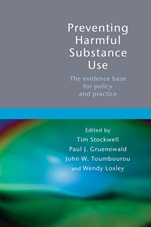
Preventing Harmful Substance Use: The Evidence Base for Policy and Practice
ISBN 9780470092286
Autor: Tim Stockwell, Paul Gruenewald, John Toumbourou, Wendy Loxley
Wydawca: Wiley
Dostępność: 3-6 tygodni
Cena: 336,00 zł
Przed złożeniem zamówienia prosimy o kontakt mailowy celem potwierdzenia ceny.
ISBN13: |
9780470092286 |
ISBN10: |
0470092289 |
Autor: |
Tim Stockwell, Paul Gruenewald, John Toumbourou, Wendy Loxley |
Oprawa: |
Paperback |
Rok Wydania: |
2005-02-11 |
Ilość stron: |
496 |
Wymiary: |
244x178 |
Tematy: |
JC |
Tobacco, alcohol and other drug misuse accounts for a quarter of preventable death and disability in the developed world.
Preventing Harmful Substance Use: The evidence base for policy and practice offers a comprehensive summary of the best available scientific evidence for the prevention of harm from substance use. The editors provide a broad view of what constitutes prevention; including multiple approaches across various settings and levels of society. Each chapter provides important recommendations for supply, demand and harm reduction strategies that will improve the health of communities throughout the world.
A multidisciplinary team of leading international researchers and practitioners have worked together to provide authoritative accounts of their areas of expertise, which include the following:Updated concepts and theories of prevention including Community Systems Theory, Social Developmental Models, Deterrence, economics and more broad–based risk factor approaches.Overviews of the comparative health and economic costs associated with the use of alcohol, tobacco and illicit drugs.Worked examples of cost–benefit analyses and portfolio analyses to help policy makers decide how to invest available funds to achieve maximum population–level benefits.Up–to–date reviews of what works for a wide variety of policies and programs, including summary ratings of the strength of evidence for 70 specific strategies.
Preventing Harmful Substance Use will have international appeal to policy makers, educators, health professionals and researchers in psychology, psychiatry, sociology, criminology, economics, addiction, and health promotion.
Spis treści:
About the Editors.
Contributors.
Preface.
Acknowledgements.
SECTION 1: INTRODUCTION.
1.1 Preventing Risky Drug Use and Related Harms: The Need For a Synthesis of New Knowledge (Tim Stockwel
l, Paul Gruenewald, John Toumbourou and Wendy Loxley).
SECTION 2: PATTERNS OF RISK AND RELATD HARMS (Editor: Tim Stockwell).
2.1 Introduction and Overview (Tim Stockwell).
2.2 The Global Burden of Disease Attributable to Alcohol, Tobacco and Illicit Drugs (Juergen Rehm, Switzerland and Robin Room).
2.3 Substance Use and Mental Health in Longitudinal Perspective Marree Teesson, Louisa Degenhardt, Wayne Hall, Michael Lynskey, John Toumbourou and George Patton).
2.4 Predicting Developmentally Harmful Substance Use (John Toumbourou and Richard F. Catalano).
2.5 Population Ecologies of Drug Use, Drinking and Related Problems (Elizabeth LaScala, Bridget Freisthler and Paul Gruenewald).
SECTION 3: INTERVENTIONS FFOR CHILDERN AND ADOLESCENTS (Editor: John Toumbourou).
3.1 Introduction (John Toumbourou).
3.2 What Do We Know About Preventing Drug–Related Harm Through Social Developmental Intervention with Children and Young People (John Toumbourou, Jo Williams, Elizabeth Waters and George Patton).
3.3 The Evidence Base For School Drug Education Interventions 9Nyanda McBride).
3.4 Alcohol Policy and Youth Drinking: Overview of Effective Interventions For Young People (Joel Grube and Peter Nygaard).
3.5 Testing a Community Prevention Focused Model of Coalition Functioning and Sustainability: A Comprehensive Study of Communities That Care in Pennsylvania (Mark Greenberg, Mark Feinberg, Brendan Gomez and Wayne Osgood).
SECTION 4: INTERVENTIONS IN THE COMMUNITY: ILLUSTRATIVE CASE STUDIES (Editor: Paul Gruenewald).
4.1 Introduction (Paul Gruenewald).
4.2 Community Systems and Ecologies of Drug and Alcohol Problems (Harold Holder, Andrew Treno and David Levy).
4.3 Violence Prevention in Licensed Premises (Ben Haines, Australia and Kate Graham).
4.4 Application o
f Evidence–Based Approaches to Community Interventions Andrew Treno, Juliet Lee, Bridget Freisthler, Lillian Remer and Paul Gruenewald).
4.5 Preventing Alcohol and Other Drugs in the Workplace (Richard Midford, Fredrik Welande and Steve Allsop).
4.6 Effects of a Community Action Program on Problems Related to Alcohol Consumption at Licensed Premises (Eva Wallin And Sven Andreasson).
4.7 Strategies For Community–Based Drug Law Enforcement: From Prohibition To Harm Reduction (Chris Canty, Adam Sutton And Steve James).
SECTION 5: LEGISLATIVE AND REGULATORY PERSPECTIVES ON THE PREVENTION OF RISKY DRUG USE AND HARM (Editor: Wendy Loxley).
5.1 Introduction: Summary and Recommendations (Wendy Loxley).
5.2 Regulating Tobacco to Minimise Harms (Jonathan Liberman and Ron Borland).
5.3 Intelligence–Led Regulation of Licensed Premises (Neil Donnelly and Suzanne Briscoe).
5.4 Deterrence Theory and the Limitations of Criminal Penalties for Cannabis Use (Simon Lenton).
5.5 Interventions For Illicit Drug Users within the Criminal Justice System: A Review of Some Programs in Australia, the United Kingdom and the United States (Wendy Loxley).
5.6 Social Ecology and the Invention of New Regulatory Strategies For Preventing Drug and Alcohol Problems (Bridget Freisthler and Paul J. Gruenewald).
SECTION 6: THE EVIDENCE BASE FOR PREVENTION IN BROAD PERSPECTIVE (Editor: Paul Gruenewald).
6.1 Introduction (Paul Gruenewald).
6.2 What is "Evidence," and Can We Provide It? (Bob Saltz).
6.3 US Policy on Illegal Drugs: What We Don′t Know Keeps Hurting Us—A Perspective On Future Research Needs (James C. Anthony).
6.4 Preventing Tobacco Use and Harm: What Is Evidence–Based Policy? (Sandra Younie, Michelle Scollo, David Hill and Ron Borla).nd
6.5 Moving Toward
a Common Evidence Base For Alcohol and Other Drug Prevention Policy (Harold Holder and Andrew Treno).
6.6 The Evidence Base For Preventing the Spread of Blood–Borne Diseases Within and From Populations of Injecting Drug Users (Marcia Russell and Susan Carruthers).
6.7 The Evidence Base For Responding to Substance Misuse in Indigenous Minority Populations (Dennis Gray and Sherry Saggers).
SECTION 7: FUTURE DIRECTIONS FOR PREVENTION POLICY AND RESEARCH (Editor: Tim Stockwell).
7.1 Introduction (Tim Stockwell).
7.2 Investing For Cost–Effectiveness in the Face of Uncertainty: Applying Financial Portfolio Optimization to Prevention Programming (Jonathan Caulkins).
7.3 How Should Governments Spend the Drug Prevention Dollar: A Buyer′s Guide (Ted Miller, USA and Delia Hendrie).
7.4 Key Moments in the Ethnography Of Drug–Related Harm: Reality Checks for Policy Makers? (David Moore).
7.5 Recommendations For New Directions in the Prevention of Risky Substance Use and Related Harms (Tim Stockwell, Paul Gruenewald, John Toumbourou and Wendy Loxley).
Index.
Nota biograficzna:
Paul J. Gruenewald is a Senior Research Scientists and Scientific Director of Prevention Research Center (PRC) in Berkeley, California, a division of the US–based Pacific Institute for Research and Evaluation (PIRE). Research at PIRE is funded by grants and contracts from the National Institutes of Justice, Office of Juvenile Justice and Delinquency Prevention, the Center for Substance Abuse Prevention, and other national, state, local and private funding agencies. Dr Gruenewald is Principal Investigator of a Center grant funded by the National Institute on Alcohol Abuse and Alcoholism to study "Environmental Approaches to Prevention" (P60–AA906282) and a Merit award recipient for his studies of "Alcohol Outlets and Violence" (R37–AA912927). He
Koszyk
Książek w koszyku: 0 szt.
Wartość zakupów: 0,00 zł
Informacje


Kontakt
Gambit
Centrum Oprogramowania
i Szkoleń Sp. z o.o.
Al. Pokoju 29b/22-24
31-564 Kraków
Siedziba Księgarni
ul. Kordylewskiego 1
31-542 Kraków
+48 12 410 5991
+48 12 410 5987
+48 12 410 5989
Subskrypcje
Administratorem danych osobowych jest firma Gambit COiS Sp. z o.o. Na podany adres będzie wysyłany wyłącznie biuletyn informacyjny.
Autoryzacja płatności

Informacje na temat autoryzacji płatności poprzez PayU.

© Copyright 2012: GAMBIT COiS Sp. z o.o. Wszelkie prawa zastrzeżone.
Projekt i wykonanie: Alchemia Studio Reklamy