


Wydawcy
Katalog tematyczny
- Archeologia (109)
- Ekonomia, finanse, business (13704)
- Filozofia (1445)
- Historia (3040)
- Języki i językoznawstwo (2356)
- Lifestyle, hobby i rozrywka (475)
- Medycyna (9704)
- Nauki humanistyczne (4)
- Nauki o Ziemi i środowisku (2638)
- Nauki ścisłe (20412)
- Nauki społeczne (8486)
- Nauki techniczne (13450)
- Budownictwo lądowe (1045)
- Chemia przemysłowa (2258)
- Elektronika i telekomunikacja (3287)
- Energetyka (1122)
- Inne nauki stosowane (363)
- Inżynieria biochemiczna (507)
- Inżynieria transportu (232)
- Mechanika i materiały (3316)
- Nauka o środowisku (321)
- Rolnictwo (507)
- Technika, ogólnie (475)
- Prawo (1696)
- Publikacje informacyjne i interdyscyplinarne (1288)
- Religia i wierzenia (917)
- Technika komputerowa (4067)
- Zdrowie, relacje międzyludzkie i rozwój osobisty (657)





Informacje szczegółowe o książce
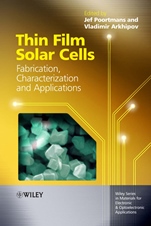
Thin Film Solar Cells: Fabrication, Characterization and Applications
ISBN 9780470091265
Autor: Jef Poortmans, Vladimir Arkhipov
Wydawca: Wiley
Dostępność: 3-6 tygodni
Cena: 971,25 zł
Przed złożeniem zamówienia prosimy o kontakt mailowy celem potwierdzenia ceny.
ISBN13: |
9780470091265 |
ISBN10: |
0470091266 |
Autor: |
Jef Poortmans, Vladimir Arkhipov |
Oprawa: |
Hardback |
Rok Wydania: |
2006-09-08 |
Ilość stron: |
502 |
Wymiary: |
262x171 |
Tematy: |
TG |
In order to make photovoltaic power generation an economically viable option, the cost of solar cell devices has to be lowered. Nowadays most solar cells are manufactured from crystalline Si substrates with a typical thickness of 200–300 mm. Since the base material for these devices is electronic–grade Si, a large part of the cost of the final solar cell is related to the active material. In order to reduce these costs, a transition from these ′bulk crystalline Si solar cells′ has to made to thin–film technologies with reduced usage of active material in the device. These thin films can consist of crystalline, protocrystalline, or amorphous silicon. In addition, II–VI polycrystalline compounds like CdTe or ternary compounds like CuIn(Ga)Se2(S)–alloys are being investigated and developed. In the case of thin films of Si, there is a broad range of deposition technologies. Although these technologies have not yet come onto the market to any great degree, there has been considerable progress over the last years both in terms of technology development, upscaling and in–depth understanding.
Currently, there is strong growth of R&D in the field of organic and hybrid solar cells. In order to exploit the full potential of these materials, novel and radically different cell concepts have been suggested. At contrast to the classical planar homo– and heterojunction structures, these concepts are based on three–dimensional structures to generate and collect the carriers. The most prominent examples of these structures are the bulk donor–acceptor heterojunction cells, the nanocrystalline photo–electrochemical cell (also known as Grätzel cell) and eta cells. In fact, these device concepts are a clear illustration of the possibilities offered by nanostructured materials to further enhance photovoltaic performance and to reduce the solar cell cost.
This book is the first comprehensive overvie
w covering the different thin–film solar cell technologies: from the more “classical ones” (a–Si:H, CdTe, CIS) to the novel ones which are making their way from the lab to actual production. The book not only provides the reader with a good overview but also provides recent insights on advanced characterization, device modelling and upscaling of the different approaches. The book is intended for postgraduate researchers in the PV domain, industrial researchers in the PV domain and photonics professionals.
Spis treści:
Series Preface.
Preface.
1. Epitaxial thin–film crystalline Si solar cells on low–cost Si carriers (Jef Poortmans).
2.Crystalline Silicon Thin–Film Solar Cells on Foreign Substrates by High–Temperature Deposition and Recrystallization (Stefan Reber and Thomas Kieliba).
3. Thin–film polycrystalline Si solar cells (Guy Beaucarne and Abdellilah Slaoui).
4. Advances in microcrystalline silicon solar cell technologies (Evelyne Vallat–Sauvain, Arvind Shah and Julien Bailat).
5. Advanced Amorphous Silicon Solar Cell Technologies (Miro Zeman).
6. Chalcopyrite Based Solar Cells (Martha Ch. Lux–Steiner).
7. CdTe Thin Film Solar Cells: Characterization, Fabrication and Modelling (Marc Burgelman).
8.Charge carrier photogeneration in doped and blended organicSemiconductors (V. I. Arkhipov and H. Bässler).
9. Nanocrystalline Injection Solar Cells (Michael Grätzel).
10. Charge Transport and Recombination in Donor–Acceptor Bulk Heterojunction Solar Cells (A. J. Mozer and N. S. Sariciftci).
11. The Terawatt Challenge for Thin Film PV (Ken Zweibel).
Okładka tylna:
In order to make photovoltaic power generation an economically viable option, the cost of solar cell devices has to be lowered. Nowadays most solar cells are m
anufactured from crystalline Si substrates with a typical thickness of 200–300 mm. Since the base material for these devices is electronic–grade Si, a large part of the cost of the final solar cell is related to the active material. In order to reduce these costs, a transition from these ′bulk crystalline Si solar cells′ has to made to thin–film technologies with reduced usage of active material in the device. These thin films can consist of crystalline, protocrystalline, or amorphous silicon. In addition, II–VI polycrystalline compounds like CdTe or ternary compounds like CuIn(Ga)Se2(S)–alloys are being investigated and developed. In the case of thin films of Si, there is a broad range of deposition technologies. Although these technologies have not yet come onto the market to any great degree, there has been considerable progress over the last years both in terms of technology development, upscaling and in–depth understanding.
Currently, there is strong growth of R&D in the field of organic and hybrid solar cells. In order to exploit the full potential of these materials, novel and radically different cell concepts have been suggested. At contrast to the classical planar homo– and heterojunction structures, these concepts are based on three–dimensional structures to generate and collect the carriers. The most prominent examples of these structures are the bulk donor–acceptor heterojunction cells, the nanocrystalline photo–electrochemical cell (also known as Grätzel cell) and eta cells. In fact, these device concepts are a clear illustration of the possibilities offered by nanostructured materials to further enhance photovoltaic performance and to reduce the solar cell cost.
This book is the first comprehensive overview covering the different thin–film solar cell technologies: from the more “classical ones” (a–Si:H, CdTe, CIS) to the novel ones which
are making their way from the lab to actual production. The book not only provides the reader with a good overview but also provides recent insights on advanced characterization, device modelling and upscaling of the different approaches. The book is intended for postgraduate researchers in the PV domain, industrial researchers in the PV domain and photonics professionals.
Koszyk
Książek w koszyku: 0 szt.
Wartość zakupów: 0,00 zł
Informacje


Kontakt
Gambit
Centrum Oprogramowania
i Szkoleń Sp. z o.o.
Al. Pokoju 29b/22-24
31-564 Kraków
Siedziba Księgarni
ul. Kordylewskiego 1
31-542 Kraków
+48 12 410 5991
+48 12 410 5987
+48 12 410 5989
Subskrypcje
Administratorem danych osobowych jest firma Gambit COiS Sp. z o.o. Na podany adres będzie wysyłany wyłącznie biuletyn informacyjny.
Autoryzacja płatności

Informacje na temat autoryzacji płatności poprzez PayU.

© Copyright 2012: GAMBIT COiS Sp. z o.o. Wszelkie prawa zastrzeżone.
Projekt i wykonanie: Alchemia Studio Reklamy