


Wydawcy
Katalog tematyczny
- Archeologia (109)
- Ekonomia, finanse, business (13704)
- Filozofia (1445)
- Historia (3040)
- Języki i językoznawstwo (2356)
- Lifestyle, hobby i rozrywka (475)
- Medycyna (9704)
- Nauki humanistyczne (4)
- Nauki o Ziemi i środowisku (2638)
- Nauki ścisłe (20412)
- Astronomia (294)
- Biologia (5119)
- Chemia (6540)
- Chemia analityczna (361)
- Chemia fizyczna (346)
- Chemia nieorganiczna (137)
- Chemia organiczna (535)
- Krystalografia (27)
- Minerologia (46)
- Fizyka (3309)
- Matematyka (4574)
- Nauki ścisłe, ogólnie (503)
- Nauki społeczne (8486)
- Nauki techniczne (13450)
- Prawo (1696)
- Publikacje informacyjne i interdyscyplinarne (1288)
- Religia i wierzenia (917)
- Technika komputerowa (4067)
- Zdrowie, relacje międzyludzkie i rozwój osobisty (657)





Informacje szczegółowe o książce
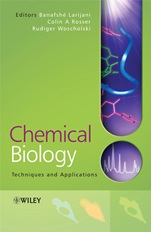
Chemical Biology: Techniques and Applications
ISBN 9780470090640
Autor: Banafshe Larijani, Colin A. Rosser, Rudiger Woscholski
Wydawca: Wiley
Dostępność: 3-6 tygodni
Cena: 892,50 zł
Przed złożeniem zamówienia prosimy o kontakt mailowy celem potwierdzenia ceny.
ISBN13: |
9780470090640 |
ISBN10: |
0470090642 |
Autor: |
Banafshe Larijani, Colin A. Rosser, Rudiger Woscholski |
Oprawa: |
Hardback |
Rok Wydania: |
2006-06-30 |
Ilość stron: |
272 |
Wymiary: |
252x178 |
Tematy: |
PN |
Written by a team of international researchers and teachers at the cutting edge of chemical biology research, this book provides an exciting, comprehensive introduction to a wide range of chemical and physical techniques with applications in areas as diverse as molecular biology, signal transduction, drug discovery and medicine.
Techniques include: Cryo–electron microscopy, atomic force microscopy, differential scanning calorimetry in the study of lipid structures, membrane potentials and membrane probes, identification and quantification of lipids using mass spectroscopy, liquid state NMR, solid state NMR in biomembranes, molecular dynamics, two dimensional infra–red studies of biomolecules, single and two–photon fluorescence, optical tweezers, PET imaging and chemical genetics.
KEY FEATURES:a unique guide to the rapidly evolving, interdisciplinary field of chemical biology.adopts a molecular structure for maximum flexibility.addresses relevant, topical chemical biological questions throughout.includes stunning illustrations in full colour.associates website with PowerPoint slides of figures within the book.
Chemical Biology: Techniques and Applications will provide an invaluable resource for final year undergraduate and post graduate bioscience and biomedical students and pharmaceutical researchers with an interest in this fascinating, and ever changing field.
Spis treści:
Preface.
List of Contributors.
1. Introduction.
1.1 Chemical biology – the present.
1.2 Chemical biology – the past.
1.3 Chemical biology – the future.
1.4 Chemical biology – mind the interdisciplinary gap.
1.5 An introduction to the following chapters.
2. Cryomicroscopy.
2.1 The need for (electron) microscopy.
2.2 Development of cryomicroscopy.
2.3 Sample–electron interaction.
2.4 Contrast in negatively stained and cryo prepa
rations.
2.5 Image formation.
2.6 Image analysis.
2.7 Software used in the analysis of electron micrographs.
2.8 Examples.
2.9 Conclusions.
3. Atomic force microscopy: applications in biology.
3.1 A brief history of microscopy.
3.2 The scanning pribe microscope revolution.
3.3 The workings of an AFM instrument.
3.4 Imaging biological molecules with force.
3.5 Factors influencing image quality.
3.6 Biological applications of AFM and recent developments.
3.7 Conclusions and future directions.
4. Differential scanning calorimetry in the study of lipid structures.
4.1 Introduction.
4.2 Membranes, lipids and lipid phases.
4.3 Heat exchanges and calorimetry.
4.4 Phase transitions in pure lipid–water systems.
4.5 Selected examples of transitions in lipid mixtures.
4.6 Complex systems: lipid–protein mixtures and cell membranes.
4.7 Conclusion.
5. Membrane potentials and membrane probes.
5.1 Introduction: biological membranes; structure and electrical properties.
5.2 Phospholipid membranes as molecular environments.
5.3 The physical origins of the transmembrane (ΔΨ), surface (φS) and dipolar (φD) membrane potentials.
5.4 Measurement of membrane potentials.
5.5 Problems with Spectroscopic Measurements of Membrane Potentials.
5.6 Spatial Imaging of membrane potentials.
6. Identification and quantification of lipids using mass spectrometry.
6.1 Introduction.
6.2 Lipid analysis by mass spectrometry.
6.3 Conclusion.
7. Liquid–state NMR.
7.1 Introduction.
7.2 How NMR works: the basics.
7.3 Some NMR applications in biology.
7.4 Conclusion.
8. Solid–state NMR in biomembranes.
8.1 Introduction.
8.2 NMR basics for membrane systems.
8.3 Applications of wide–line NMR to membrane systems.
8.4 Applications of MAS to biomembranes and natural colloids.
8.5 Conclusion.
<
b>9. Molecular dynamics.
9.1 Introduction.
9.2 The basis of molecular mechanics.
9.3 The basis of molecular dynamics.
9.4 Factors affecting the length of simulations.
9.5 Problems caused by solvents.
9.6 How to build a lipid bilayer for simulation purposes.
9.7 Special cases of membrane proteins.
9.8 Summary.
10. Two–dimensional infrared studies of biomolecules.
10.1 Introduction.
10.2 Description of the technique.
10.3 Spectral simulations.
10.4 Two–dimensional studies of human lipoproteins.
10.5 Summary.
11. Biological applications of single– and two–photon fluorescence.
11.1 Introduction.
11.2 Basic principles of fluorescence.
11.3 Main principles of RET via single–photon excitation.
11.4 Detection of RET.
11.5 Biological examples of RET monitored by frequency–domain FLIM.
11.6 Two–photon fluorescence.
11.7 Applications of two–photon fluorescence.
11.8 Photoselection and fluorescence anisotropy.
11.9 Fluorescence anisotropy and isotropic rotational diffusion.
11.10 Fluorescent probes in proteins and membranes.
11.11 Future developments.
11.12 Conclusions.
12. Optical tweezers.
12.1 Introduction.
12.2 Theoretical background.
12.3 Apparatus.
12.4 Data collection and analysis.
12.5 A biological application.
12.6 Other biological examples.
12.7 Summary.
13. PET imaging in chemical biology.
13.1 Introduction.
13.2 Positron emission tomography: principles and instrumentation.
13.3 Applications of PET imaging in the biomedical sciences.
13.4 Conclusions and outlook.
14. Chemical genetics.
14.1 Introduction.
14.2 Why chemicals?.
14.3 Chemical genetics – why now?.
14.4 The relationship between classical genetics and chemical genetics.
14.5 Forward chemical genetics.
14.6 Reverse chemical genetics.
14.7 Closing remarks.
Index.
Nota biograficzna:
Dr Larijani, London, UK.Research scientist, Cell Biophysics Laboratory, London Research Institute, Cancer Research UK, London WC2A 3PX
Dr. Rudiger Woscholski, London, UK.Lecturer, Biochemistry Building, Imperial College, South Kensington, London SW7 2AY, UK
Dr. Colin A. Rosser, Oxford, UK.Director of Studies, St Anthony School, Rye St Anthony, Headington, Oxford OX3 0BY, UK
Okładka tylna:
Written by a team of international researchers and teachers at the cutting edge of chemical biology research, this book provides an exciting, comprehensive introduction to a wide range of chemical and physical techniques with applications in areas as diverse as molecular biology, signal transduction, drug discovery and medicine.
Techniques include: Cryo–electron microscopy, atomic force microscopy, differential scanning calorimetry in the study of lipid structures, membrane potentials and membrane probes, identification and quantification of lipids using mass spectroscopy, liquid state NMR, solid state NMR in biomembranes, molecular dynamics, two dimensional infra–red studies of biomolecules, single and two–photon fluorescence, optical tweezers, PET imaging and chemical genetics.
KEY FEATURES:a unique guide to the rapidly evolving, interdisciplinary field of chemical biology.adopts a molecular structure for maximum flexibility.addresses relevant, topical chemical biological questions throughout.includes stunning illustrations in full colour.associates website with PowerPoint slides of figures within the book.
Chemical Biology: Techniques and Applications will provide an invaluable resource for final year undergraduate and post graduate bioscience and biomedical students and pharmaceutical researchers with an interest in this fascinating, and ever changing field.
Koszyk
Książek w koszyku: 0 szt.
Wartość zakupów: 0,00 zł
Informacje


Kontakt
Gambit
Centrum Oprogramowania
i Szkoleń Sp. z o.o.
Al. Pokoju 29b/22-24
31-564 Kraków
Siedziba Księgarni
ul. Kordylewskiego 1
31-542 Kraków
+48 12 410 5991
+48 12 410 5987
+48 12 410 5989
Subskrypcje
Administratorem danych osobowych jest firma Gambit COiS Sp. z o.o. Na podany adres będzie wysyłany wyłącznie biuletyn informacyjny.
Autoryzacja płatności

Informacje na temat autoryzacji płatności poprzez PayU.

© Copyright 2012: GAMBIT COiS Sp. z o.o. Wszelkie prawa zastrzeżone.
Projekt i wykonanie: Alchemia Studio Reklamy