


Wydawcy
Katalog tematyczny
- Archeologia (109)
- Ekonomia, finanse, business (13704)
- Filozofia (1445)
- Historia (3040)
- Języki i językoznawstwo (2356)
- Lifestyle, hobby i rozrywka (475)
- Medycyna (9704)
- Chirurgia (272)
- Inne gałęzie medycyny (1871)
- Medycyna kliniczna (4187)
- Choroby wewnętrzne (514)
- Dermatologia (51)
- Diagnostyka medyczna (3)
- Endokrynologia (144)
- Gastroenterologia (27)
- Geriatria (50)
- Ginekologia i położnictwo (134)
- Hematologia (46)
- Hepatologia (10)
- Kardiologia (71)
- Laryngologia (12)
- Nefrologia (10)
- Neurologia (500)
- Oftalmologia (50)
- Pediatria (33)
- Pulmunologia (32)
- Reumatologia (14)
- Terapia genowa (1)
- Układ mięśniowo-szkieletowy (1)
- Urologia (14)
- Medycyna niekonwencjonalna (14)
- Medycyna przedkliniczna (269)
- Medycyna, ogólnie (1740)
- Medyczne służby pomocnicze (745)
- Studia medyczne (16)
- Weterynaria (548)
- Nauki humanistyczne (4)
- Nauki o Ziemi i środowisku (2638)
- Nauki ścisłe (20412)
- Nauki społeczne (8486)
- Nauki techniczne (13450)
- Prawo (1696)
- Publikacje informacyjne i interdyscyplinarne (1288)
- Religia i wierzenia (917)
- Technika komputerowa (4067)
- Zdrowie, relacje międzyludzkie i rozwój osobisty (657)





Informacje szczegółowe o książce
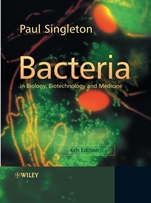
Bacteria in Biology, Biotechnology and Medicine
ISBN 9780470090275
Autor: Paul Singleton
Wydawca: Wiley
Dostępność: 3-6 tygodni
Cena: 434,70 zł
Przed złożeniem zamówienia prosimy o kontakt mailowy celem potwierdzenia ceny.
ISBN13: |
9780470090275 |
ISBN10: |
0470090278 |
Autor: |
Paul Singleton |
Oprawa: |
Paperback |
Rok Wydania: |
2004-08-27 |
Numer Wydania: |
6th Edition |
Ilość stron: |
570 |
Wymiary: |
244x190 |
Tematy: |
MJ |
Bacteria is a broadly based textbook of pure and applied bacteriology. Written in clear language, the up–to–date text gives readers access to new ideas and developments in the current literature. The book is intended primarily for undergraduates and postgraduates in biology, biotechnology, medicine, veterinary science, pharmacology, microbiology, food science, environmental science and agriculture; no prior knowledge of bacteria is assumed.
The sixth edition has been extensively updated; much of the text is new, or re–written, and there are many new references. Over 70 genera of bacteria, listed alphabetically, are described in the Appendix. Cross–references and a detailed index, maximise the accessibility of data.
Reviews of previous editions:
"….a useful survey of the subject for students contemplating specialization."
—Nature
"Singleton assumes the reader has no prior knowledge of DNA and gene expression, and does an extraordinary job of explaining things from scratch."
—Quarterly Review of Biology
"….recommended to undergraduates and those seeking clear explanations of basic concepts of bacteriology."
—Journal of Medical Microbiology
Spis treści:
Preface.
1. The bacteria: An introduction.
1.1 What are bacteria?
1.2 Why study bacteria?
1.3 Classifying and naming bacteria.
2. The bacterial cell.
2.1 Shapes, sizes and arrangements of bacterial cells.
2.2 The bacterial cell: A closer look.
2.3 Trichomes and coenocytic bacteria.
3. Growth and reproduction.
3.1 Conditions for growth.
3.2 Growth in a single cell.
3.3 Growth in bacterial populations.
3.4 Diauxic growth.
3.5 Measuring growth.
4. Differentiation.
4.1 The life–cycle of Caulobacter.
4.2 Swarming.
4.3 Resting cells.
4.4 Akinetes, heterocysts, hormogoni.
5. Metabolism I: en
ergy.
5.1 Energy metabolism in chemotrophs.
5.2 Energy metabolism in phototrophs.
5.3 Other topics in energy metabolism.
5.4 Transport systems.
6 Metabolism II: carbon. 6.1 Carbon assimilation in autotrophs.
6.2 Carbon assimilation in heterotrophs.
6.3 Synthesis, interconversion and polymerization of carbon compounds.
6.4 Methylotrophy in bacteria.
7. Molecular biology I: genes and gene expression.
7.1 Chromosomes and plasmids.
7.2 Nucleic acids: Structure.
7.3 DNA replication.
7.4 DNA modification and restriction.
7.5 RNA synthesis: Transcription.
7.6 Proteins: Synthesis and other aspects.
7.7 DNA monitoring and repair.
7.8 Regulation of gene expression.
7.9 RNA.
8. Molecular biology II: changing the message.
8.1 Mutation.
8.2 Recombination.
8.3 Transposition.
8.4 Gene transfer.
8.5 Genetic engineering/recombinant DNA technology.
9. Bacteriophages.
9.1 Virulent phages: The lytic cycle.
9.2 Temperate phages: Lysogeny.
9.3 Androphages.
9.4 Phage conversion.
9.5 Transduction.
9.6 How does phage DNA escape restriction in the host bacterium?
10. Bacteria in the living world.
10.1 Microbial communities.
10.2 Saprotrophs, predators, parasites, symbionts.
10.3 Bacteria and the cycles of matter.
10.4 Ice–nucleation bacteria.
10.5 Bacteriology in situ – fact or fiction?
10.6 The greenhouse effect.
10.7 Recombinant bacteria in the environment.
10.8 Uncultivable/uncultured bacteria.
11. Bacteria in medicine.
11.1 Bacteria as pathogens.
11.2 The routes of infection.
11.3 Pathogenesis.
11.4 The body′s defences.
11.5 The pathogen: Virulence factors.
11.6 Pathogen–host interactions: A new perspective.
11.7 The transmission of disease.
11.8 Laboratory detection and characterization of pathogens.
11.9 Prevention and control of transmissible diseases.
11.10 Some n
otes on chemotherapy.
11.11 Some bacterial diseases.
12. Applied bacteriology I: Food.
12.1 Bacteria in the food industry.
12.2 Food preservation.
12.3 Food poisoning and food hygiene.
13. Applied bacteriology II: Miscellaneous aspects.
13.1 Feeding animals, protecting plants.
13.2 Biomining (bioleaching).
13.3 Biological washing powders.
13.4 Sewage treatment.
13.5 Water supplies.
13.6 Putting pathogens to work.
13.7 Plastics from bacteria: ′Biopol′.
13.8 Bioremediation.
13.9 Biomimetic technology.
14 Some practical bacteriology.
14.1 Safety in the laboratory.
14.2 Bacteriological media.
14.3 Aseptic technique.
14.4 The tools of the bacteriologist.
14.5 Methods of inoculation.
14.6 Preparing a pure culture from a mixture of organisms.
14.7 Anaerobic incubation.
14.8 Counting bacteria.
14.9 Staining.
14.10 Microscopy.
15. Man against bacteria.
15.1 Sterilization.
15.2 Disinfection.
15.3 Antisepsis.
15.4 Antibiotics.
16 The identification and classification of bacteria.
16.1 Identification.
16.2 The classification (taxonomy) of prokaryotes.
Appendix Minidescriptions of some genera, families, orders and other categories of bacteria.
Index.
Okładka tylna:
Bacteria is a broadly based textbook of pure and applied bacteriology. Written in clear language, the up–to–date text gives readers access to new ideas and developments in the current literature. The book is intended primarily for undergraduates and postgraduates in biology, biotechnology, medicine, veterinary science, pharmacology, microbiology, food science, environmental science and agriculture; no prior knowledge of bacteria is assumed.
The sixth edition has been extensively updated; much of the text is new, or re–written, and there are many new references. Over 70 genera of bacteria, listed alphab
etically, are described in the Appendix. Cross–references and a detailed index, maximise the accessibility of data.
Reviews of previous editions:
"….a useful survey of the subject for students contemplating specialization."
—Nature
"Singleton assumes the reader has no prior knowledge of DNA and gene expression, and does an extraordinary job of explaining things from scratch."
—Quarterly Review of Biology
"….recommended to undergraduates and those seeking clear explanations of basic concepts of bacteriology."
—Journal of Medical Microbiology
Koszyk
Książek w koszyku: 0 szt.
Wartość zakupów: 0,00 zł
Informacje


Kontakt
Gambit
Centrum Oprogramowania
i Szkoleń Sp. z o.o.
Al. Pokoju 29b/22-24
31-564 Kraków
Siedziba Księgarni
ul. Kordylewskiego 1
31-542 Kraków
+48 12 410 5991
+48 12 410 5987
+48 12 410 5989
Subskrypcje
Administratorem danych osobowych jest firma Gambit COiS Sp. z o.o. Na podany adres będzie wysyłany wyłącznie biuletyn informacyjny.
Autoryzacja płatności

Informacje na temat autoryzacji płatności poprzez PayU.

© Copyright 2012: GAMBIT COiS Sp. z o.o. Wszelkie prawa zastrzeżone.
Projekt i wykonanie: Alchemia Studio Reklamy