


Wydawcy
Katalog tematyczny
- Archeologia (1)
- Ekonomia, finanse, business (698)
- Filozofia (20)
- Historia (57)
- Języki i językoznawstwo (4)
- Lifestyle, hobby i rozrywka (32)
- Medycyna (1025)
- Nauki humanistyczne (2)
- Nauki o Ziemi i środowisku (430)
- Nauki ścisłe (1681)
- Astronomia (219)
- Biologia (486)
- Chemia (9)
- Fizyka (440)
- Elektryczność i magnetyzm (2)
- Fizyka atomowa i molekularna (8)
- Fizyka cząstek elementarnych (17)
- Fizyka jądra atomowego (4)
- Fizyka kwantowa (26)
- Fizyka matematyczna (36)
- Fizyka relatywistyczna (9)
- Fizyka statystyczna (20)
- Fizyka stosowana (148)
- Mechanika klasyczna (47)
- Optyka i światło (34)
- Stany materii (42)
- Matematyka (422)
- Nauki ścisłe, ogólnie (91)
- Nauki społeczne (1297)
- Nauki techniczne (530)
- Prawo (1437)
- Publikacje informacyjne i interdyscyplinarne (32)
- Religia i wierzenia (15)
- Technika komputerowa (237)
- Zdrowie, relacje międzyludzkie i rozwój osobisty (4)





Informacje szczegółowe o książce
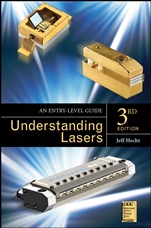
Understanding Lasers: An Entry–Level Guide
ISBN 9780470088906
Autor: Jeff Hecht
Wydawca: Wiley
Dostępność: 3-6 tygodni
Cena: 459,90 zł
Przed złożeniem zamówienia prosimy o kontakt mailowy celem potwierdzenia ceny.
ISBN13: |
9780470088906 |
ISBN10: |
0470088907 |
Autor: |
Jeff Hecht |
Oprawa: |
Paperback |
Rok Wydania: |
2008-06-24 |
Numer Wydania: |
3rd Edition |
Ilość stron: |
496 |
Wymiary: |
233x168 |
Tematy: |
PH |
An up–to–date and easy–to–follow introduction to laser technology
Laser technology has become important in a wide range of practical applications, ranging from medicine and consumer electronics to telecommunications and military technology. Lasers are also vital tools on the cutting edge of research—eighteen recipients of the Nobel Prize received the award for laser–related research, including the laser itself, holography, laser cooling, and Bose–Einstein condensates.
Updated to reflect advancements since publication of the previous edition, Understanding Lasers, Third Edition offers an introduction to lasers and associated equipment at a level that nontechnicians can fundamentally understand. The author focuses on real–world lasers and assumes only a minimal background in algebra, making the book a practical, easy–to–follow guide for a broad audience.
Beginning with an overview of how lasers work, what they do, and how they′re used, the book goes on to explore:
Optics and laser accessories
Semiconductor diode lasers
Gas lasers
Low–power laser applications
Solid–state and fiber lasers
High–power laser applications
Lasers in research
Complete with conceptual drawings, tables, and multiple–choice quizzes with answers provided at the back of the book, Understanding Lasers, Third Edition serves as an ideal introduction to the subject for advanced high school students, undergraduate physics and engineering students, and professionals who work with lasers but lack formal training.
Spis treści:
Preface.
CHAPTER 1 Introduction and Overview.
1.1 The Idea of the Laser.
1.2 What is a Laser?
1.3 Laser Materials and Types.
1.4 Optical Properties of Laser Light.
1.5 How Lasers are Used.
1.6 What Have We Learned?
CHAPTER 2 Physic
al Basics.
2.1 Electromagnetic Waves and Photons.
2.2 Quantum and Classical Physics.
2.3 Interactions of Light and Matter.
2.4 Basic Optics and Simple Lenses.
2.5 What Have We Learned?
CHAPTER 3 How Lasers Work.
3.1 Building a Laser.
3.2 Producing a Population Inversion.
3.3 Resonant Cavities.
3.4 Laser Beams and Resonance.
3.5 Wavelength Selection and Tuning.
3.6 Laser Excitation Techniques.
3.7 What Have We Learned?
CHAPTER 4 Laser Characteristics.
4.1 Coherence.
4.2 Laser Wavelengths.
4.3 Behavior of Laser Beams.
4.4 Laser Power.
4.5 Laser Efficiency.
4.6 Duration of Emission.
4.7 Polarization.
4.8 What Have We Learned?
CHAPTER 5 Optics and Laser Accessories.
5.1 Classical Optical Devices.
5.2 Transparent Optical Materials.
5.3 Optical Surfaces, Coatings and Filters.
5.4 Nonlinear Optics.
5.5 Beam Intensity and Pulse Control.
5.6 Beam Direction and Propagation.
5.7 Mounting and Positioning Equipment.
5.8 Optical Measurement.
5.9 What Have We Learned?
CHAPTER 6 Types of Lasers.
6.1 Laser Oscillators and Optical Amplifiers.
6.2 Laser Media.
6.3 The Importance of Gain.
6.4 Broadband and Wavelength–Tunable Lasers.
6.5 Laser–Like Light Sources.
6.6 What Have We Learned?
CHAPTER 7 Gas Lasers.
7.1 The Gas Laser Family.
7.2 Gas–Laser Basics.
7.3 Helium–Neon Lasers.
7.4 Argon– and Krypton–Ion Lasers.
7.5 Metal–Vapor Lasers.
7.6 Carbon Dioxide Laser.
7.7 Excimer Lasers.
7.8 Chemical Lasers.
7.9 Other Gas Lasers.
7.10 What Have We Learned?
CHAPTER 8 Solid–State and Fiber Lasers.
8.1 What is a Solid–State Laser?
8.2 Solid–State Laser Materials.
8.3 Optical Pumping.
8.4 Ruby Lasers.
8.5 Neodymium Lasers.
8.6 Vibronic and Tunable Solid–State Lasers.
8.7 Erbium and Other Eye–Safe Laser.
8.8 Rare–Earth–Doped Fiber Lasers.
8.9 Rare–Earth–Doped Fiber Amplifiers.
8.10 Raman Fiber Lasers and Amplifiers.
8.11 What Have We Learned?
CHAPTER 9 Semiconductor Diode Lasers.
9.1 Basics of Semiconductor Diode Lasers.
9.2 Semiconductor Basics.
9.3 Light Emission at Junctions.
9.4 Layers and Confinement in Diode Lasers.
9.5 Confinement in the Junction Plane.
9.6 Edge–Emitting Diode Lasers.
9.7 Surface–Emitting Diode Lasers.
9.8 Quantum Wells and Dots.
9.9 Quantum Cascade Lasers.
9.10 Optical Properties of Diode Lasers.
9.11 Diode Laser Materials and Wavelengths.
9.12 Silicon Lasers.
9.13 Packaging and Specialization of Diode Lasers.
9.14 What Have We Learned?
CHAPTER 10 Other Lasers and Related Sources.
10.1 Tunable Dye Lasers.
10.2 Extreme–Ultraviolet Sources.
10.3 Free–Electron Lasers.
10.4 Silicon Lasers.
10.5 What Have We Learned?
CHAPTER 11 Low–Power Laser Applications.
11.1 Advantages of Laser Light.
11.2 Reading with Lasers.
11.3 Optical Disks and Data Storage.
11.4 Laser Printing and Marking.
11.5 Fiber–Optic Communications.
11.6 Laser Measurement.
11.7 Laser Pointers, Art, and Entertainment.
11.8 Low–Power Defense Applications.
11.9 Sensing and Spectroscopy.
11.10 Holography.
11.11 Other Low–Power Applications.
11.12 What Have We Learned?
CHAPTER 12 High–Power Laser Applications.
12.1 High– Versus Low–Power Laser Applications.
12.2 Attractions of High–Power Lasers.
12.3 Materials Working.
12.4 Electronics Manufacturing.
12.5 Three–Dimensional Modeling.
12.6 Laser Medical Treatment.
12.7 Photochemistry and Isotope Separation.
12.8 Laser–Driven Nuclear Fusion.
12.9 High–Energy Laser Weapons.
12.10 Futuristic High–Power Laser Ideas.
12.11 What Have We Learned?
C
HAPTER 13 Lasers In Research.
13.1 Lasers Open New Opportunities.
13.2 Laser Spectroscopy.
13.3 Manipulating Tiny Objects.
13.4 Atom Lasers and Bose–Einstein Condensates.
13.5 Slow Light.
13.6 Nanoscale Lasers.
13.7 Petawatt Lasers.
13.8 Attosecond Pulses.
13.9 Laser Acceleration.
13.10 Other Emerging Research.
13.11 What We Have Learned.
Answers to Quiz Questions.
Appendix A: Laser Safety.
Appendix B: Handy Numbers and Formulas.
Appendix C: Resources and Suggested Readings.
Glossary.
Index.
Nota biograficzna:
Jeff Hecht is a science and technology writer who has covered the laser industry for more than thirty years. He cofounded Lasers & Optronics magazine and has been a contributing editor to Laser Focus World since 1991, where he was also managing editor for seven years. He has been a Boston correspondent for New Scientist magazine since 1984 and is the author of eleven books. He has taught short courses on optics at SPIE, OSA, and IEEE LEOS conferences. He is a member of the IEEE, APS, OSA, and the National Association of Science Writers.
Okładka tylna:
An up–to–date and easy–to–follow introduction to laser technology
Laser technology has become important in a wide range of practical applications, ranging from medicine and consumer electronics to telecommunications and military technology. Lasers are also vital tools on the cutting edge of research—eighteen recipients of the Nobel Prize received the award for laser–related research, including the laser itself, holography, laser cooling, and Bose–Einstein condensates.
Updated to reflect advancements since publication of the previous edition, Understanding Lasers, Third Edition offers an introduction to lasers and associated equipment at a level that nontechnicians can fundamentally understand. The author focuses on real–world lasers and assumes only
Koszyk
Książek w koszyku: 0 szt.
Wartość zakupów: 0,00 zł
Informacje


Kontakt
Gambit
Centrum Oprogramowania
i Szkoleń Sp. z o.o.
Al. Pokoju 29b/22-24
31-564 Kraków
Siedziba Księgarni
ul. Kordylewskiego 1
31-542 Kraków
+48 12 410 5991
+48 12 410 5987
+48 12 410 5989
Subskrypcje
Administratorem danych osobowych jest firma Gambit COiS Sp. z o.o. Na podany adres będzie wysyłany wyłącznie biuletyn informacyjny.
Autoryzacja płatności

Informacje na temat autoryzacji płatności poprzez PayU.

© Copyright 2012: GAMBIT COiS Sp. z o.o. Wszelkie prawa zastrzeżone.
Projekt i wykonanie: Alchemia Studio Reklamy