


Wydawcy
Katalog tematyczny
- Archeologia (109)
- Ekonomia, finanse, business (13704)
- Filozofia (1445)
- Historia (3040)
- Języki i językoznawstwo (2356)
- Lifestyle, hobby i rozrywka (475)
- Medycyna (9704)
- Nauki humanistyczne (4)
- Nauki o Ziemi i środowisku (2638)
- Nauki ścisłe (20412)
- Nauki społeczne (8486)
- Nauki techniczne (13450)
- Prawo (1696)
- Publikacje informacyjne i interdyscyplinarne (1288)
- Religia i wierzenia (917)
- Technika komputerowa (4067)
- Zdrowie, relacje międzyludzkie i rozwój osobisty (657)





Informacje szczegółowe o książce
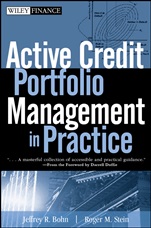
Active Credit Portfolio Management in Practice
ISBN 9780470080184
Autor: Jeffrey R. Bohn, Roger M. Stein
Wydawca: Wiley
Dostępność: 3-6 tygodni
Cena: 449,40 zł
Przed złożeniem zamówienia prosimy o kontakt mailowy celem potwierdzenia ceny.
ISBN13: |
9780470080184 |
ISBN10: |
0470080183 |
Autor: |
Jeffrey R. Bohn, Roger M. Stein |
Oprawa: |
Hardback |
Rok Wydania: |
2009-04-21 |
Ilość stron: |
640 |
Wymiary: |
240x159 |
Tematy: |
KF |
Praise for
Active Credit Portfolio Management in Practice
"This is an excellent book written by two authors who have a wealth of credit modeling experience."
—John Hull, Maple Financial Group Professor of Derivatives and Risk Management, Joseph L. Rotman School of Management, University of Toronto
"Bohn and Stein, both accomplished theorists and practitioners, present an accessible collection of complex models to assist the modern financial institution to manage credit risk effectively in what we all now understand to be the most critical financial risk concept in the world today. Now it is up to the major stakeholders, especially senior management and boards, to embrace these models and make them an integral part of their firms′ culture."
—Professor Edward I. Altman, Max L. Heine Professor of Finance, Stern School of Business, NYU
"This book, by authors who have worked very closely with the theory and practical implementation of credit models, is an excellent field guide to credit risk modeling . . . The authors do not shrink from explaining difficult models but, instead of providing lengthy proofs, focus on explaining the intuition behind the models, and their practical limitations, in simple, accessible language. This is a must–read for practitioners in the area of credit risk, risk management, and banking, and for students and faculty in finance."
—Raghuram G. Rajan, Eric J. Gleacher Distinguished Service Professor ofFinance, University of Chicago Booth School of Business, and former Chief Economist, International Monetary Fund
"Bohn and Stein have created a wonderful guide to state–of–the–art credit risk modeling and credit risk portfolio construction. The book will provide the reader with a clear understanding of the theoretical foundation for the most useful credit models, and with a wealth of practical information on implementing these models. This book provides key insights on how to
use and, perhaps more importantly, how to not misuse creditrisk models."
—Kent D. Daniel, Director of Equity Research, Quantitative Investment Strategies, Goldman Sachs Asset Management
"Suffice it to say that this is a rich book on matters of historic proportions."
—Peter Carr, PhD, Head of Quantitative Financial Research, Bloomberg; Director of the Masters in Math Finance Program, Courant Institute, NYU
"A breakthrough piece and so timely! Bohn and Stein take us through this complex topic in a clearly articulated rational progression."
—Loretta M. Hennessey, First Chairperson of the International Association of Credit Portfolio Managers
Spis treści:
Foreword.
Preface.
Acknowledgments.
Chapter 1. The Framework: Definitions and Concepts.
What Is Credit?
Evolution of Credit Markets.
Defining Risk.
A Word About Regulation.
What Are Credit Models Good For?
Active Credit Portfolio Management (ACPM).
Framework at 30,000 Feet.
Building Blocks of Portfolio Risk.
Using PDs in Practice.
Value, Price, and Spread.
Defining Default.
Portfolio Performance Metrics.
Data and Data Systems.
Review Questions.
Chapter 2. ACPM in Practice.
Bank Valuation.
Organizing Financial Institutions: Dividing into Two Business Lines.
Emphasis on Credit Risk.
Market Trends Supporting ACPM.
Financial Instruments Used for Hedging and Managing Risk in a Credit Portfolio.
Mark–To–Market and Transfer Pricing.
Metrics for Managing a Credit Portfolio.
Data and Models.
Evaluating an ACPM Unit.
Managing a Research Team.
Conclusion.
Review Questions.
Exercises.
Chapter 3. Structural Models.
Structural Models in Context.
A Basic Structural Model.
Black–Scholes–Merton (BSM).
Valuation.
Modifying BSM.
First–Passage Time: Black–Cox.
Practical Implementation: Vasicek–Kealhofer.Stochastic Interest Rates: Longstaff–Schwartz.
Jump–Diffusion Models: Zhou.
Endogenous Default Barrier (Taxes and Bankruptcy Costs): Leland–Toft.
Corporate Transaction Analysis.
Liquidity.
Other Structural Approaches.
Conclusion.
Appendix 1. Derivation of Black–Scholes–Merton Framework for Calculating Distance–to–Default (DD).
Appendix 2. Derivation of Conversion of Physical Probability of Default (PD) to a Risk–Neutral Probability of Default (PDQ).
Review Questions.
Exercises.
Chapter 4. Econometric Models.
Discrete–Choice Models.
Early Discrete Choice Models: Beaver (1966) and Altman (1968).
Hazard Rate (Duration) Models.
Example of a Hazard Rate Framework for Predicting Default: Shumway (2001).
Hazard Rates versus Discrete Choice.
Practical Applications: Falkenstein, et al. (2000) and Dwyer and Stein (2004).
Calibrating Econometric Models.
Calibrating to PDs.
Calibrating to Ratings.
Interpreting the Relative Influence of Factors in Econometric Models.
Data Issues.
Taxonomy of Basic Data Woes.
Biased Samples Cannot Easily Be Fixed.
Conclusion.
Appendix 1. Some Alternative Default Model Specifications.
Review Questions.
Exercises.
Chapter 5. Loss Given Default.
Road to Recovery: The Timeline of Default Resolution.
Measures of LGD (Recovery).
The Relationship between Market Prices and Ultimate Recovery.
Approaches to Modeling LGD: The LossCalc (2002, 2004) Approaches and Extensions.
Conclusion.
Review Questions.
Exercises.
Chapter 6. Reduced–Form Models.
Reduced–Form Models in Context.
Basic Intensity Models.
A Brief Interlude to Discuss Valuation.
Duffie and Singleton Intensity Model.
Credit Rating Transition Models.
Default Probability Density Version of Intensity Models (Hull–White).
Generic Credit Curves.
Conclusion.<
br>Appendix: Kalman Filter.
Review Questions.
Exercises.
Chapter 7. PD Model Validation.
The Basics. Parameter Robustness.
Measures of Model Power.
Measures of PD Levels and Calibration.
Sample Size and Confidence Bounds.
Assessing the Economic Value of More Powerful PD Models.
Avoiding Overfitting: A Walk–Forward Approach to Model Testing.
Conclusion.
Appendix 1. Type I and Type II Error: Converting Cap Plots into Contingency Tables.
Appendix 2. The Likelihood for the General Case of a Default Model.
Appendix 3. Tables of ROC e and nmax.
Appendix 4. Proof of the Relationship between NPV Terms and ROC Terms.
Appendix 5. Derivation of Minimum Sample Size Required to Test for Default Rate Accuracy in Uncorrelated Case.
Appendix 6. Tables for Lower Bounds of e and N on Probabilities of Default.
Review Questions.
Exercises.
Chapter 8. Portfolio Models.
A Structural Model of Default Risk.
Measurement of Portfolio Diversification.
Portfolio Risk Assuming No Credit Migration.
Structural Models of Default Correlation.
Credit Migration.
A Model of Value Correlation.
Probability of Large Losses.
Valuation.
Return Calculations.
Risk Calculations.
Portfolio Loss Distribution.
Capital.
Economic Capital and Portfolio Management.
Improving Portfolio Performance.
Performance Metrics.
Reduced–Form Models and Portfolio Modeling.
Correlation in Intensity Models.
Copulas.
Frailty.
Integrating Market and Credit Risk.
Counterparty Risk in Credit Default Swaps (CDS) and Credit Portfolios.
Conclusion.
Review Questions.
Exercises.
Chapter 9. Building a Better Bank.
A Case Study.
Description.
Current Organization.
Transforming the Capital Allocation Process.
Portfolio Analysis.
Active Credit Portfolio Management (ACPM).
Data, Systems, and Metrics.
ACPM and Transforming the
Koszyk
Książek w koszyku: 0 szt.
Wartość zakupów: 0,00 zł
Informacje


Kontakt
Gambit
Centrum Oprogramowania
i Szkoleń Sp. z o.o.
Al. Pokoju 29b/22-24
31-564 Kraków
Siedziba Księgarni
ul. Kordylewskiego 1
31-542 Kraków
+48 12 410 5991
+48 12 410 5987
+48 12 410 5989
Subskrypcje
Administratorem danych osobowych jest firma Gambit COiS Sp. z o.o. Na podany adres będzie wysyłany wyłącznie biuletyn informacyjny.
Autoryzacja płatności

Informacje na temat autoryzacji płatności poprzez PayU.

© Copyright 2012: GAMBIT COiS Sp. z o.o. Wszelkie prawa zastrzeżone.
Projekt i wykonanie: Alchemia Studio Reklamy