


Wydawcy
Katalog tematyczny
- Archeologia (109)
- Ekonomia, finanse, business (13704)
- Filozofia (1445)
- Historia (3040)
- Języki i językoznawstwo (2356)
- Lifestyle, hobby i rozrywka (475)
- Medycyna (9704)
- Nauki humanistyczne (4)
- Nauki o Ziemi i środowisku (2638)
- Nauki ścisłe (20412)
- Nauki społeczne (8486)
- Nauki techniczne (13450)
- Budownictwo lądowe (1045)
- Chemia przemysłowa (2258)
- Elektronika i telekomunikacja (3287)
- Energetyka (1122)
- Inne nauki stosowane (363)
- Inżynieria biochemiczna (507)
- Inżynieria transportu (232)
- Mechanika i materiały (3316)
- Nauka o środowisku (321)
- Rolnictwo (507)
- Technika, ogólnie (475)
- Prawo (1696)
- Publikacje informacyjne i interdyscyplinarne (1288)
- Religia i wierzenia (917)
- Technika komputerowa (4067)
- Zdrowie, relacje międzyludzkie i rozwój osobisty (657)





Informacje szczegółowe o książce
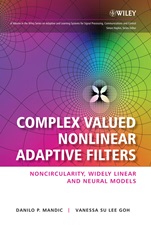
Complex Valued Nonlinear Adaptive Filters: Noncircularity, Widely Linear and Neural Models
ISBN 9780470066355
Autor: Danilo P. Mandic, Vanessa Su Lee Goh
Wydawca: Wiley
Dostępność: 3-6 tygodni
Cena: 605,85 zł
Przed złożeniem zamówienia prosimy o kontakt mailowy celem potwierdzenia ceny.
ISBN13: |
9780470066355 |
ISBN10: |
0470066350 |
Autor: |
Danilo P. Mandic, Vanessa Su Lee Goh |
Oprawa: |
Hardback |
Rok Wydania: |
2009-04-17 |
Ilość stron: |
344 |
Wymiary: |
249x171 |
Tematy: |
TJ |
The filtering of real world signals requires an adaptive mode of operation to deal with the statistically nonstationary nature of the data. Feedback and nonlinearity within filtering architectures are needed to cater for long time dependencies and possibly nonlinear signal generating mechanisms. Using the authors’ original research and current established methods, this book covers the foundations of standard complex adaptive filtering and offers next generation solutions for the generality of complex valued signals. It provides a rigorous treatment of complex noncircularity and nonlinearity, thus avoiding the deficiencies inherent in several mathematical shortcuts typically used in the treatment of complex random signals. Simulations for both circular and noncircular data sources are included—from benchmark models to real world directional processes such as wind and radar signals.
Key features: Provides theoretical and practical justification for converting many apparently real valued signal processing problems into the complex domain; Offers a unified approach to the design of complex valued adaptive filters and temporal neural networks, based on augmented complex statistics and the duality between the bivariate and complex calculus (CR calculus);Introduces augmented filtering algorithms based on widely linear models, making them suitable for processing both second order circular (proper) and noncircular (improper) complex signals; Covers adaptive stepsizes, dynamical range reduction, validity of complex representations, and data driven time–frequency decompositions; Includes extensive background material in appendices ranging from the theory of complex variables through to fixed point theory.
Complex valued signals play a central role in the fields of communications, radar, sonar, array, biomedical and environmental signal processing amongst others. This book will have wide appeal to researchers and practising
engineers in these and related disciplines, and can also be used as lecture material for a course on adaptive filters.
Spis treści:
Preface.
Acknowledgements.
1 The Magic of Complex Numbers.
1.1 History of Complex Numbers.
1.2 History of Mathematical Notation.
1.3 Development of Complex Valued Adaptive Signal Processing.
2 Why Signal Processing in the Complex Domain?
2.1 Some Examples of Complex Valued Signal Processing.
2.2 Modelling in C is Not Only Convenient But Also Natural.
2.3 Why Complex Modelling of Real Valued Processes?
2.4 Exploiting the Phase Information.
2.5 Other Applications of Complex Domain Processing of Real Valued Signals.
2.6 Additional Benefits of Complex Domain Processing.
3 Adaptive Filtering Architectures.
3.1 Linear and Nonlinear Stochastic Models.
3.2 Linear and Nonlinear Adaptive Filtering Architectures.
3.3 State Space Representation and Canonical Forms.
4 Complex Nonlinear Activation Functions.
4.1 Properties of Complex Functions.
4.2 Universal Function Approximation.
4.3 Nonlinear Activation Functions for Complex Neural Networks.
4.4 Generalised Splitting Activation Functions (GSAF).
4.5 Summary: Choice of the Complex Activation Function.
5 Elements of CR Calculus.
5.1 Continuous Complex Functions.
5.2 The Cauchy–Riemann Equations.
5.3 Generalised Derivatives of Functions of Complex Variable.
5.4 CR–derivatives of Cost Functions.
6 Complex Valued Adaptive Filters.
6.1 Adaptive Filtering Configurations.
6.2 The Complex Least Mean Square Algorithm.
6.3 Nonlinear Feedforward Complex Adaptive Filters.
6.4 Normalisation of Learning Algorithms.
6.5 Performance of Feedforward Nonlinear Adaptive Filters.
6.6 Summary: Choice of a Nonlinear Adaptive Filter.
7 Adaptive Filters with Feedback.
7.1 Training of IIR Adaptive Filters.
7.2 Nonlinear Adaptive IIR Filters: Recurrent Perceptron.
7.3 Training of Recurrent Neural Networks.
7.4 Simulation Examples.
8 Filters with an Adaptive Stepsize.
8.1 Benveniste Type Variable Stepsize Algorithms.
8.2 Complex Valued GNGD Algorithms.
8.3 Simulation Examples.
9 Filters with an Adaptive Amplitude of Nonlinearity.
9.1 Dynamical Range Reduction.
9.2 FIR Adaptive Filters with an Adaptive Nonlinearity.
9.3 Recurrent Neural Networks with Trainable Amplitude of Activation Functions.
9.4 Simulation Results.
10 Data–reusing Algorithms for Complex Valued Adaptive Filters.
10.1 The Data–reusing Complex Valued Least Mean Square (DRCLMS) Algorithm.
10.2 Data–reusing Complex Nonlinear Adaptive Filters.
10.3 Data–reusing Algorithms for Complex RNNs.
11 Complex Mappings and M¨obius Transformations.
11.1 Matrix Representation of a Complex Number.
11.2 The M¨obius Transformation.
11.3 Activation Functions and M¨obius Transformations.
11.4 All–pass Systems as M¨obius Transformations.
11.5 Fractional Delay Filters.
12 Augmented Complex Statistics.
12.1 Complex Random Variables (CRV).
12.2 Complex Circular Random Variables.
12.3 Complex Signals.
12.4 Second–order Characterisation of Complex Signals.
13 Widely Linear Estimation and Augmented CLMS (ACLMS).
13.1 Minimum Mean Square Error (MMSE) Estimation in C.
13.2 Complex White Noise.
13.3 Autoregressive Modelling in C.
13.4 The Augmented Complex LMS (ACLMS) Algorithm.
13.5 Adaptive Prediction Based on ACLMS.
14 Duality Between Complex Valued and Real Valued Filters.
14.1 A Dual Channel Real Valued Adaptive Filter.
14.2 Duality Between Real and Complex Valued Filters.
14.3 Simulations.
15 Widely Linear Filters with Feedback.
15.1 The Widely Linear ARMA (WL–ARMA) Model.
15.2 Widely Linear
Adaptive Filters with Feedback.
15.3 The Augmented Complex Valued RTRL (ACRTRL) Algorithm.
15.4 The Augmented Kalman Filter Algorithm for RNNs.
15.5 Augmented Complex Unscented Kalman Filter (ACUKF).
15.6 Simulation Examples.
16 Collaborative Adaptive Filtering.
16.1 Parametric Signal Modality Characterisation.
16.2 Standard Hybrid Filtering in R.
16.3 Tracking the Linear/Nonlinear Nature of Complex Valued Signals.
16.4 Split vs Fully Complex Signal Natures.
16.5 Online Assessment of the Nature of Wind Signal.
16.6 Collaborative Filters for General Complex Signals.
17 Adaptive Filtering Based on EMD.
17.1 The Empirical Mode Decomposition Algorithm.
17.2 Complex Extensions of Empirical Mode Decomposition.
17.3 Addressing the Problem of Uniqueness.
17.4 Applications of Complex Extensions of EMD.
18 Validation of Complex Representations – Is This Worthwhile?
18.1 Signal Modality Characterisation in R.
18.2 Testing for the Validity of Complex Representation.
18.3 Quantifying Benefits of Complex Valued Representation.
Appendix A: Some Distinctive Properties of Calculus in C.
Appendix B: Liouville’s Theorem.
Appendix C: Hypercomplex and Clifford Algebras.
C.1 Definitions of Algebraic Notions of Group, Ring and Field.
C.2 Definition of a Vector Space.
C.3 Higher Dimension Algebras.
C.4 The Algebra of Quaternions.
C.5 Clifford Algebras.
Appendix D: Real Valued Activation Functions.
D.1 Logistic Sigmoid Activation Function.
D.2 Hyperbolic Tangent Activation Function.
Appendix E: Elementary Transcendental Functions (ETF).
Appendix F: The O Notation and Standard Vector and Matrix Differentiation.
F.1 The O Notation.
F.2 Standard Vector and Matrix Differentiation.
Appendix G: Notions From Learning Theory.
G.1 Types of Learning.
G.2 The Bias–Variance
Koszyk
Książek w koszyku: 0 szt.
Wartość zakupów: 0,00 zł
Informacje


Kontakt
Gambit
Centrum Oprogramowania
i Szkoleń Sp. z o.o.
Al. Pokoju 29b/22-24
31-564 Kraków
Siedziba Księgarni
ul. Kordylewskiego 1
31-542 Kraków
+48 12 410 5991
+48 12 410 5987
+48 12 410 5989
Subskrypcje
Administratorem danych osobowych jest firma Gambit COiS Sp. z o.o. Na podany adres będzie wysyłany wyłącznie biuletyn informacyjny.
Autoryzacja płatności

Informacje na temat autoryzacji płatności poprzez PayU.

© Copyright 2012: GAMBIT COiS Sp. z o.o. Wszelkie prawa zastrzeżone.
Projekt i wykonanie: Alchemia Studio Reklamy