


Wydawcy
Katalog tematyczny
- Archeologia (109)
- Ekonomia, finanse, business (13704)
- Filozofia (1445)
- Historia (3040)
- Języki i językoznawstwo (2356)
- Lifestyle, hobby i rozrywka (475)
- Medycyna (9704)
- Nauki humanistyczne (4)
- Nauki o Ziemi i środowisku (2638)
- Nauki ścisłe (20412)
- Astronomia (294)
- Biologia (5119)
- Chemia (6540)
- Fizyka (3309)
- Elektryczność i magnetyzm (90)
- Fizyka atomowa i molekularna (110)
- Fizyka cząstek elementarnych (36)
- Fizyka jądra atomowego (36)
- Fizyka kwantowa (210)
- Fizyka matematyczna (121)
- Fizyka relatywistyczna (36)
- Fizyka statystyczna (51)
- Fizyka stosowana (498)
- Mechanika klasyczna (186)
- Optyka i światło (133)
- Stany materii (202)
- Matematyka (4574)
- Nauki ścisłe, ogólnie (503)
- Nauki społeczne (8486)
- Nauki techniczne (13450)
- Prawo (1696)
- Publikacje informacyjne i interdyscyplinarne (1288)
- Religia i wierzenia (917)
- Technika komputerowa (4067)
- Zdrowie, relacje międzyludzkie i rozwój osobisty (657)





Informacje szczegółowe o książce
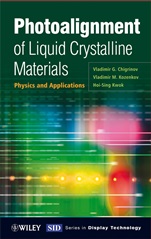
Photoalignment of Liquid Crystalline Materials: Physics and Applications
ISBN 9780470065396
Autor: Vladimir G. Chigrinov, Vladimir M. Kozenkov, Hoi–Sing Kwok
Wydawca: Wiley
Dostępność: 3-6 tygodni
Cena: 589,05 zł
Przed złożeniem zamówienia prosimy o kontakt mailowy celem potwierdzenia ceny.
ISBN13: |
9780470065396 |
ISBN10: |
0470065397 |
Autor: |
Vladimir G. Chigrinov, Vladimir M. Kozenkov, Hoi–Sing Kwok |
Oprawa: |
Hardback |
Rok Wydania: |
2008-06-06 |
Ilość stron: |
248 |
Wymiary: |
233x161 |
Tematy: |
PH |
Photoalignment possesses significant advantages in comparison with the usual ‘rubbing’ treatment of the substrates of liquid crystal display (LCD) cells as it is a non–contact method with a high resolution. A new technique recently pioneered by the authors of this book, namely the photo–induced diffusion reorientation of azodyes, does not involve any photochemical or structural transformations of the molecules. This results in photoaligning films which are robust and possess good aligning properties making them particularly suitable for the new generation of liquid crystal devices.
Photoalignment of Liquid Crystalline Materials covers state–of–the–art techniques and key applications, as well as the authors’ own diffusion model for photoalignment. The book aims to stimulate new research and development in the field of liquid crystalline photoalignment and in so doing, enable the technology to be used in large scale LCD production.
Key features:
Provides a full examination of the mechanisms of photoalignment.
Examines the properties of liquid crystals during photoalignment, with particular reference made to the effect on their chemical structure and stability.
Considers the most useful photosensitive materials and preparation procedures suitable for liquid crystalline photoalignment.
Presents several methods for photoalignment of liquid crystals.
Compares various applications of photoalignment technology for in–cell patterned polarizers and phase retarders, transflective and micro displays, security and other liquid crystal devices.
Through its interdisciplinary approach, this book is aimed at a wide range of practising electrical engineers, optical engineers, display technologists, materials scientists, physicists and chemists working on the development of liquid crystal devices. It will also appeal to researcher
s and graduate students taking courses on liquid crystals or display technologies.
The Society for Information Display (SID) is an international society which has the aim of encouraging the development of all aspects of the field of information display. complementary to the aims of the society the Wiley–SID series is intended to explain the latest developments in information display technology at a professional level. The broad scope of the series addresses all facets of information displays from technical aspects through systems and prototypes to standards and ergonomics.
Spis treści:
About the Authors.
Series Editor′s Foreword.
1. Introduction.
References.
2. Mechanisms of LC Photoalignment.
2.1 Cis–Trans Isomerization.
2.2 Pure Reorientation of the Azo–Dye Chromophore Molecules or Azo–Dye Molecular Solvates.
2.3 Crosslinking in Cinnamoyl Side–Chain Polymers.
2.4 Photodegradation in Polymide Materials.
2.5 Photoinduced Order in Langmuir–Blodgett Films.
References.
3. LC–Surface Interaction in a Photoaligned Cell.
3.1 Pretilt Angle Generation in Photoaligning Materials.
3.2 Generation of Large Pretilt Angles.
3.3 Anchoring Energy in Photoaligning Materials.
3.4 Stability of Photoaligning Materials Sensitivity to UV Light.
3.5 Comparison of the Characteristics of Photoalignment Layers for Different Mechanisms of LC Photoalignment.
3.6 Various Methods for the Experimental Characterization of Photoalignment Layers.
References.
4. Photoalignment of LCs.
4.1 Vertical LC Alignment.
4.2 Twisted LC Photoalignment.
4.3 Photoalignment of Ferroelectric LC.
4.4 Optical Rewritable LC Alignment.
4.5 Photoalignment with Asymmetric Surface Anchoring.
4.6 LC Photoalignment on Plastic Substrates.
4.7 Photoalignment on Grating Surface.
4.8 Photoalignment of Lyotropic and Discotic
LCs.
4.9 Other Types of LC Photoalignment.
References.
5. Application of Photoalignment Materials in Optical Elements.
5.1 Polarizers.
5.2 Retardation Films.
5.3 Transflective LCD with Photo–Patterned Polarizers and Phase Retarders.
5.4 Security Applications of Photoaligning and Photo–Patterning.
5.5 Optical Elements Based on Photoaligning Technology.
References.
6. Novel LCDs Based on Photoalignment.
6.1 Bistable Nematic Displays.
6.2 Photoaligned Liquid–Crystal–on–Silicon Microdisplays.
6.3 Photoaligned Ferroelectric LCDs.
6.4 New Optical Rewritable Electronic Paper.
6.5 Application of Photoalignment in Photonic LC Devices.
References.
7. US Patents Related to Photoalignment of Liquid Crystals.
7.1 Introductory Remarks.
7.2 List of Patents Patent Classification.
7.3 Analysis and Comments on the Patents.
Index.
Nota biograficzna:
Vladimir G. Chigrinov obtained his PhD degree in solid–state physics from the Shubnikov Institute of Crystallography, USSR Academy of Sciences, in 1978. In 1988, he defended his doctoral degree and became a professor at the Shubnikov Institute of Crystallography, where he was a leading researcher from 1996. He joined HKUST in 1999 and is currently an associate professor. Since 1974 Professor Chigrinov has published 2 books. 15 reviews and book chapters, about 150 journal papers, more than 300 conference presentations, and holds more than 50 patents and patent applications in the field of liquid crystals. He is a Senior SID Member, SID Fellow and an Associate Editor of the Journal of the Society for Information Display.
Vladimir M. Kozenkov graduated from the Moscow Energetic Institute as a scientist in applied physical optics (laser department). For 30 years he worked at the Organic Intermediates and Dyes Institute (NIOPIK) in Moscow. He pioneered research and development of vari
ous organic photosensitive materials for holography, waveguide, integral and polarization optics, stereolithography, optical memory, imaging processing, and security applications. He was the first to discover the phenomenon of photoinduced birefringence in polyvinyl–cinnamate films in 1977. He has published more than 100 refereed papers and holds more than 50 patents.
Hoi–Sing Kwok obtained his PhD degree in applied physics from Harvard University in 1978. He joined the State University of New York at Buffalo in 1980 and became a full professor in 1985. He joined HKUST in 1992 an is currently Director of the Center for Display Research (www.cdr.ust.hk). Professor Kwok has written over 500 refereed publications and holds 40 patents in laser optics and LCD technologies. He is a Fellow of the OSA, the IEEE, and the SID.
Okładka tylna:
Photoalignment possesses significant advantages in comparison with the usual ‘rubbing’ treatment of the substrates of liquid crystal display (LCD) cells as it is a non–contact method with a high resolution. A new technique recently pioneered by the authors of this book, namely the photo–induced diffusion reorientation of azodyes, does not involve any photochemical or structural transformations of the molecules. This results in photoaligning films which are robust and possess good aligning properties making them particularly suitable for the new generation of liquid crystal devices.
Photoalignment of Liquid Crystalline Materials covers state–of–the–art techniques and key applications, as well as the authors’ own diffusion model for photoalignment. The book aims to stimulate new research and development in the field of liquid crystalline photoalignment and in so doing, enable the technology to be used in large scale LCD production.
Key features:
Provides a full examination of the mechani
Koszyk
Książek w koszyku: 0 szt.
Wartość zakupów: 0,00 zł
Informacje


Kontakt
Gambit
Centrum Oprogramowania
i Szkoleń Sp. z o.o.
Al. Pokoju 29b/22-24
31-564 Kraków
Siedziba Księgarni
ul. Kordylewskiego 1
31-542 Kraków
+48 12 410 5991
+48 12 410 5987
+48 12 410 5989
Subskrypcje
Administratorem danych osobowych jest firma Gambit COiS Sp. z o.o. Na podany adres będzie wysyłany wyłącznie biuletyn informacyjny.
Autoryzacja płatności

Informacje na temat autoryzacji płatności poprzez PayU.

© Copyright 2012: GAMBIT COiS Sp. z o.o. Wszelkie prawa zastrzeżone.
Projekt i wykonanie: Alchemia Studio Reklamy