


Wydawcy
Katalog tematyczny
- Archeologia (109)
- Ekonomia, finanse, business (13704)
- Filozofia (1445)
- Historia (3040)
- Języki i językoznawstwo (2356)
- Lifestyle, hobby i rozrywka (475)
- Medycyna (9704)
- Nauki humanistyczne (4)
- Nauki o Ziemi i środowisku (2638)
- Nauki ścisłe (20412)
- Nauki społeczne (8486)
- Nauki techniczne (13450)
- Budownictwo lądowe (1045)
- Chemia przemysłowa (2258)
- Elektronika i telekomunikacja (3287)
- Energetyka (1122)
- Inne nauki stosowane (363)
- Inżynieria biochemiczna (507)
- Inżynieria transportu (232)
- Mechanika i materiały (3316)
- Nauka o środowisku (321)
- Rolnictwo (507)
- Technika, ogólnie (475)
- Prawo (1696)
- Publikacje informacyjne i interdyscyplinarne (1288)
- Religia i wierzenia (917)
- Technika komputerowa (4067)
- Zdrowie, relacje międzyludzkie i rozwój osobisty (657)





Informacje szczegółowe o książce
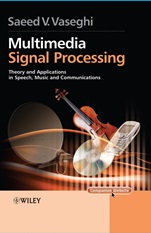
Multimedia Signal Processing: Theory and Applications in Speech, Music and Communications
ISBN 9780470062012
Autor: Saeed V. Vaseghi
Wydawca: Wiley
Dostępność: 3-6 tygodni
Cena: 583,80 zł
Przed złożeniem zamówienia prosimy o kontakt mailowy celem potwierdzenia ceny.
ISBN13: |
9780470062012 |
ISBN10: |
0470062010 |
Autor: |
Saeed V. Vaseghi |
Oprawa: |
Hardback |
Rok Wydania: |
2007-10-05 |
Ilość stron: |
674 |
Wymiary: |
252x179 |
Tematy: |
TJ |
Multimedia Signal Processing is a comprehensive and accessible text to the theory and applications of digital signal processing (DSP). The applications of DSP are pervasive and include multimedia systems, cellular communication, adaptive network management, radar, pattern recognition, medical signal processing, financial data forecasting, artificial intelligence, decision making, control systems and search engines.
This book is organised in to three major parts making it a coherent and structured presentation of the theory and applications of digital signal processing. A range of important topics are covered in basic signal processing, model–based statistical signal processing and their applications.
Part 1: Basic Digital Signal Processing gives an introduction to the topic, discussing sampling and quantization, Fourier analysis and synthesis, Z–transform, and digital filters.
Part 2: Model–based Signal Processing covers probability and information models, Bayesian inference, Wiener filter, adaptive filters, linear prediction hidden Markov models and independent component analysis.
Part 3: Applications of Signal Processing in Speech, Music and Telecommunications explains the topics of speech and music processing, echo cancellation, deconvolution and channel equalization, and mobile communication signal processing.
Covers music signal processing, explains the anatomy and psychoacoustics of hearing and the design of MP3 music coderExamines speech processing technology including speech models, speech coding for mobile phones and speech recognitionCovers single–input and multiple–inputs denoising methods, bandwidth extension and the recovery of lost speech packets in applications such as voice over IP (VoIP)Illustrated throughout, including numerous solved problems, Matlab experiments and demonstrationsCompanion website featur
es Matlab and C++ programs with electronic copies of all figures.
This book is ideal for researchers, postgraduates and senior undergraduates in the fields of digital signal processing, telecommunications and statistical data analysis. It will also be a valuable text to professional engineers in telecommunications and audio and signal processing industries.
Spis treści:
Preface.
Acknowledgement.
Symbols.
Abbreviations.
Part I Basic Digital Signal Processing.
1 Introduction.
1.1 Signals and Information.
1.2 Signal Processing Methods.
1.3 Applications of Digital Signal Processing.
1.4 Summary.
2 Fourier Analysis and Synthesis.
2.1 Introduction.
2.2 Fourier Series: Representation of Periodic Signals.
2.3 Fourier Transform: Representation of Nonperiodic Signals.
2.4 Discrete Fourier Transform.
2.5 Short–Time Fourier Transform.
2.6 Fast Fourier Transform (FFT).
2.7 2–D Discrete Fourier Transform (2–D DFT).
2.8 Discrete Cosine Transform (DCT).
2.9 Some Applications of the Fourier Transform.
2.10 Summary.
3 z–Transform.
3.1 Introduction.
3.2 Derivation of the z–Transform.
3.3 The z–Plane and the Unit Circle.
3.4 Properties of z–Transform.
3.5 z–Transfer Function, Poles (Resonance) and Zeros (Anti–resonance).
3.6 z–Transform of Analysis of Exponential Transient Signals.
3.7 Inverse z–Transform.
3.8 Summary.
4 Digital Filters.
4.1 Introduction.
4.2 Linear Time–Invariant Digital Filters.
4.3 Recursive and Non–Recursive Filters.
4.4 Filtering Operation: Sum of Vector Products, A Comparison of Convolution and Correlation.
4.5 Filter Structures: Direct, Cascade and Parallel Forms.
4.6 Linear Phase FIR Filters.
4.7 Design of Digital FIR Filter–banks.
4.8 Quadrature Mirror Sub–band Fi
lters.
4.9 Design of Infinite Impulse Response (IIR) Filters by Pole–zero Placements.
4.10 Issues in the Design and Implementation of a Digital Filter.
4.11 Summary.
5 Sampling and Quantisation.
5.1 Introduction.
5.2 Sampling a Continuous–Time Signal.
5.3 Quantisation.
5.4 Sampling Rate Conversion: Interpolation and Decimation.
5.5 Summary.
Part II Model–Based Signal Processing.
6 Information Theory and Probability Models.
6.1 Introduction: Probability and Information Models.
6.2 Random Processes.
6.3 Probability Models of Random Signals.
6.4 Information Models.
6.5 Stationary and Non–Stationary Random Processes.
6.6 Statistics (Expected Values) of a Random Process.
6.7 Some Useful Practical Classes of Random Processes.
6.8 Transformation of a Random Process.
6.9 Search Engines: Citation Ranking.
6.10 Summary.
7 Bayesian Inference.
7.1 Bayesian Estimation Theory: Basic Definitions.
7.2 Bayesian Estimation.
7.3 Expectation Maximisation Method.
7.4 Cramer–Rao Bound on the Minimum Estimator Variance.
7.5 Design of Gaussian Mixture Models (GMM).
7.6 Bayesian Classification.
7.7 Modelling the Space of a Random Process.
7.8 Summary.
8 Least Square Error, Wiener–Kolmogorov Filters.
8.1 Least Square Error Estimation: Wiener–Kolmogorov Filter.
8.2 Block–Data Formulation of the Wiener Filter.
8.3 Interpretation of Wiener Filter as Projection in Vector Space.
8.4 Analysis of the Least Mean Square Error Signal.
8.5 Formulation of Wiener Filters in the Frequency Domain.
8.6 Some Applications of Wiener Filters.
8.7 Implementation of Wiener Filters.
8.8 Summary.
9 Adaptive Filters: Kalman, RLS, LMS.
9.1 Introduction.
9.2 State–Space Kalman Filters.
9.3 Sample Adaptive Filters.
9.4 Recursive Least Square (RLS) Adaptive Filters.
9.5 The Steepest–Des
cent Method.
9.6 LMS Filter.
9.7 Summary.
10 Linear Prediction Models.
10.1 Linear Prediction Coding.
10.2 Forward, Backward and Lattice Predictors.
10.3 Short–Term and Long–Term Predictors.
10.4 MAP Estimation of Predictor Coefficients.
10.5 Formant–Tracking LP Models.
10.6 Sub–Band Linear Prediction Model.
10.7 Signal Restoration Using Linear Prediction Models.
10.8 Summary.
11 Hidden Markov Models.
11.1 Statistical Models for Non–Stationary Processes.
11.2 Hidden Markov Models.
11.3 Training Hidden Markov Models.
11.4 Decoding Signals Using Hidden Markov Models.
11.5 HMM in DNA and Protein Sequences.
11.6 HMMs for Modelling Speech and Noise.
11.7 Summary.
12 Eigenvector Analysis, Principal Component Analysis and Independent Component Analysis.
12.1 Introduction – Linear Systems and Eigenanalysis.
12.2 Eigenvectors and Eigenvalues.
12.3 Principal Component Analysis (PCA).
12.4 Independent Component Analysis.
12.5 Summary.
Part III Applications of Digital Signal Processing to Speech, Music and Telecommunications.
13 Music Signal Processing and Auditory Perception.
13.1 Introduction.
13.2 Musical Notes, Intervals and Scales.
13.3 Musical Instruments.
13.4 Review of Basic Physics of Sounds.
13.5 Music Signal Features and Models.
13.6 Anatomy of the Ear and the Hearing Process.
13.7 Psychoacoustics of Hearing.
13.8 Music Coding (Compression).
13.9 High Quality Audio Coding: MPEG Audio Layer–3 (MP3).
13.10 Stereo Music Coding.
13.11 Summary.
14 Speech Processing.
14.1 Speech Communication.
14.2 Acoustic Theory of Speech: The Source–filter Model.
14.3 Speech Models and Features.
14.4 Linear Prediction Models of Speech.
14.5 Harmonic Plus Noise Model of Speech.
14.6 Fundamental Frequency (Pitch) Information.
14.7 Speech Coding.
14.8 Speech Rec
Koszyk
Książek w koszyku: 0 szt.
Wartość zakupów: 0,00 zł
Informacje


Kontakt
Gambit
Centrum Oprogramowania
i Szkoleń Sp. z o.o.
Al. Pokoju 29b/22-24
31-564 Kraków
Siedziba Księgarni
ul. Kordylewskiego 1
31-542 Kraków
+48 12 410 5991
+48 12 410 5987
+48 12 410 5989
Subskrypcje
Administratorem danych osobowych jest firma Gambit COiS Sp. z o.o. Na podany adres będzie wysyłany wyłącznie biuletyn informacyjny.
Autoryzacja płatności

Informacje na temat autoryzacji płatności poprzez PayU.

© Copyright 2012: GAMBIT COiS Sp. z o.o. Wszelkie prawa zastrzeżone.
Projekt i wykonanie: Alchemia Studio Reklamy