


Wydawcy
Katalog tematyczny
- Archeologia (109)
- Ekonomia, finanse, business (13704)
- Filozofia (1445)
- Historia (3040)
- Języki i językoznawstwo (2356)
- Lifestyle, hobby i rozrywka (475)
- Medycyna (9704)
- Nauki humanistyczne (4)
- Nauki o Ziemi i środowisku (2638)
- Nauki ścisłe (20412)
- Astronomia (294)
- Biologia (5119)
- Chemia (6540)
- Chemia analityczna (361)
- Chemia fizyczna (346)
- Chemia nieorganiczna (137)
- Chemia organiczna (535)
- Krystalografia (27)
- Minerologia (46)
- Fizyka (3309)
- Matematyka (4574)
- Nauki ścisłe, ogólnie (503)
- Nauki społeczne (8486)
- Nauki techniczne (13450)
- Prawo (1696)
- Publikacje informacyjne i interdyscyplinarne (1288)
- Religia i wierzenia (917)
- Technika komputerowa (4067)
- Zdrowie, relacje międzyludzkie i rozwój osobisty (657)





Informacje szczegółowe o książce
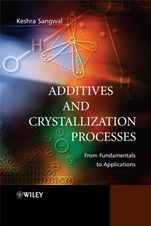
Additives and Crystallization Processes: From Fundamentals to Applications
ISBN 9780470061534
Autor: Keshra Sangwal
Wydawca: Wiley
Dostępność: 3-6 tygodni
Cena: 871,50 zł
Przed złożeniem zamówienia prosimy o kontakt mailowy celem potwierdzenia ceny.
ISBN13: |
9780470061534 |
ISBN10: |
0470061537 |
Autor: |
Keshra Sangwal |
Oprawa: |
Hardback |
Rok Wydania: |
2007-09-27 |
Ilość stron: |
468 |
Wymiary: |
253x176 |
Tematy: |
PN |
Crystal growth technology involves processes for the production of crystals essential for microelectronics, communication technologies, lasers and energy producing and energy saving technology. A deliberately added impurity is called an additive and in different industries these affect the process of crystal growth. Thus, understanding of interactions between additives and the crystallizing phases is important in different processes found in the lab, nature and in various industries.
This book presents a generalized description of the mechanisms of action of additives during nucleation, growth and aggregation of crystals during crystallization and has received endorsement from the President of the International Organization for Crystal Growth. It is the first text devoted to the role of additives in different crystallization processes encountered in the lab, nature and in industries as diverse as pharmaceuticals, food and biofuels.
A unique highlight of the book are chapters on the effect of additives on crystal growth processes, since the phenomena discussed is an issue of debate between researchers
Spis treści:
Preface.
1 Complexes in Solutions.
1.1 Structure of Common Solvents.
1.2 Structure of Pure Aqueous Electrolyte Solutions.
1.2.1 Solvation of Electrolyte Ions in Solutions.
1.2.2 Concentrated and Saturated Electrolyte Solutions.
1.2.3 Formation of Aquo and Partially Aquo Complexes.
1.3 Structure of Aqueous Electrolyte Solutions Containing Additives.
1.4 Polyelectrolytes and Surfactants in Solutions.
1.5 Polydentate Ligands and Molecular Additives.
1.6 Crystal–Additive Interactions.
References.
2 Three–Dimensional Nucleation and Metastable Zone Width.
2.1 Driving Force for Phase Transition.
2.2 Three–Dimensional Nucleation of Crystals.
2.2.1 Three–Dimensional Nucleation Rate.
2.2.2 Three–Dimensional Heterogeneous Nucleation.2.3 Metastable Zone Width.
2.4 Nucleation and Transformation of Metastable Phases.
2.4.1 Crystallization of Metastable Phases.
2.4.2 Overall Crystallization.
2.5 Induction Period for Crystallization.
2.6 Effects of Additives.
2.6.1 Solubility.
2.6.2 Three–Dimensional Nucleation Rate.
2.6.3 Metastable Zone Width.
References.
3 Kinetics and Mechanism of Crystal Growth: An Overview.
3.1 Crystal Growth as a Kinetic Process.
3.2 Types of Crystal–Medium Interfaces.
3.3 Roughening of Steps and Surfaces.
3.3.1 Thermodynamic Roughening and the Surface Entropy Factor.
3.3.2 Kinetic Roughening.
3.4 Growth Kinetics of Rough Faces.
3.5 Growth Kinetics of Perfect Smooth Faces.
3.6 Growth Kinetics of Imperfect Smooth Faces.
3.6.1 Surface Diffusion and Direct Integration Models.
3.6.2 Bulk Diffusion Models.
3.6.3 Growth by a Group of Cooperating Screw Dislocations.
3.6.4 Preferential Growth at Edge Dislocations.
3.7 Effect of Foreign Substances on Growth Kinetics.
3.7.1 Some General Considerations.
3.7.2 Growth Kinetics by Heterogeneous Two–Dimensional Nucleation.
3.8 Real Crystal Growth Mechanisms.
3.8.1 Structure of Interfacial Layer.
3.8.2 Sources of Growth Steps.
3.9 Techniques for Studying Growth Kinetics.
References.
4 Effect of Impurities on Crystal Growth Kinetics.
4.1 Mobile and Immobile Impurities.
4.2 Surface Coverage and Adsorption Isotherms.
4.2.1 Adsorption Isotherms.
4.2.2 Changes in Surface Free Energy by Adsorption of Impurities.
4.3 Kinetic Models of Impurity Adsorption.
4.3.1 Earlier Models.
4.3.2 Velocity of Curved Steps.
4.3.3 Impurity Adsorption at Kinks in Steps: Kubota–Mullin Model.
4.3.4 Impurity Adsorption at Surface Terrace: Cabrera–Vermilyea Model.
4.3.5 Effectiveness Factor for Impurity Adsorption.
4.3.6 Adsorption of Two Competing Impurities.
4.4 Confrontation of Impurity Adsorpt
ion Mechanisms with Experimental Data.
4.5 Time–Dependent Impurity Adsorption.
4.6 Growth Kinetics in the Presence of Impurities.
4.6.1 Basic Kinetic Equations.
4.6.2 Time Dependence of Face Displacement.
4.6.3 Dependence of Kinetic Coefficient for Step Motion on Impurity Concentration.
4.7 Tapering of KDP–Type Crystals.
4.8 Growth–Promoting Effects of Impurities.
4.8.1 Decrease in Step Free Energy and Roughening of Steps.
4.8.2 Formation of Surface Macroclusters.
4.9 Impurity Adsorption on Rough Faces.
4.10 Formation of Two–Dimensional Adsorption Layer.
4.11 Interactions Between Additives and Crystal Interface.
4.11.1 Nature of Impurity–Crystal Interactions.
4.11.2 Chemical Aspects of Impurity–Crystal Interactions.
4.12 Tailor–Made Additives.
References.
5 Dead Supersaturation Zone and Threshold Supersaturations for Growth.
5.1 Origin of Threshold Supersaturations for Growth.
5.1.1 Basic Kinetic Equations.
5.1.2 Three Different Distances Between Impurity Particles.
5.2 Determination of Threshold Supersaturations from v(σ) and R(σ) Data.
5.2.1 Relationship Between the Model Involving Cooperating Spirals and the Power–Law Approach.
5.2.2 Relationship Between the Power–Law Approach and an Empirical Expression with Corrected Supersaturation.
5.2.3 Determination of σ∗.
5.3 Dependence of Threshold Supersaturations on Impurity Concentration: Basic Theoretical Equations and Linear Approximations.
5.4 Confrontation of Theoretical Equations with Experimental Data.
5.4.1 Impurity Adsorption at Kinks and Surface Terrace.
5.4.2 Threshold Supersaturations and Impurity Adsorption Isotherms.
5.5 Impurity Adsorption and Solution Supersaturation.
5.6 Dependence of Ratios σd/σ∗ and σ∗/σ∗∗ on ci References.
6 Mineralization in Natural and Artificial Systems.
6.1 Biomineralization as a Process.
6.1.1 Structure and Composition of Biominerals.
6.1.2 Humans and Animals.
6.1.3 Plants.
6.1.4 Mollusk Shells and Avian Eggshells.
6.2 Pathological Mineralization.
6.3 Effect of Biologically Active Additives on Crystallization Processes.
6.3.1 Overall Precipitation Kinetics.
6.3.2 Overall Growth Kinetics.
6.3.3 Phases and Polymorphs of Crystallizing Calcium Salts.
6.3.4 Transformation of Metastable Phases.
6.4 Scale Formation and Salt Weathering.
References.
7 Morphology and Size Distribution of Crystals.
7.1 Growth Morphology of Crystals.
7.1.1 General Concepts.
7.1.2 Effect of Additives on Surface Morphology.
7.1.3 Effect of Solvent on Crystal Morphology.
7.1.4 Growth Morphodroms.
7.2 Ostwald Ripening and Crystal Size Dispersion.
7.3 Crystal Size Distribution.
7.3.1 Population Balance Approach.
7.3.2 Balanced Nucleation–Growth Approach.
7.3.3 Approach Based on Law of Proportionate Effect.
7.3.4 Effect of Additives on Crystal Size Distribution.
7.4 Control of Shape and Size of Particles.
7.4.1 Growth–Directed Synthesis.
7.4.2 Template–Directed Synthesis.
7.5 Biological Tissue Engineering.
References.
8 Additives and Crystallization Processes in Industries.
8.1 Pharmaceutical Industry.
8.1.1 Nucleation, Growth and Morphology of Drug Crystals.
8.1.2 Preparation and Size Distribution of Drug Particles.
8.2 Petroleum Industry.
8.2.1 Some Basic Concepts.
8.2.2 Crystallization Behavior of Linear Long–Chain n–Alkanes.
8.2.3 Biodiesels and their Crystallization Behavior.
8.3 Food Industry.
8.3.1 Some Basic Concepts.
8.3.2 Crystallization of Food Fats in the Bulk.
8.3.3 Crystallization of Polymorphs.
8.3.4 Crystallization of Fats and Oils in Emulsion Droplets.
8.3.5 Number of Nucleation Centers and Overall Crystallization in Emulsion Systems.
References.
9 Inc
Koszyk
Książek w koszyku: 0 szt.
Wartość zakupów: 0,00 zł
Informacje


Kontakt
Gambit
Centrum Oprogramowania
i Szkoleń Sp. z o.o.
Al. Pokoju 29b/22-24
31-564 Kraków
Siedziba Księgarni
ul. Kordylewskiego 1
31-542 Kraków
+48 12 410 5991
+48 12 410 5987
+48 12 410 5989
Subskrypcje
Administratorem danych osobowych jest firma Gambit COiS Sp. z o.o. Na podany adres będzie wysyłany wyłącznie biuletyn informacyjny.
Autoryzacja płatności

Informacje na temat autoryzacji płatności poprzez PayU.

© Copyright 2012: GAMBIT COiS Sp. z o.o. Wszelkie prawa zastrzeżone.
Projekt i wykonanie: Alchemia Studio Reklamy