


Wydawcy
Katalog tematyczny
- Archeologia (109)
- Ekonomia, finanse, business (13704)
- Filozofia (1445)
- Historia (3040)
- Języki i językoznawstwo (2356)
- Lifestyle, hobby i rozrywka (475)
- Medycyna (9704)
- Nauki humanistyczne (4)
- Nauki o Ziemi i środowisku (2638)
- Nauki ścisłe (20412)
- Nauki społeczne (8486)
- Nauki techniczne (13450)
- Budownictwo lądowe (1045)
- Chemia przemysłowa (2258)
- Elektronika i telekomunikacja (3287)
- Energetyka (1122)
- Inne nauki stosowane (363)
- Inżynieria biochemiczna (507)
- Inżynieria transportu (232)
- Mechanika i materiały (3316)
- Nauka o środowisku (321)
- Rolnictwo (507)
- Technika, ogólnie (475)
- Prawo (1696)
- Publikacje informacyjne i interdyscyplinarne (1288)
- Religia i wierzenia (917)
- Technika komputerowa (4067)
- Zdrowie, relacje międzyludzkie i rozwój osobisty (657)





Informacje szczegółowe o książce
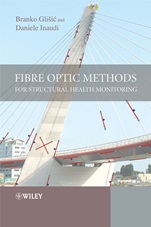
Fibre Optic Methods for Structural Health Monitoring
ISBN 9780470061428
Autor: Branko Glisic, Daniele Inaudi
Wydawca: Wiley
Dostępność: Wysyłka w ciągu 2-3 dni
Cena: 622,65 zł
ISBN13: |
9780470061428 |
ISBN10: |
0470061421 |
Autor: |
Branko Glisic, Daniele Inaudi |
Oprawa: |
Hardback |
Rok Wydania: |
2007-10-26 |
Ilość stron: |
276 |
Wymiary: |
248x175 |
Tematy: |
TG |
The use of fibre optic sensors in structural health monitoring has rapidly accelerated in recent years. By embedding fibre optic sensors in structures (e.g. buildings, bridges and pipelines) it is possible to obtain real time data on structural changes such as stress or strain. Engineers use monitoring data to detect deviations from a structure’s original design performance in order to optimise the operation, repair and maintenance of a structure over time.
Fibre Optic Methods for Structural Health Monitoring is organised as a step–by–step guide to implementing a monitoring system and includes examples of common structures and their most–frequently monitored parameters. This book:presents a universal method for static structural health monitoring, using a technique with proven effectiveness in hundreds of applications worldwide;discusses a variety of different structures including buildings, bridges, dams, tunnels and pipelines;features case studies which describe common problems and offer solutions to those problems;provides advice on establishing mechanical parameters to monitor (including deformations, rotations and displacements) and on placing sensors to achieve monitoring objectives;identifies methods for interpreting data according to construction material and shows how to apply numerical concepts and formulae to data in order to inform decision making.
Fibre Optic Methods for Structural Health Monitoring is an invaluable reference for practising engineers in the fields of civil, structural and geotechnical engineering. It will also be of interest to academics and undergraduate/graduate students studying civil and structural engineering.
Spis treści:
Foreword.
Preface.
Acknowledgments.
1 Introduction to Structural Health Monitoring.
1.1 Basic Notions, Needs and Benefits.
1.1.1 Introduction.
1.1.2 Basic Notions.<
br>1.1.3 Monitoring Needs and Benefits.
1.1.4 Whole Lifespan Monitoring.
1.2 The Structural Health Monitoring Process.
1.2.1 Core Activities.
1.2.2 Actors.
1.3 On–Site Example of Structural Health Monitoring Project.
2 Fibre–Optic Sensors.
2.1 Introduction to Fibre–Optic Technology.
2.2 Fibre–Optic Sensing Technologies.
2.2.1 SOFO Interferometric Sensors.
2.2.2 Fabry–Perot Interferometric Sensors.
2.2.3 Fibre Bragg–Grating Sensors.
2.2.4 Distributed Brillouin– and Raman–Scattering Sensors.
2.3 Sensor Packaging.
2.4 Distributed Sensing Cables.
2.4.1 Introduction.
2.4.2 Temperature–Sensing Cable.
2.4.3 Strain–Sensing Tape: SMARTape.
2.4.4 Combined Strain– and Temperature–Sensing: SMARTprofile.
2.5 Software and System Integration.
2.6 Conclusions and Summary.
3 Fibre–Optic Deformation Sensors: Applicability and Interpretation of Measurements.
3.1 Strain Components and Strain Time Evolution.
3.1.1 Basic Notions.
3.1.2 Elastic and Plastic Structural Strain.
3.1.3 Thermal Strain.
3.1.4 Creep.
3.1.5 Shrinkage.
3.1.6 Reference Time and Reference Measurement.
3.2 Sensor Gauge Length and Measurement.
3.2.1 Introduction.
3.2.2 Deformation Sensor Measurements.
3.2.3 Global Structural Monitoring: Basic Notions.
3.2.4 Sensor Measurement Dependence on Strain Distribution: Maximal Gauge Length.
3.2.5 Sensor Measurement in Inhomogeneous Materials: Minimal–Gauge Length.
3.2.6 General Principle in the Determination of Sensor Gauge Length.
3.2.7 Distributed Strain Sensor Measurement.
3.3 Interpretation of strain measurement.
3.3.1 Introduction.
3.3.2 Sources of Errors and Detection of Anomalous Structural Condition.
3.3.3 Determination of Strain Components and Stress from Total–Strain Measurement.
3.3.4 Example of Strain Measurement Interpretation.
4 Senso
r Topologies: Monitoring Global Parameters.
4.1 Finite Element Structural Health Monitoring Concept: Introduction.
4.2 Simple Topology and Applications.
4.2.1 Basic Notions on Simple Topology.
4.2.2 Enchained Simple Topology.
4.2.3 Example of an Enchained Simple Topology Application.
4.2.4 Scattered Simple Topology.
4.2.5 Example of a Scattered Simple Topology Application.
4.3 Parallel Topology.
4.3.1 Basic Notions on Parallel Topology: Uniaxial Bending.
4.3.2 Basic Notions on Parallel Topology: Biaxial Bending.
4.3.3 Deformed Shape and Displacement Diagram.
4.3.4 Examples of Parallel Topology Application.
4.4 Crossed Topology.
4.4.1 Basic Notions on Crossed Topology: Planar Case.
4.4.2 Basic Notions on Crossed Topology: Spatial Case.
4.4.3 Example of a Crossed Topology Application.
4.5 Triangular Topology.
4.5.1 Basic Notions on Triangular Topology.
4.5.2 Scattered and Spread Triangular Topologies.
4.5.3 Monitoring of Planar Relative Movements Between Two Blocks.
4.5.4 Example of a Triangular Topology Application.
5 Finite Element Structural Health Monitoring Strategies and Application Examples.
5.1 Introduction.
5.2 Monitoring of Pile Foundations.
5.2.1 Monitoring the Pile.
5.2.2 Monitoring a Group of Piles.
5.2.3 Monitoring of Foundation Slab.
5.2.4 On–Site Example of Piles Monitoring.
5.3 Monitoring of Buildings.
5.3.1 Monitoring of Building Structural Members.
5.3.2 Monitoring of Columns.
5.3.3 Monitoring of Cores.
5.3.4 Monitoring of Frames, Slabs and Walls.
5.3.5 Monitoring of a Whole Building.
5.3.6 On–Site Example of Building Monitoring.
5.4 Monitoring of Bridges.
5.4.1 Introduction.
5.4.2 Monitoring of a Simple Beam.
5.4.3 On–Site Example of Monitoring of a Simple Beam.
5.4.4 Monitoring of a Continuous Girder.
5.4.5 On–Site Example of Monitoring of a Continuous Girder.
5.4.6 Monitoring of a Balanc
ed Cantilever Bridge.
5.4.7 On–Site Example of Monitoring of a Balanced Cantilever Girder.
5.4.8 Monitoring of an Arch Bridge.
5.4.9 On–Site Example of Monitoring of an Arch Bridge.
5.4.10 Monitoring of a Cable–Stayed Bridge.
5.4.11 On–Site Example of Monitoring of a Cable–Stayed Bridge.
5.4.12 Monitoring of a Suspended Bridge.
5.4.13 Bridge Integrity Monitoring.
5.4.14 On–Site Example of Bridge Integrity Monitoring.
5.5 Monitoring of Dams.
5.5.1 Introduction.
5.5.2 Monitoring of an Arch Dam.
5.5.3 On–Site Examples on Monitoring of an Arch Dam.
5.5.4 Monitoring of a Gravity Dam.
5.5.5 On–Site Example of Monitoring a Gravity Dam.
5.5.6 Monitoring of a Dyke (Earth or Rockfill Dam).
5.5.7 On–Site Example of Monitoring a Dyke.
5.6 Monitoring of Tunnels.
5.6.1 Introduction.
5.6.2 Monitoring of Convergence.
5.6.3 On–Site Example of Monitoring of Convergence.
5.6.4 Monitoring of Strain and Deformation.
5.6.5 On–Site Example of Monitoring of Deformation.
5.6.6 Monitoring of Other Parameters and Tunnel Integrity Monitoring.
5.7 Monitoring of Heritage Structures.
5.7.1 Introduction.
5.7.2 Monitoring of San Vigilio Church, Gandria, Switzerland.
5.7.3 Monitoring of Royal Villa, Monza, Italy.
5.7.4 Monitoring of Bolshoi Moskvoretskiy Bridge, Moscow, Russia.
5.8 Monitoring of Pipelines.
5.8.1 Introduction.
5.8.2 Pipeline Monitoring.
5.8.3 Pipeline Monitoring Application Examples.
5.8.4 Conclusions.
6 Conclusions and Outlook.
6.1 Conclusions.
6.2 Outlook.
References.
Index.
Nota biograficzna:
Dr. Branko Glišić has studied at the University of Belgrade and received his degrees, in civil engineering in 1994, and in mathematics in 1996. He was awarded as the best student of the year of the Department for Structural Engineering, and as the best student
Koszyk
Książek w koszyku: 0 szt.
Wartość zakupów: 0,00 zł
Informacje


Kontakt
Gambit
Centrum Oprogramowania
i Szkoleń Sp. z o.o.
Al. Pokoju 29b/22-24
31-564 Kraków
Siedziba Księgarni
ul. Kordylewskiego 1
31-542 Kraków
+48 12 410 5991
+48 12 410 5987
+48 12 410 5989
Subskrypcje
Administratorem danych osobowych jest firma Gambit COiS Sp. z o.o. Na podany adres będzie wysyłany wyłącznie biuletyn informacyjny.
Autoryzacja płatności

Informacje na temat autoryzacji płatności poprzez PayU.

© Copyright 2012: GAMBIT COiS Sp. z o.o. Wszelkie prawa zastrzeżone.
Projekt i wykonanie: Alchemia Studio Reklamy