


Wydawcy
Katalog tematyczny
- Archeologia (109)
- Ekonomia, finanse, business (13704)
- Filozofia (1445)
- Historia (3040)
- Języki i językoznawstwo (2356)
- Lifestyle, hobby i rozrywka (475)
- Medycyna (9704)
- Nauki humanistyczne (4)
- Nauki o Ziemi i środowisku (2638)
- Nauki ścisłe (20412)
- Nauki społeczne (8486)
- Nauki techniczne (13450)
- Prawo (1696)
- Publikacje informacyjne i interdyscyplinarne (1288)
- Religia i wierzenia (917)
- Technika komputerowa (4067)
- Zdrowie, relacje międzyludzkie i rozwój osobisty (657)





Informacje szczegółowe o książce
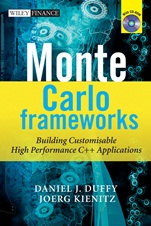
Monte Carlo Frameworks: Building Customisable High–performance C++ Applications
ISBN 9780470060698
Autor: Daniel J. Duffy, Joerg Kienitz
Wydawca: Wiley
Dostępność: 3-6 tygodni
Cena: 468,30 zł
Przed złożeniem zamówienia prosimy o kontakt mailowy celem potwierdzenia ceny.
ISBN13: |
9780470060698 |
ISBN10: |
0470060697 |
Autor: |
Daniel J. Duffy, Joerg Kienitz |
Oprawa: |
Hardback |
Rok Wydania: |
2009-09-25 |
Ilość stron: |
776 |
Wymiary: |
245x166 |
Tematy: |
KF |
The Monte Carlo method is now acknowledged as being one of the most robust tools for a range of applications in finance, from option pricing to risk management and optimization. One of the best languages for the development of Monte Carlo applications and frameworks is C++, an object–oriented and generic programming language which is also an industry standard.
This is one of the first books that describe all the steps that are needed in order to analyze, design and implement Monte Carlo applications. It discusses the financial theory as well as the mathematical and numerical background that is needed to write flexible and efficient C++ code using state–of–the–art design and system patterns, object–oriented and generic programming models in combination with standard libraries and tools.
The book is divided into four parts, each one dealing with one major aspect of the current problem domain. The features and topics are:Option pricing for a range of one–factor and n–factor models;European, Asian, baskets, Heston, jump models;Early exercises, calculating option sensitivities;The mathematical theory of n–factor Stochastic Differential Equations (SDE);An introduction to the numerical analysis of SDE;Modelling SDE and the Finite Difference Method (FDM) in C++;Applying design and system patterns (GOF, POSA) for improved design;Extensive use of the STL and boost libraries;Multi–threading and parallel programming (OpenMP) techniques for Monte Carlo;Creating Excel–based applications using xlw, Automation and COM;Extra discussion of mathematical foundations for Monte Carlo;Working source code is provided along with numerous examples, exercises and projects related to the extension of the C++ framework.
The book is accompanied by a CD which contains the source code for all the examples. It is strongly advised that you experiment with the code by compili
ng it and extending it to suit your needs. Support is offered via a user forum on www.datasimfinancial.com where you can post queries and communicate with other purchasers of the book.
Spis treści:
Notation.
Executive Overview.
0 My First Monte Carlo Application One–Factor Problems.
0.1 Introduction and objectives.
0.2 Description of the problem.
0.3 Ordinary differential equations (ODE).
0.4 Stochastic differential equations (SDE) and their solution.
0.5 Generating uniform and normal random numbers.
0.6 The Monte Carlo method.
0.7 Calculating sensitivities.
0.8 The initial C++ Monte Carlo framework: hierarchy and paths.
0.9 The initial C++ Monte Carlo framework: calculating option price.
0.10 The predictor–corrector method: a scheme for all seasons?
0.11 The Monte Carlo approach: caveats and nasty surprises.
0.12 Summary and conclusions.
0.13 Exercises and projects.
PART I FUNDAMENTALS.
1 Mathematical Preparations for the Monte Carlo Method.
1.1 Introduction and objectives.
1.2 Random variables.
1.3 Discrete and continuous random variables.
1.4 Multiple random variables.
1.5 A short history of integration.
1.6 σ–algebras, measurable spaces and measurable functions.
1.7 Probability spaces and stochastic processes.
1.8 The Ito stochastic integral.
1.9 Applications of the Lebesgue theory.
1.10 Some useful inequalities.
1.11 Some special functions.
1.12 Convergence of function sequences.
1.13 Applications to stochastic analysis.
1.14 Summary and conclusions.
1.15 Exercises and projects.
2 The Mathematics of Stochastic Differential Equations (SDE).
2.1 Introduction and objectives.
2.2 A survey of the literature.
2.3 Mathematical foundations for SDEs.
2.4 Motivating random (stochastic) processes.
2.5 An introduction to one–dimensional random processes.
2.6 Stochastic dif
ferential equations in Banach spaces: prologue.
2.7 Classes of SIEs and properties of their solutions.
2.8 Existence and uniqueness results.
2.9 A special SDE: the Ito equation.
2.10 Numerical approximation of SIEs.
2.11 Transforming an SDE: the Ito formula.
2.12 Summary and conclusions.
2.13 Appendix: proof of the Banach fixed–point theorem and some applications.
2.14 Exercises and projects.
3 Alternative SDEs and Toolkit Functionality.
3.1 Introduction and objectives.
3.2 Bessel processes.
3.3 Random variate generation.
3.4 The exponential distribution.
3.5 The beta and gamma distributions.
3.6 The chi–squared, Student and other distributions.
3.7 Discrete variate generation.
3.8 The Fokker–Planck equation.
3.9 The relationship with PDEs.
3.9.1 The Fichera function.
3.10 Alternative stochastic processes.
3.11 Using associative arrays and matrices to model lookup tables and volatility surfaces.
3.12 Summary and conclusion.
3.13 Appendix: statistical distributions and special functions in the Boost library.
3.14 Exercises and projects.
4 An Introduction to the Finite Difference Method for SDE.
4.1 Introduction and objectives.
4.2 An introduction to discrete time simulation, motivation and notation.
4.3 Foundations of discrete time approximation: ordinary differential equations.
4.4 Foundations of discrete time approximation: stochastic differential equations.
4.5 Some common schemes for one–factor SDEs.
4.6 The Milstein schemes.
4.7 Predictor–corrector methods.
4.8 Stiff ordinary and stochastic differential equations.
4.9 Software design and C++ implementation issues.
4.10 Computational results.
4.11 Aside: the characteristic equation of a difference scheme.
4.12 Summary and conclusions.
4.13 Exercises and projects.
5 Design and Implementation of Finite Difference Schemes in Computational Finance.
5.1 Introduction and objectives.
5.2 Modelling SDEs and FDM in C++.
5.3 Mathematical and numerical tools.
5.4 The Karhunen–Loeve expansion.
5.5 Cholesky decomposition.
5.6 Spread options with stochastic volatility.
5.7 The Heston stochastic volatility model.
5.8 Path–dependent options and the Monte Carlo method.
5.9 A small software framework for pricing options.
5.10 Summary and conclusions.
5.11 Exercises and projects.
6 Advanced Finance Models and Numerical Methods.
6.1 Introduction and objectives.
6.2 Processes with jumps.
6.3 Lévy processes.
6.4 Measuring the order of convergence.
6.5 Mollifiers, bump functions and function regularisation.
6.6 When Monte Carlo does not work: counterexamples.
6.7 Approximating SDEs using strong Taylor, explicit and implicit schemes.
6.8 Summary and conclusions.
6.9 Exercises and projects.
7 Foundations of the Monte Carlo Method.
7.1 Introduction and objectives.
7.2 Basic probability.
7.3 The Law of Large Numbers.
7.4 The Central Limit Theorem.
7.5 Quasi Monte Carlo methods.
7.6 Summary and conclusions.
7.7 Exercises and projects.
PART II DESIGN PATTERNS.
8 Architectures and Frameworks for Monte Carlo Methods: Overview.
8.1 Goals of Part II of this book.
8.2 Introduction and objectives of this chapter.
8.3 The advantages of domain architectures.
8.4 Software Architectures for the Monte Carlo method.
8.5 Summary and conclusions.
8.6 Exercises and projects.
9 System Decomposition and System Patterns.
9.1 Introduction and objectives.
9.2 Software development process; a critique.
9.3 System decomposition, from concept to code.
9.4 Decomposition techniques, the process.
9.5 Whole–part.
9.6 Whole–part decomposition; the process.
9.7 Presentation–Abstraction Control (PAC).
9.8 Building complex objects and configuring applications.
9.9 Su
Koszyk
Książek w koszyku: 0 szt.
Wartość zakupów: 0,00 zł
Informacje


Kontakt
Gambit
Centrum Oprogramowania
i Szkoleń Sp. z o.o.
Al. Pokoju 29b/22-24
31-564 Kraków
Siedziba Księgarni
ul. Kordylewskiego 1
31-542 Kraków
+48 12 410 5991
+48 12 410 5987
+48 12 410 5989
Subskrypcje
Administratorem danych osobowych jest firma Gambit COiS Sp. z o.o. Na podany adres będzie wysyłany wyłącznie biuletyn informacyjny.
Autoryzacja płatności

Informacje na temat autoryzacji płatności poprzez PayU.

© Copyright 2012: GAMBIT COiS Sp. z o.o. Wszelkie prawa zastrzeżone.
Projekt i wykonanie: Alchemia Studio Reklamy