


Wydawcy
Katalog tematyczny
- Archeologia (109)
- Ekonomia, finanse, business (13704)
- Filozofia (1445)
- Historia (3040)
- Języki i językoznawstwo (2356)
- Lifestyle, hobby i rozrywka (475)
- Medycyna (9704)
- Nauki humanistyczne (4)
- Nauki o Ziemi i środowisku (2638)
- Nauki ścisłe (20412)
- Astronomia (294)
- Biologia (5119)
- Chemia (6540)
- Chemia analityczna (361)
- Chemia fizyczna (346)
- Chemia nieorganiczna (137)
- Chemia organiczna (535)
- Krystalografia (27)
- Minerologia (46)
- Fizyka (3309)
- Matematyka (4574)
- Nauki ścisłe, ogólnie (503)
- Nauki społeczne (8486)
- Nauki techniczne (13450)
- Prawo (1696)
- Publikacje informacyjne i interdyscyplinarne (1288)
- Religia i wierzenia (917)
- Technika komputerowa (4067)
- Zdrowie, relacje międzyludzkie i rozwój osobisty (657)





Informacje szczegółowe o książce
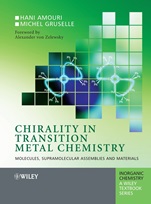
Chirality in Transition Metal Chemistry: Molecules, Supramolecular Assemblies and Materials
ISBN 9780470060544
Autor: Hani Amouri, Michel Gruselle, J. Derek Woollins, David A. Atwood, Robert H. Crabtree, Gerd Mayer
Wydawca: Wiley
Dostępność: 3-6 tygodni
Cena: 351,75 zł
Przed złożeniem zamówienia prosimy o kontakt mailowy celem potwierdzenia ceny.
ISBN13: |
9780470060544 |
ISBN10: |
0470060549 |
Autor: |
Hani Amouri, Michel Gruselle, J. Derek Woollins, David A. Atwood, Robert H. Crabtree, Gerd Mayer |
Oprawa: |
Paperback |
Rok Wydania: |
2008-11-25 |
Ilość stron: |
260 |
Wymiary: |
252x189 |
Tematy: |
PN |
Chirality in Transition Metal Chemistry show how transition metal chirality has an important role in coordination, organometallic and supramolecular systems, and discusses applications in organic synthesis, materials science, and molecular recognition.
The book begins with an overview of chirality,with a discussion of absolute configurations and system descriptors, physical properties of enantiomers, and principles of resolution and preparation of enantiomers. the subsequent chapters deal with the specifics of chirality as it applies to transition metals, including examples of:chirality at metal half sandwich compounds including Brunner and Gladysz chiral compoundschiral–at–metal complexes in organic synthesis, including Davies and Liebeskind chiral complexeshomogenous catalysis by chiral complexeschiral Ferrocene ligands in asymmetric catalysischiral recognition in coordination compoundsintroduction to DNA discrimination by chiral octahedral metal complexeschirality in supramolecular coordination compoundsthe new field of chiral materials, including chiral metal conductors and chiral networks based on optically active bricks
Chirality in Transition Metal Chemistry is an essential introduction to this increasingly important field for students and researchers in inorganic chemistry.
Inorganic Chemistry Advanced textbook
This series reflects the pivotal role of modern inorganic and physical chemistry in a whole range of emerging areas, such as materials chemistry, green chemistry and bioinorganic chemistry, as well as providing a solid grounding in established areas such as solid state chemistry, coordination chemistry, main group chemistry and physical inorganic chemistry.
Spis treści:
Preface.
Foreword.
1. Introduction.
2. Chirality and Enantiomers.
2.1. Chirality.
2.2. Enantiomers and Racemic Compounds.
2.3. Absolute Configurations and
System Descriptors.
2.4. Physical Properties of Enantiomers and Racemics.
2.5. Principles of Resolution and Preparation of Enantiomers.
2.6. Summary.
3. Some Examples of Chiral Organometallic Complexes and Asymmetric Catalysis.
3.1. Chirality at Metal Half–sandwich Compounds.
3.2. Chiral–at–metal Complexes in Organic Synthesis.
3.3. Asymmetric Catalysis by Chiral Complexes.
3.4. Summary.
4. Chiral Recognition in Organometallic and Coordination Compounds.
4.1. Octahedral Metal Complexes with Helical Chirality.
4.2. Chiral Recognition Using the Chiral Anion Strategy.
4.3. Brief Introduction to DNA Discrimination by Octahedral Polypyridyl Metal Complexes.
4.4. Summary.
5. Chirality in Supramolecular Coordination Compounds.
5.1. Self–assembly of Chiral Polynuclear Complexes from Achiral Building Units.
5.2. Chirality Transfer in Polynuclear Complexes: Enantioselective Synthesis.
5.3. Summary.
6. Chiral Enantiopure Molecular Materials.
6.1. General considerations.
6.2. Conductors.
6.3. Metallomesogens.
6.4. Porous Metalorganic Coordination Networks (MOCN).
6.5. Molecular Magnets.
6.6. Chiral Surfaces.
6.7. Summary.
Index.
Nota biograficzna:
Hani, Haniel Amouri, was born in Anapolis Goias (Brazil) and obtained his Ph.D. degree (1987) in chemistry from Universite Louis Pasteur Strasbourg (France), with Professor John A. Osborn, on the subject of homogeneous catalysis (hydrogenation). In 1988 he spent one year at Gif–sur–Yvette (France) as a post–doctoral fellow with Dr Hugh Felkin where he studied C–H activation of saturated hydrocarbon with transition metal polyhydrides. In 1992–1993 he spent one year at UC–Berkeley (USA) with Professor K. Peter C. Vollhardt and was working on the synthesis of oligocyclopentadienyl metal complex and their behaviour as electron transfer reagents. He i
s a Research Director in CNRS and is currently the director of the ′ARC′ group (Auto–assemblage, Reconnaissance et Chiralite) of the IPCM at Universite Pierre et Marie Curie Paris–6. His main research interests are chirality, organometallic and coordination chemistry, and he has had over 90 research papers and reviews published in international scientific journals.
Michel Gruselle was born in Decazeville (France) and obtained his Ph.D. degree (doctorat d′Etat) in the CNRS laboratory of Thiais, a suburb of Paris, in 1975 with Dr Daniel Lefort where he worked on stereochemical problems in radical chemistry. In 1974 he joined Bianca Tchoubar′s group and started working on nitrogen activation by organometallic complexes, and he spent some time collaborating with Prof. A.E. Shilov in Moscow. he is a Research Director in CNRS at Universite Pierre et Marie Curie Paris–6 and was the director of the ARC group (Auto–assemblage, Reconnaissance et Chiralite) at the IPCM from 1996–2000. His main research interests a4re enantioselective synthesis in coordination chemistry and in material science and he has had over 110 research papers and reviews published in international scientific journals.
Okładka tylna:
Chirality in Transition Metal Chemistry show how transition metal chirality has an important role in coordination, organometallic and supramolecular systems, and discusses applications in organic synthesis, materials science, and molecular recognition.
The book begins with an overview of chirality,with a discussion of absolute configurations and system descriptors, physical properties of enantiomers, and principles of resolution and preparation of enantiomers. the subsequent chapters deal with the specifics of chirality as it applies to transition metals, including examples of:chirality at metal half sandwich compounds including Brunner and Gladysz chiral compoundschiral̵
1;at–metal complexes in organic synthesis, including Davies and Liebeskind chiral complexeshomogenous catalysis by chiral complexeschiral Ferrocene ligands in asymmetric catalysischiral recognition in coordination compoundsintroduction to DNA discrimination by chiral octahedral metal complexeschirality in supramolecular coordination compoundsthe new field of chiral materials, including chiral metal conductors and chiral networks based on optically active bricks
Chirality in Transition Metal Chemistry is an essential introduction to this increasingly important field for students and researchers in inorganic chemistry.
Inorganic Chemistry Advanced textbook
This series reflects the pivotal role of modern inorganic and physical chemistry in a whole range of emerging areas, such as materials chemistry, green chemistry and bioinorganic chemistry, as well as providing a solid grounding in established areas such as solid state chemistry, coordination chemistry, main group chemistry and physical inorganic chemistry.
Koszyk
Książek w koszyku: 0 szt.
Wartość zakupów: 0,00 zł
Informacje


Kontakt
Gambit
Centrum Oprogramowania
i Szkoleń Sp. z o.o.
Al. Pokoju 29b/22-24
31-564 Kraków
Siedziba Księgarni
ul. Kordylewskiego 1
31-542 Kraków
+48 12 410 5991
+48 12 410 5987
+48 12 410 5989
Subskrypcje
Administratorem danych osobowych jest firma Gambit COiS Sp. z o.o. Na podany adres będzie wysyłany wyłącznie biuletyn informacyjny.
Autoryzacja płatności

Informacje na temat autoryzacji płatności poprzez PayU.

© Copyright 2012: GAMBIT COiS Sp. z o.o. Wszelkie prawa zastrzeżone.
Projekt i wykonanie: Alchemia Studio Reklamy