


Wydawcy
Katalog tematyczny
- Archeologia (109)
- Ekonomia, finanse, business (13704)
- Filozofia (1445)
- Historia (3040)
- Języki i językoznawstwo (2356)
- Lifestyle, hobby i rozrywka (475)
- Medycyna (9704)
- Nauki humanistyczne (4)
- Nauki o Ziemi i środowisku (2638)
- Nauki ścisłe (20412)
- Astronomia (294)
- Biologia (5119)
- Chemia (6540)
- Chemia analityczna (361)
- Chemia fizyczna (346)
- Chemia nieorganiczna (137)
- Chemia organiczna (535)
- Krystalografia (27)
- Minerologia (46)
- Fizyka (3309)
- Matematyka (4574)
- Nauki ścisłe, ogólnie (503)
- Nauki społeczne (8486)
- Nauki techniczne (13450)
- Prawo (1696)
- Publikacje informacyjne i interdyscyplinarne (1288)
- Religia i wierzenia (917)
- Technika komputerowa (4067)
- Zdrowie, relacje międzyludzkie i rozwój osobisty (657)





Informacje szczegółowe o książce
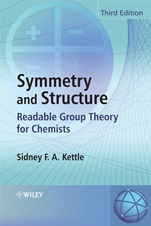
Symmetry and Structure: Readable Group Theory for Chemists
ISBN 9780470060391
Autor: Sidney F. A. Kettle
Wydawca: Wiley
Dostępność: 3-6 tygodni
Cena: 904,05 zł
Przed złożeniem zamówienia prosimy o kontakt mailowy celem potwierdzenia ceny.
ISBN13: |
9780470060391 |
ISBN10: |
0470060395 |
Autor: |
Sidney F. A. Kettle |
Oprawa: |
Hardback |
Rok Wydania: |
2007-10-26 |
Numer Wydania: |
3rd Edition |
Ilość stron: |
436 |
Wymiary: |
250x175 |
Tematy: |
PN |
The Third Edition of Symmetry and Structure: Readable Group Theory for Chemists builds on the foundation of the second edition presenting all aspects of group theory relevant to chemists. By using a diagrammatical approach and demonstrating the physical principles involved in understanding group theory the book provides a non–mathematical, yet thorough, treatment of this important topic.
This new edition has been fully revised and updated to enhance its accessibility. It focuses on the applications and concepts of group theory, rather than the detailed mathematics associated with the subject. The mathematical appendix has been written at an accessible level and character tables have been given a pictorial interpretation in order to offer a deeper insight into the nature of irreducible representations.
pictorial representation of character tables
large number of diagrams and tables for ease of reading and to enhance student understanding
problems and summaries included in each chapter
all the applications of group theory covered are applied to the water molecule initially to enable greater student understanding
important topics normally regarded as ‘advanced’, such as complex characters, spherical symmetry, double groups (odd–electron systems), spin–orbit coupling and space groups are presented in a readable but insightful manner
Spis treści:
Preface to Third Edition.
Preface to Second Edition.
Preface to First Edition.
1–Theories in conflict.
1.1 Introduction.
1.2 The ammonia molecule.
1.2.1 The atomic orbital model.
1.2.2 The hybrid orbital model.
1.2.3 The electron repulsion model.
1.2.4 The electron spin repulsion model.
1.2.5 Accurate calculations.
2–The symmetry of the water molecule.
2.1 Symmetry operations and symmetry elements.
2.2 Multipl
iers associated with symmetry operations.
2.3 Group multiplication tables.
2.4 Character tables.
2.5 Summary.
3– The electronic structure of the water molecule.
3.1 The orthonormal properties of irreducible representations.
3.2 The transformation properties of atomic orbitals in the water molecule.
3.3 A reducible representation.
3.4 Symmetry adapted combinations.
3.5 The bonding interactions in H2O and their angular dependence.
3.6 The molecular orbital energy level diagram for H2O.
3.7 Comparison with experiment.
3.8 The Walsh diagram for triatomic dihydrides.
3.9 Simple models for the bonding in H2O.
3.10 A rapprochement between simple and symmetry models.
3.11 Summary.
4–Vibrational spectra of the water molecule.
4.1 Vibrations of the water molecule: Part 1 (easy).
4.2 Vibrations of the water molecule: Part 2 (less easy!).
4.3 Product functions.
4.4 Direct products and quantum mechanical integrals.
4.5 Spectroscopic selection rules.
4.6 The vibrational spectroscopy of the water molecule.
4.7 Optical activity.
4.8 Summary.
5–The D2h character table and the electronic structures of ethene (ethylene) and diborane.
5.1 The symmetry of the ethene molecule.
5.2 The character and multiplication tables of the D2h group.
5.3 Direct products of groups.
5.4 Nodal patterns of the irreducible representations of the D2h group.
5.5 The symmetries of the carbon atomic orbitals in ethene.
5.6 The symmetries of the hydrogen 1s orbitals in ethene.
5.7 The projection operator method.
5.8 Bonding in the ethene molecule.
5.9 Bonding in the diborane molecule.
5.10 Comparison with other models.
5.11 Summary.
6–The electronic structure of bromine pentafluoride, BrF5.
6.1 Symmetry operations of the C4v group.
6.2 Problems in using the C4v group.
6.3 Orthonormality relationships.
6.4 The derivation of the C4v character table using the orthonor
mality theorems.
6.5 Nodal patterns of the irreducible representations of C4v.
6.6 The bonding in the BrF5 molecule.
6.7 Summary.
7–The electronic structure of the ammonia molecule.
7.1 The symmetry of the ammonia molecule.
7.2 Nodal patterns of the irreducible representations of C3v.
7.3 The bonding in the ammonia molecule.
7.4 Summary.
8–The electronic structures of some octahedral molecules.
8.1 The symmetry operations of the octahedron.
8.2 Nodal patterns of the irreducible representations of the Oh group.
8.3 The bonding in the SF6, molecule.
8.4 Octahedral transition metal complexes.
8.5 Summary.
9. Point groups and their relationships.
9.1 The determination of the point group of a molecule.
9.2 The relationships between point groups.
9.3 Correlation tables.
9.4 Summary.
10–Tetrahedral, icosahedral and spherical symmetries.
10.1 An overview.
10.2 The tetrahedron.
10.3 The icosahedron.
10.4 Spherical symmetry.
10.5 Linear molecules.
10.6 Summary.
11–Electron systems.
11.1 Square cyclobutadiene and the C4 point group.
11.2 Working with complex characters.
11.3 The p orbitals of cyclobutadiene.
11.4 The energies of the p orbitals of cyclobutadiene in the Hckel approximation.
11.5 Symmetry and chemical reactions.
11.6 Summary.
12 The group theory of electron spin.
12.1 The problem of electron spin.
12.2 More about the symmetry of product functions.
12.3 Configurations and terms.
12.4 The inclusion of electron spin.
12.5 Summary.
13–Space groups.
13.1 The crystal systems.
13.2 The Bravais lattices.
13.3 The crystallographic point groups.
13.4 The symmorphic space groups.
13.5 The non symmorphic space groups.
13.6 Unit cells.
13.7 Wigner–Seitz unit cells.
13.8 Summary.
14 Spectroscopic studies of crystals.
14.1 Translational invariance.
14.2 The factor group and unit cell group m
odels.
14.3 Examples of use of the factor and unit cell group models.
14.3.1 The ?(CO) spectra of crystalline (C6H6)Cr(CO)3.
14.3.2 The vibrational spectrum of a M(C&O)3 species crystallizing in the C2/c (C2h6) space group using the unit cell model.
14.4 Summary.
Appendix 1 Groups and classes: definitions and examples.
A1.1 Groups.
A1.2 Some examples of groups.
A1.3 The classes of a group.
A1.4 Class algebra.
Appendix 2 Matrix algebra and group theory.
A2.1 Matrix algebra and symmetry operations.
A2.2 Direct products.
Appendix 3 Character tables of the more important point groups.
Appendix 4 The fluorine group orbitals of p symmetry in SF6.
A4.1 Ligand group orbitals of complex ions.
APPENDIX 5 The Hermann–Mauguin notation.
APPENDIX 6 Non symmorphic relatives of the point group D2.
A6.1 The space group P21/c (C2h5).
Index.
Nota biograficzna:
Professor Sidney Kettle. Retired, formerly Professor of Inorganic Chemistry, University of East Anglia, UK.
Okładka tylna:
The Third Edition of Symmetry and Structure: Readable Group Theory for Chemists builds on the foundation of the second edition presenting all aspects of group theory relevant to chemists. By using a diagrammatical approach and demonstrating the physical principles involved in understanding group theory the book provides a non–mathematical, yet thorough, treatment of this important topic.
This new edition has been fully revised and updated to enhance its accessibility. It focuses on the applications and concepts of group theory, rather than the detailed mathematics associated with the subject. The mathematical appendix has been written at an accessible level and character tables have been given a pictorial interpretation in order to offer a deeper insight into the nature of irreducible representations.
pictorial representation of character tables
Koszyk
Książek w koszyku: 0 szt.
Wartość zakupów: 0,00 zł
Informacje


Kontakt
Gambit
Centrum Oprogramowania
i Szkoleń Sp. z o.o.
Al. Pokoju 29b/22-24
31-564 Kraków
Siedziba Księgarni
ul. Kordylewskiego 1
31-542 Kraków
+48 12 410 5991
+48 12 410 5987
+48 12 410 5989
Subskrypcje
Administratorem danych osobowych jest firma Gambit COiS Sp. z o.o. Na podany adres będzie wysyłany wyłącznie biuletyn informacyjny.
Autoryzacja płatności

Informacje na temat autoryzacji płatności poprzez PayU.

© Copyright 2012: GAMBIT COiS Sp. z o.o. Wszelkie prawa zastrzeżone.
Projekt i wykonanie: Alchemia Studio Reklamy