


Wydawcy
Katalog tematyczny
- Archeologia (6)
- Ekonomia, finanse, business (87)
- Historia (5)
- Medycyna (1123)
- Nauki o Ziemi i środowisku (299)
- Nauki ścisłe (2368)
- Nauki społeczne (35)
- Nauki techniczne (950)
- Budownictwo lądowe (39)
- Chemia przemysłowa (95)
- Elektronika i telekomunikacja (237)
- Energetyka (134)
- Inne nauki stosowane (51)
- Inżynieria biochemiczna (13)
- Inżynieria transportu (68)
- Mechanika i materiały (222)
- Nauka o środowisku (14)
- Rolnictwo (16)
- Technika, ogólnie (61)
- Prawo (8)
- Publikacje informacyjne i interdyscyplinarne (36)
- Technika komputerowa (126)
- Zdrowie, relacje międzyludzkie i rozwój osobisty (2)





Informacje szczegółowe o książce
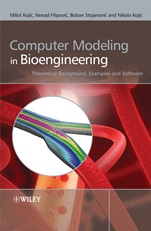
Computer Modeling in Bioengineering: Theoretical Background, Examples and Software
ISBN 9780470060353
Autor: Miloš Kojić, Nenad Filipović, Boban Stojanović, Nikola Kojić
Wydawca: Wiley
Dostępność: 3-6 tygodni
Cena: 702,45 zł
Przed złożeniem zamówienia prosimy o kontakt mailowy celem potwierdzenia ceny.
ISBN13: |
9780470060353 |
ISBN10: |
0470060352 |
Autor: |
Miloš Kojić, Nenad Filipović, Boban Stojanović, Nikola Kojić |
Oprawa: |
Hardback |
Rok Wydania: |
2008-05-09 |
Ilość stron: |
466 |
Wymiary: |
253x175 |
Tematy: |
TCB |
Bioengineering is a broad–based engineering discipline that applies engineering principles and design to challenges in human health and medicine, dealing with bio–molecular and molecular processes, product design, sustainability and analysis of biological systems. Applications that benefit from bioengineering include medical devices, diagnostic equipment and biocompatible materials, amongst others.
Computer Modeling in Bioengineering offers a comprehensive reference for a large number of bioengineering topics, presenting important computer modeling problems and solutions for research and medical practice. Starting with basic theory and fundamentals, the book progresses to more advanced methods and applications, allowing the reader to become familiar with different topics to the desired extent. It includes unique and original topics alongside classical computational modeling methods, and each application is structured to explain the physiological background, phenomena that are to be modeled, the computational methods used in the model, and solutions of typical cases. The accompanying software contains over 80 examples, enabling the reader to study a topic using the theory and examples, then run the software to solve the same, or similar examples, varying the model parameters within a given range in order to investigate the problem at greater depth. Tutorials also guide the user in further exploring the modeled problem; these features promote easier learning and will help lecturers with presentations.
Computer Modeling in Bioengineering includes computational methods for modelling bones, tissues, muscles, cardiovascular components, thrombosis, cartilage, cells, cellular mechanotransduction, spider silk, and cancer nanotechnology as well as many other applications. It bridges the gap between engineering, biology and medicine, and will appeal not only to bioengineering students, lecturers and researchers, but also medical students and cl
inical researchers.
Spis treści:
Contributors.
Preface.
Part I: Theoretical Background of Computational Methods.
1. Notation – Matrices and Tensors.
2. Fundamentals of Continuum Mechanics.
3. Heat Transfer, Diffusion, Fluid Mechanics, and Fluid Flow through Porous Deformable Media.
Part II: Fundamentals of Computational Methods.
4. Isoparametric Formulation of Finite Elements.
5. Dynamic Finite Element Analysis.
6. Introduction to Nonlinear Finite Element Analysis.
7. Finite Element Modeling of Field Problems.
8. Discrete Particle Methods for Modeling of Solids and Fluids.
Part III: Computational Methods in Bioengineering.
9. Introduction to Bioengineering.
10. Bone Modeling.
11. Biological Soft Tissue.
12. Skeletal Muscles.
13. Blood Flow and Blood Vessels.
14. Modeling Mass Transport and Thrombosis in Arteries.
15. Cartilage Mechanics.
16. Cell Mechanics.
17. Extracellular Mechanotransduction: Modeling Ligand Concentration Dynamics in the Lateral Intercellular Space of Compressed Airway Epithelial Cells.
18. Spider Silk: Modeling Solvent Removal during Synthetic and Nephila clavipes Fiber Spinning.
19. Modeling in Cancer Nanotechnology.
Index.
Okładka tylna:
Bioengineering is a broad–based engineering discipline that applies engineering principles and design to challenges in human health and medicine, dealing with bio–molecular and molecular processes, product design, sustainability and analysis of biological systems. Applications that benefit from bioengineering include medical devices, diagnostic equipment and biocompatible materials, amongst others.
Computer Modeling in Bioengineering offers a comprehensive reference for a large number of bioengineering topics, presenting important computer modeling problems and solutions for research and medical practice. Starting with basic theory and fundamental
s, the book progresses to more advanced methods and applications, allowing the reader to become familiar with different topics to the desired extent. It includes unique and original topics alongside classical computational modeling methods, and each application is structured to explain the physiological background, phenomena that are to be modeled, the computational methods used in the model, and solutions of typical cases. The accompanying software contains over 80 examples, enabling the reader to study a topic using the theory and examples, then run the software to solve the same, or similar examples, varying the model parameters within a given range in order to investigate the problem at greater depth. Tutorials also guide the user in further exploring the modeled problem; these features promote easier learning and will help lecturers with presentations.
Computer Modeling in Bioengineering includes computational methods for modelling bones, tissues, muscles, cardiovascular components, thrombosis, cartilage, cells, cellular mechanotransduction, spider silk, and cancer nanotechnology as well as many other applications. It bridges the gap between engineering, biology and medicine, and will appeal not only to bioengineering students, lecturers and researchers, but also medical students and clinical researchers.
Koszyk
Książek w koszyku: 0 szt.
Wartość zakupów: 0,00 zł
Informacje


Kontakt
Gambit
Centrum Oprogramowania
i Szkoleń Sp. z o.o.
Al. Pokoju 29b/22-24
31-564 Kraków
Siedziba Księgarni
ul. Kordylewskiego 1
31-542 Kraków
+48 12 410 5991
+48 12 410 5987
+48 12 410 5989
Subskrypcje
Administratorem danych osobowych jest firma Gambit COiS Sp. z o.o. Na podany adres będzie wysyłany wyłącznie biuletyn informacyjny.
Autoryzacja płatności

Informacje na temat autoryzacji płatności poprzez PayU.

© Copyright 2012: GAMBIT COiS Sp. z o.o. Wszelkie prawa zastrzeżone.
Projekt i wykonanie: Alchemia Studio Reklamy