


Wydawcy
Katalog tematyczny
- Archeologia (109)
- Ekonomia, finanse, business (13704)
- Filozofia (1445)
- Historia (3040)
- Języki i językoznawstwo (2356)
- Lifestyle, hobby i rozrywka (475)
- Medycyna (9704)
- Nauki humanistyczne (4)
- Nauki o Ziemi i środowisku (2638)
- Nauki ścisłe (20412)
- Nauki społeczne (8486)
- Nauki techniczne (13450)
- Budownictwo lądowe (1045)
- Chemia przemysłowa (2258)
- Elektronika i telekomunikacja (3287)
- Energetyka (1122)
- Inne nauki stosowane (363)
- Inżynieria biochemiczna (507)
- Inżynieria transportu (232)
- Mechanika i materiały (3316)
- Nauka o środowisku (321)
- Rolnictwo (507)
- Technika, ogólnie (475)
- Prawo (1696)
- Publikacje informacyjne i interdyscyplinarne (1288)
- Religia i wierzenia (917)
- Technika komputerowa (4067)
- Zdrowie, relacje międzyludzkie i rozwój osobisty (657)





Informacje szczegółowe o książce
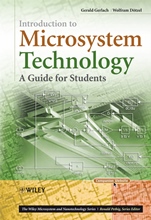
Introduction to Microsystem Technology: A Guide for Students
ISBN 9780470058619
Autor: Gerald Gerlach, Wolfram Dotzel, Dörte Müller
Wydawca: Wiley
Dostępność: 3-6 tygodni
Cena: 476,70 zł
Przed złożeniem zamówienia prosimy o kontakt mailowy celem potwierdzenia ceny.
ISBN13: |
9780470058619 |
ISBN10: |
0470058617 |
Autor: |
Gerald Gerlach, Wolfram Dotzel, Dörte Müller |
Oprawa: |
Hardback |
Rok Wydania: |
2008-03-14 |
Ilość stron: |
376 |
Wymiary: |
252x177 |
Tematy: |
TJ |
Over half a century after the discovery of the piezoresistive effect, microsystem technology has experienced considerable developments. Expanding the opportunities of microelectronics to non–electronic systems, its number of application fields continues to increase. Microsensors are one of the most important fields, used in medical applications and micromechanics. Microfluidic systems are also a significant area, most commonly used in ink–jet printer heads.
This textbook focuses on the essentials of microsystems technology, providing a knowledgeable grounding and a clear path through this well–established scientific dicipline. With a methodical, student–orientated approach, Introduction to Microsystem Technology covers the following:
microsystem materials (including silicon, polymers and thin films), and the scaling effects of going micro; fabrication techniques based on different material properties, descriptions of their limitations and functional and shape elements produced by these techniques; sensors and actuators based on elements such as mechanical, fluidic, and thermal (yaw rate sensor components are described); the influence of technology parameters on microsystem properties, examing, for example, the robust and safe operation of a microsystem.The book presents problems at the end of each chapter so that you may test your understanding of the key concepts (full solutions for these are given on an accompanying website). Practical examples are included also, as well as case studies that enable a better understanding of the technology as a whole. With its extensive treatment on the fundamentals of microsystems, this book also serves as a compendium for engineers and technicians working with the technology.
Preface.
List of Symbols.
List of Abbreviations.
1 Introduction.
1.1 What is a Microsystem?
1.2 Microelectronics and Microsystem Technology.
1.3 Areas of Application and Trends of Development.
1.4 Example: Yaw Rate Sensor.
2 Scaling and Similarity.
2.1 Scaling.
2.2 Similarity and Dimensionless Numbers.
3 Materials.
3.1 Overview.
3.2 Single Crystalline Silicon.
3.3 Glasses.
3.4 Polymers.
3.5 Thin Films.
3.6 Comparison of Material Characteristics.
4 Microfabrication.
4.1 Overview.
4.2 Cleanliness During Production.
4.3 Lithography.
4.4 Thin–film Formation.
4.5 Layer Patterning.
4.6 Anisotropic Wet Chemical Deep Etching.
4.7 Doping.
4.8 Bonding Techniques.
4.9 Insulation Techniques.
4.10 Surface Micromachining.
4.11 Near–surface Micromachining.
4.12 HARMST.
4.13 Miniaturized Classical Techniques.
4.14 Selection of Microtechnical Manufacturing Techniques.
5 Packaging.
5.1 Tasks and Requirements.
5.2 Functions of Packaging.
6 Function and Form Elements in Microsystem Technology.
6.1 Mechanical Elements.
6.2 Fluidic Elements.
6.3 Thermal Elements.
7 Sensors and Actuators.
7.1 Reversible and Parametric Transducers.
7.2 Transducers for Sensors and Actuators.
8 Design of Microsystems.
8.1 Design Methods and Tools.
8.2 Systems with Lumped Parameters.
8.3 Systems with Distributed Parameters.
9 Effect of Technological Processes on Microsystem Properties.
9.1 Parameter–based Microsystem Design.
9.2 Robust Microsystem Design.
10 The Future of Microsystems.
10.1 Status and Trends in Microsystem Technology.
10.2 Microoptical Applications.
10.3 Probe Tips.
10.4 RF Microsystems.
10.5 Actuators.
10.6 Microfluidic Systems.
10.7 Chemical, Biological and Medical Systems.
10.8 Energy Harvesting and Wireless Communications.
10.9 Micro Fuel Cells.
References.
Appendix A Physical Constants.
Appendix B Coordinate Transformation.
B.1 Elastic Coefficients.
B.2 Piezoresistive Coefficients.
References.
Appendix C Properties of Silicon Dioxide and Silicon Nitride Layers.
References.
Appendix D Nomenclature of Thin–film Processes.
Reference.
Appendix E Adhesion of Surface Micromechanical Structures.
E.1 Capillary Forces.
E.2 Critical Length of Cantilever Springs.
Reference.
Index.
Gerald Gerlach is currently a Professor for Solid–state Sensors at the Dresden University of Technology, Germany, a post he has held since 1996. His research interests include micromachined solid–state sensors (pressure, humidity, chemical) and sensor fabrication techniques, and he teaches courses in Microtechnology and Sensors. He has also held positions as a Researcher at different German companies making micromachined pressure sensors for biomedical applications, and is active in the sensor and measuring technology fields, having been Chairman of the German Association of University Professors in Measuring Technology (AHMT) and Vice–President of the German Society for Measurement and Control (GMA) since 2002. He has co–authored the German version of this book Einführung in die Mikrosystemtechnik (Hanser, 2006) and has contributed chapters to the book Functional Elements in Precision Engineering (Hanser) and Fabrication in Precision Engineering and Microtechnology (Hanser, 1995). He has also written over 250 journal and conference papers, and holds more than 35 patents.
Wolfram Dötzel is currently Professor for Microsystems and Precision Engineering at Chemnitz University of Technology, also holding the position of Vice–President for Research at the university. His main research fields are in the modelling, design and simulation of micromechanical components, characterization and testing of micromechanical components by experimental methods, and adaptation of methods and principles of precision engineering for microsystems. He teaches courses in Microsystems, reliability and the design of devices and has previously co–authored Einführung in die Mikrosystemtechnik (Hanser, 2006) with Gerald Gerlach. He has also authored a chapter in the book Manual of Data Acquisition (Verlag Technik, 1984), more than 130 publications in journals and conference proceedings on micromechanical and precision engineering components as well as modelling, simulation, and characterization, and holds 8 patents.
Koszyk
Książek w koszyku: 0 szt.
Wartość zakupów: 0,00 zł
Informacje


Kontakt
Gambit
Centrum Oprogramowania
i Szkoleń Sp. z o.o.
Al. Pokoju 29b/22-24
31-564 Kraków
Siedziba Księgarni
ul. Kordylewskiego 1
31-542 Kraków
+48 12 410 5991
+48 12 410 5987
+48 12 410 5989
Subskrypcje
Administratorem danych osobowych jest firma Gambit COiS Sp. z o.o. Na podany adres będzie wysyłany wyłącznie biuletyn informacyjny.
Autoryzacja płatności

Informacje na temat autoryzacji płatności poprzez PayU.

© Copyright 2012: GAMBIT COiS Sp. z o.o. Wszelkie prawa zastrzeżone.
Projekt i wykonanie: Alchemia Studio Reklamy