


Wydawcy
Katalog tematyczny
- Archeologia (109)
- Ekonomia, finanse, business (13704)
- Filozofia (1445)
- Historia (3040)
- Języki i językoznawstwo (2356)
- Lifestyle, hobby i rozrywka (475)
- Medycyna (9704)
- Nauki humanistyczne (4)
- Nauki o Ziemi i środowisku (2638)
- Nauki ścisłe (20412)
- Nauki społeczne (8486)
- Edukacja (229)
- Kryminologia, opieka spełeczna (284)
- Obronność (10)
- Polityka (1389)
- Psychologia (777)
- Socjologia (410)
- Społeczeństwo i kultura (187)
- Nauki techniczne (13450)
- Prawo (1696)
- Publikacje informacyjne i interdyscyplinarne (1288)
- Religia i wierzenia (917)
- Technika komputerowa (4067)
- Zdrowie, relacje międzyludzkie i rozwój osobisty (657)





Informacje szczegółowe o książce
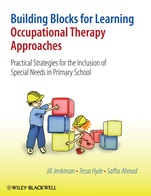
Building Blocks for Learning Occupational Therapy Approaches: Practical Strategies for the Inclusion of Special Needs in Primary School
ISBN 9780470058572
Autor: Jill Jenkinson, Tessa Hyde, Saffia Ahmad
Wydawca: Wiley
Dostępność: 3-6 tygodni
Cena: 369,60 zł
Przed złożeniem zamówienia prosimy o kontakt mailowy celem potwierdzenia ceny.
ISBN13: |
9780470058572 |
ISBN10: |
0470058579 |
Autor: |
Jill Jenkinson, Tessa Hyde, Saffia Ahmad |
Oprawa: |
Hardback |
Rok Wydania: |
2008-09-05 |
Ilość stron: |
450 |
Wymiary: |
286x217 |
Tematy: |
JDGS |
A highly practical resource for the primary years written by the authors of the successful handbook Occupational Therapy Approaches for Secondary Special Needs. The reader is guided through the process of:
Observing a child’s performance in classIdentifying areas of foundation skills requiring attentionPlanning programmes to develop foundation skillsImplementing classroom strategiesResourcing equipment for interventions
The early years of a child’s life are crucial for laying down the foundations necessary to establish the building blocks for learning. Occupational Therapists specialise in assessing and treating motor, sensory, perceptual, social and emotional skills to develop inclusion for all children within primary school.
Chapters include:
Medical conditions seen in the classroom – Attention Deficit / Hyperactivity Disorder, Autistic Spectrum Disorder, Cerebral Palsy, Developmental Co–ordination Disorder and some Physical DisabilitiesFoundation skills – gross motor co–ordination, fine motor control, sensory processing, visual perception, language and social/emotional well beingSubject areas – teacher observations of foundation skills are compared with curriculum requirementsPractical ideas and advice on activities and programmes to build skills e.g. handwriting, hand function, sensory processing, organisation, social and emotional well beingEstablishing activity clubs and managing transition from primary to secondary schoolEquipment and suppliers
The information, which is easily accessible and clearly laid out, will prove to be an invaluable resource for all primary school Teachers, SENCOs, Teaching Assistants and Occupational Therapists.
‘…this immensely practical manual provides a wealth of workable stra
tegies for enabling the busy teacher to individualise and differentiate learning resources to enable each child to maximise his potential.’
Lois M. Addy, Faculty of Health and Life Sciences, St John University, York
Spis treści:
Foreword.
Acknowledgements.
Introduction.
Online Resources.
FOUNDATION SKILLS.
Introduction to foundation skills.
FS 1 Introduction to sensory processing.
FS 2 Vestibular processing (movement and balance sense).
FS 3 Tactile sense and tactile processing.
FS 4 Proprioceptive processing/sense.
FS 5 Auditory processing.
FS 6 Visual processing.
FS 7 Introduction to gross motor coordination.
FS 8 Motor planning.
FS 9 Postural stability and balance.
FS 10 Spatial and body awareness.
FS 11 Bilateral integration.
FS 12 Midline crossing and laterality.
FS 13 Introduction to fine motor control.
FS 14 Visual motor integration.
FS 15 Vision and ocular motor control.
FS 16 Manual dexterity.
FS 17 Introduction to perception.
FS 18 Visual discrimination.
FS 19 Visual spatial relationships.
FS 20 Visual form constancy.
FS 21 Visual figure ground discrimination.
FS 22 Visual closure.
FS 23 Visual memory.
FS 24 Introduction to language.
FS 25 Attention and listening.
FS 26 Receptive language.
FS 27 Expressive language.
FS 28 Auditory memory.
FS 29 Organisation.
FS 30 Social and emotional aspects.
SUBJECT AREAS.
Introduction to subjects.
General behaviour.
Literacy.
Numeracy.
Science.
Art and Design.
Information Communication Technology.
Physical Education.
Subject area teacher observation summary chart.
Personalised profile for child.
MEDICAL CONDITIONS.
Introduction to medical conditions.
Attention deficit disorder/attention deficit hyperactivity disorder.
Autistic spectrum disorders, including Asperger′s syndrome.
Cerebral palsy.<
br>Developmental coordination disorder including dyspraxia.
Physical disabilities.
OCCUPATIONAL THERAPY APPROACHES.
Introduction to occupational therapy approaches.
OTA 1 Building firm foundations for spatial and body awareness.
OTA 2 Building firm foundations for left/right awareness.
General activities.
Activities to help with left/right discrimination on oneself.
Activities to help with left/right orientation on others.
Activities to help with left/right discrimination of objects.
Activities to help with left/right orientation and tracking when writing.
OTA 3 Building firm foundations for fine motor control.
Warm up for the upper limb.
Handwriting warm up.
Hand gym.
Ideas for using therapeutic putty.
Pencil aerobics.
Doodle games.
Hand/finger relaxation strategies.
OTA 4 Building firm foundations for handwriting.
Handwriting.
Development of pencil grasp.
Efficient and inefficient grasps.
Improving pencil grasp.
Three easy stages for teaching pencil grip.
Equipment to help develop pencil grasp and fluency.
Commerically available equipment.
Hand development for handwriting.
Ergonomics.
Table surface.
Texture of writing paper or surface.
Paper position.
Position in class.
Development of pencil skills.
Pre–writing skills, based around using your senses.
Multi–sensory handwriting approach.
Establishing correct pressure.
Consolidation for efficient handwriting.
Rules for writing tasks.
Activities to encourage self–evaluation of handwriting.
Copying from the board.
Specific advice for left–handed children.
OTA 5 Building firm foundations for alternative methods of recording.
Complexity of handwriting.
Low–tech alternatives.
Interactive whiteboards.
Digital cameras.
Word processing as an alternative.
ICT resources.
Suggested equipment.
Software.
Adaptations/strategies to try.
Furt
her resources.
OTA 6 Building firm foundations for dressing skills.
OTA 7 Building firm foundations for scissor development.
The 14 steps in scissor skill development.
Activities to develop pre–scissor skills.
Activities to help with scissor skills.
Equipment to help with scissor control.
OTA 8 Sensory strategies.
OTA 9 Self–organisation approaches.
OTA 10 Consolidating foundation skills through group activities.
Establishing groups.
Non–themed activity groups.
Themed activity groups.
OTA 10A Gross motor activities for pirate groups.
OTA 10B Fine motor activities for pirate groups.
OTA 11 Consolidating foundation skills for transition from primary to secondary school.
Appendices.
A 1 Ages and stages of development.
A 2 Alphabet ABC sentences.
A 3 Fine motor circuit score sheet.
A 4 Handwriting self–evaluation checklist.
A 5 Handwriting programmes and fine motor resources.
A 6 Information communication technology checklist.
A 7 Movement programmes and gross motor resources.
A 8 Individual child profile.
A 9 Resources for developing social, emotional and behavioural skills.
A 10 Teacherâ s checklist for visual signs.
A 11 Thinking skills.
A 12 Twelve rules of legibility.
A 13 Visual perception resources.
A 14 Work system
Equipment Resources.
Suppliers′ Addresses.
Useful Addresses.
Further Reading.
Glossary.
Index.
Okładka tylna:
A highly practical resource for the primary years written by the authors of the successful handbook Occupational Therapy Approaches for Secondary Special Needs. The reader is guided through the process of:
Observing a child’s performance in classIdentifying areas of foundation skills requiring attentionPlanning programmes to develop foundation skillsImplementing classroom strategies
Resourcing equipment for interventions
The early years of a child’s life are crucial for laying down the foundations necessary to establish the building blocks for learning. Occupational Therapists specialise in assessing and treating motor, sensory, perceptual, social and emotional skills to develop inclusion for all children within primary school.
Chapters include:
Medical conditions seen in the classroom – Attention Deficit / Hyperactivity Disorder, Autistic Spectrum Disorder, Cerebral Palsy, Developmental Co–ordination Disorder and some Physical DisabilitiesFoundation skills – gross motor co–ordination, fine motor control, sensory processing, visual perception, language and social/emotional well beingSubject areas – teacher observations of foundation skills are compared with curriculum requirementsPractical ideas and advice on activities and programmes to build skills e.g. handwriting, hand function, sensory processing, organisation, social and emotional well beingEstablishing activity clubs and managing transition from primary to secondary schoolEquipment and suppliers
The information, which is easily accessible and clearly laid out, will prove to be an invaluable resource for all primary school Teachers, SENCOs, Teaching Assistants and Occupational Therapists.
‘…this immensely practical manual provides a wealth of workable strategies for enabling the busy teacher to individualise and differentiate learning resources to enable each child to maximise his potential.’
Lois M. Addy, Faculty of Health and Life Sciences, St John University, York
Koszyk
Książek w koszyku: 0 szt.
Wartość zakupów: 0,00 zł
Informacje


Kontakt
Gambit
Centrum Oprogramowania
i Szkoleń Sp. z o.o.
Al. Pokoju 29b/22-24
31-564 Kraków
Siedziba Księgarni
ul. Kordylewskiego 1
31-542 Kraków
+48 12 410 5991
+48 12 410 5987
+48 12 410 5989
Subskrypcje
Administratorem danych osobowych jest firma Gambit COiS Sp. z o.o. Na podany adres będzie wysyłany wyłącznie biuletyn informacyjny.
Autoryzacja płatności

Informacje na temat autoryzacji płatności poprzez PayU.

© Copyright 2012: GAMBIT COiS Sp. z o.o. Wszelkie prawa zastrzeżone.
Projekt i wykonanie: Alchemia Studio Reklamy