


Wydawcy
Katalog tematyczny
- Archeologia (109)
- Ekonomia, finanse, business (13704)
- Filozofia (1445)
- Historia (3040)
- Języki i językoznawstwo (2356)
- Lifestyle, hobby i rozrywka (475)
- Medycyna (9704)
- Chirurgia (272)
- Inne gałęzie medycyny (1871)
- Medycyna kliniczna (4187)
- Medycyna niekonwencjonalna (14)
- Medycyna przedkliniczna (269)
- Medycyna, ogólnie (1740)
- Medyczne służby pomocnicze (745)
- Studia medyczne (16)
- Weterynaria (548)
- Nauki humanistyczne (4)
- Nauki o Ziemi i środowisku (2638)
- Nauki ścisłe (20412)
- Nauki społeczne (8486)
- Nauki techniczne (13450)
- Prawo (1696)
- Publikacje informacyjne i interdyscyplinarne (1288)
- Religia i wierzenia (917)
- Technika komputerowa (4067)
- Zdrowie, relacje międzyludzkie i rozwój osobisty (657)





Informacje szczegółowe o książce
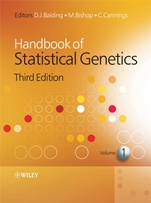
Handbook of Statistical Genetics
ISBN 9780470058305
Autor: David J. Balding, Martin Bishop, Chris Cannings
Wydawca: Wiley
Dostępność: 3-6 tygodni
Cena: 1 546,65 zł
Przed złożeniem zamówienia prosimy o kontakt mailowy celem potwierdzenia ceny.
ISBN13: |
9780470058305 |
ISBN10: |
0470058307 |
Autor: |
David J. Balding, Martin Bishop, Chris Cannings |
Oprawa: |
Hardback |
Rok Wydania: |
2007-08-24 |
Numer Wydania: |
3rd Edition |
Ilość stron: |
1616 |
Wymiary: |
253x195 |
Tematy: |
MFN |
The Handbook for Statistical Genetics is widely regarded as the reference work in the field. However, the field has developed considerably over the past three years. In particular the modeling of genetic networks has advanced considerably via the evolution of microarray analysis. As a consequence the 3rd edition of the handbook contains a much expanded section on Network Modeling, including 5 new chapters covering metabolic networks, graphical modeling and inference and simulation of pedigrees and genealogies. Other chapters new to the 3rd edition include Human Population Genetics, Genome–wide Association Studies, Family–based Association Studies, Pharmacogenetics, Epigenetics, Ethic and Insurance.
As with the second Edition, the Handbook includes a glossary of terms, acronyms and abbreviations, and features extensive cross–referencing between the chapters, tying the different areas together. With heavy use of up–to–date examples, real–life case studies and references to web–based resources, this continues to be must–have reference in a vital area of research.
Edited by the leading international authorities in the field.
David Balding – Department of Epidemiology & Public Health, Imperial College
An advisor for our Probability & Statistics series, Professor Balding is also a previous Wiley author, having written Weight–of–Evidence for Forensic DNA Profiles, as well as having edited the two previous editions of HSG. With over 20 years teaching experience, he’s also had dozens of articles published in numerous international journals.
Martin Bishop – Head of the Bioinformatics Division at the HGMP Resource Centre
As well as the first two editions of HSG, Dr Bishop has edited a number of introductory books on the application of informatics to molecular biology and genetics. He is the Associate Editor of the journal Bioinf
ormatics and Managing Editor of Briefings in Bioinformatics.
Chris Cannings – Division of Genomic Medicine, University of Sheffield
With over 40 years teaching in the area, Professor Cannings has published over 100 papers and is on the editorial board of many related journals. Co–editor of the two previous editions of HSG, he also authored a book on this topic.
Spis treści:
Volume 1.
List of Contributors.
Editor’s Preface to the Third Edition.
Glossary of Terms.
Abbreviations and Acronyms.
Part 1 GENOMES.
1 Chromosome Maps.
T.P. Speed and H. Zhao.
1.1 Introduction.
1.2 Genetic Maps.
1.3 Physical Maps.
1.4 Radiation Hybrid Mapping.
1.5 Other Physical Mapping Approaches.
1.6 Gene Maps.
Acknowledgments.
References.
2 Statistical Significance in Biological Sequence Comparison.
W.R. Pearson and T.C. Wood.
2.1 Introduction.
2.2 Statistical Significance and Biological Significance.
2.3 Estimating Statistical Significance for Local Similarity Searches.
2.4 Summary: Exploiting Statistical Estimates.
Acknowledgments.
References.
3 Bayesian Methods in Biological Sequence Analysis.
Jun S. Liu and T. Logvinenko.
3.1 Introduction.
3.2 Overview of the Bayesian Methodology.
3.3 Hidden Markov Model: A General Introduction.
3.4 Pairwise Alignment of Biological Sequences.
3.5 Multiple Sequence Alignment.
3.6 Finding Recurring Patterns in Biological Sequences.
3.7 Joint Analysis of Sequence Motifs and Expression Microarrays.
3.8 Summary.
Acknowledgments.
Appendix A: Markov Chain Monte Carlo Methods.
References.
4 Statistical Approaches in Eukaryotic Gene Prediction.
V. Solovyev.
4.1 Structural Organization and Expression of Eukaryotic Genes.
4.2 Methods of Functional Signal Recognition.
4.3 Linear Discriminant Analysis.
4.4 Predi
ction of Donor and Acceptor Splice Junctions.
4.5 Identification of Promoter Regions in Human DNA.
4.6 Recognition of PolyA Sites.
4.7 Characteristics for Recognition of 3–Processing Sites.
4.8 Identification of Multiple Genes in Genomic Sequences.
4.9 Discriminative and Probabilistic Approaches for Multiple Gene Prediction.
4.10 Internal Exon Recognition.
4.11 Recognition of Flanking Exons.
4.12 Performance of Gene Identification Programs
4.13 Using Protein Similarity Information to Improve Gene Prediction.
4.14 Genome Annotation Assessment Project (EGASP).
4.15 Annotation of Sequences from Genome Sequencing Projects.
4.16 Characteristics and Computational Identification of miRNA genes.
4.17 Prediction of microRNA Targets.
4.18 Internet Resources for Gene Finding and Functional Site Prediction.
Acknowledgments.
References.
5 Comparative Genomics.
J. Dicks and G. Savva.
5.1 Introduction.
5.2 Homology.
5.3 Genomic Mutation.
5.4 Comparative Maps.
5.5 Gene Order and Content.
5.6 Whole Genome Sequences.
5.7 Conclusions and Future Research.
Acknowledgments.
References.
Part 2 BEYOND THE GENOME.
6 Analysis of Microarray Gene Expression Data.
W. Huber, A. von Heydebreck and M. Vingron.
6.1 Introduction.
6.2 Data Visualization and Quality Control.
6.3 Error Models, Calibration and Measures of Differential Expression.
6.4 Identification of Differentially Expressed Genes.
6.5 Pattern Discovery.
6.6 Conclusions.
Acknowledgments.
References.
7 Statistical Inference for Microarray Studies.
S.B. Pounds, C. Cheng and A. Onar.
7.1 Introduction.
7.2 Initial Data Processing.
7.3 Testing the Association of Phenotype with Expression.
7.4 Multiple Testing.
7.5 Annotation Analysis.
7.6 Validation Analysis.
7.7 Study Design and Sample Size.
7.8 Discussion.
Related Chapters.
References.<
br>8 Bayesian Methods for Microarray Data.
A. Lewin and S. Richardson.
8.1 Introduction.
8.2 Extracting Signal From Observed Intensities.
8.3 Differential Expression.
8.4 Clustering Gene Expression Profiles.
8.5 Multivariate Gene Selection Models.
Acknowledgments.
Related Chapters.
References.
9 Inferring Causal Associations between Genes and Disease via the Mapping of Expression Quantitative Trait Loci.
S.K. Sieberts and E.E. Schadt.
9.1 Introduction.
9.2 An Overview of Transcription as a Complex Process.
9.3 Human Versus Experimental Models.
9.4 Heritability of Expression Traits.
9.5 Joint eQTL Mapping.
9.6 Multilocus Models AND FDR.
9.7 eQTL and Clinical Trait Linkage Mapping to Infer Causal Associations.
9.8 Using eQTL Data to Reconstruct Coexpression Networks.
9.9 Using eQTL Data to Reconstruct Probabilistic Networks.
9.10 Conclusions.
9.11 Software.
References.
10 Protein Structure Prediction.
D.P. Klose and W.R. Taylor.
10.1 History.
10.2 Basic Structural Biology.
10.3 Protein Structure Prediction.
10.4 Model Evaluation.
10.5 Conclusions.
References.
11 Statistical Techniques in Metabolic Profiling.
M. De Iorio, T.M.D. Ebbels and D.A. Stephens.
11.1 Introduction.
11.2 Principal Components Analysis and Regression.
11.3 Partial Least Squares and Related Methods.
11.4 Clustering Procedures.
11.5 Neural Networks, Kernel Methods and Related Approaches.
11.6 Evolutionary Algorithms.
11.7 Conclusions.
Acknowledgments.
References.
Part 3 EVOLUTIONARY GENETICS.
12 Adaptive Molecular Evolution.
Z. Yang.
12.1 Introduction.
12.2 Markov Model of Codon Substitution.
12.3 Estimation of Synonymous (dS) and Nonsynonymous (dN) Substitution Rates Between Two Sequences.
12.4 Likelihood Calculation on a Phylogeny.
12.5 Detecting Adaptive Evol
Koszyk
Książek w koszyku: 0 szt.
Wartość zakupów: 0,00 zł
Informacje


Kontakt
Gambit
Centrum Oprogramowania
i Szkoleń Sp. z o.o.
Al. Pokoju 29b/22-24
31-564 Kraków
Siedziba Księgarni
ul. Kordylewskiego 1
31-542 Kraków
+48 12 410 5991
+48 12 410 5987
+48 12 410 5989
Subskrypcje
Administratorem danych osobowych jest firma Gambit COiS Sp. z o.o. Na podany adres będzie wysyłany wyłącznie biuletyn informacyjny.
Autoryzacja płatności

Informacje na temat autoryzacji płatności poprzez PayU.

© Copyright 2012: GAMBIT COiS Sp. z o.o. Wszelkie prawa zastrzeżone.
Projekt i wykonanie: Alchemia Studio Reklamy