


Wydawcy
Katalog tematyczny
- Archeologia (109)
- Ekonomia, finanse, business (13704)
- Filozofia (1445)
- Historia (3040)
- Języki i językoznawstwo (2356)
- Lifestyle, hobby i rozrywka (475)
- Medycyna (9704)
- Nauki humanistyczne (4)
- Nauki o Ziemi i środowisku (2638)
- Nauki ścisłe (20412)
- Nauki społeczne (8486)
- Nauki techniczne (13450)
- Budownictwo lądowe (1045)
- Chemia przemysłowa (2258)
- Elektronika i telekomunikacja (3287)
- Energetyka (1122)
- Inne nauki stosowane (363)
- Inżynieria biochemiczna (507)
- Inżynieria transportu (232)
- Mechanika i materiały (3316)
- Nauka o środowisku (321)
- Rolnictwo (507)
- Technika, ogólnie (475)
- Prawo (1696)
- Publikacje informacyjne i interdyscyplinarne (1288)
- Religia i wierzenia (917)
- Technika komputerowa (4067)
- Zdrowie, relacje międzyludzkie i rozwój osobisty (657)





Informacje szczegółowe o książce
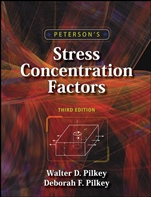
Petersons Stress Concentration Factors
ISBN 9780470048245
Autor: Walter D. Pilkey, Deborah F. Pilkey
Wydawca: Wiley
Dostępność: 3-6 tygodni
Cena: 854,70 zł
Przed złożeniem zamówienia prosimy o kontakt mailowy celem potwierdzenia ceny.
ISBN13: |
9780470048245 |
ISBN10: |
0470048247 |
Autor: |
Walter D. Pilkey, Deborah F. Pilkey |
Oprawa: |
Hardback |
Rok Wydania: |
2008-02-01 |
Numer Wydania: |
3rd Edition |
Ilość stron: |
560 |
Wymiary: |
253x187 |
Tematy: |
TG |
The definitive guide to stress concentration, newly revised and updated
Stress concentration factors are used in the design of mechanical or engineering structures and machinery and have a tremendous impact on design of virtually every product or structure subject to environmental or use–related stress—from nuclear equipment, deep–sea vehicles, and aircraft to space vehicles, underground tunnels, and turbines. But the sheer volume of stress concentration data is now so large that analysts and designers may have difficulty integrating this information efficiently into design applications.
Now in its third edition, Peterson′s Stress Concentration Factors establishes and maintains a system of data classification for all of the applications of stress and strain analysis and expedites their synthesis into CAD applications. This new edition of the book has been substantially revised and completely updated and presents stress concentration factors both graphically and with formulas. Structures and shapes of interest can be easily accessed via an illustrated table of contents that permits identification based on the geometry and loading of the location of a factor.
This updated Third Edition features:
Completely updated and revised coverage of the most recent stress concentration factors, including geometric discontinuities in tubes and countersunk holes in plates
The how–to′s of optimizing a shape to circumvent stress concentration problems and to achieve a well–balanced design of structures and machines that will result in reduced costs, lighter products, and improved performance
New guidelines for the likely stress decay away from the point of the stress concentration for various holes and notches
New methods for analyzing and calculating the stress concentration factors based on the length of elements and on the location of loading on components
More co
mprehensive and up–to–date than previous editions, Peterson′s Stress Concentration Factors is an essential addition to the professional libraries of engineers and designers working in the automotive, aerospace, and nuclear industries; for civil and mechanical engineers; and for students and researchers in these fields.
Spis treści:
Index to the Stress Concentration Factors.
Preface for the Third Edition.
Preface for the Second Edition.
1. Definitions and Design Relations.
1.1 Notation.
1.2 Stress Concentration.
1.3 Stress Concentration as a Two–Dimensional Problem.
1.4 Stress Concentration as a Three–Dimensional Problem.
1.5 Plane and Axisymmetric Problems.
1.6 Local and Nonlocal Stress Concentration.
1.7 Multiple Stress Concentration.
1.8 Theories of Strength and Failure.
1.9 Notch Sensitivity.
1.10 Design Relations For Static Stress.
1.11 Design Relations for Alternating Stress.
1.12 Design Relations for Combined Alternating and Static Stresses.
1.13 Limited Number of Cycles of Alternating Stress.
1.14 Stress Concentration Factors and Stress Intensity Factors.
References
2. Notches and Grooves.
2.1 Notation.
2.2 Stress Concentration Factors.
2.3 Notches in Tension.
2.4 Depressions in Tension.
2.5 Grooves in Tension.
2.6 Bending of Thin Beams with Notches.
2.7 Bending of Plates with Notches.
2.8 Bending of Solids with Grooves.
2.9 Direct Shear and Torsion.
2.10 Test Specimen Design for Maximum Kt for a Given r D or r H 76.
References.
Charts.
3. Shoulder Fillets.
3.1 Notation.
3.2 Stress Concentration Factors.
3.3 Tension (Axial Loading).
3.4 Bending.
3.5 Torsion.
3.6 Methods of Reducing Stress Concentration at a Shoulder.
References.
Charts.
4. Holes.
4.1 Notation.
4.2 Stress Concentration Factors.
4.3 Circular Holes with I
n–Plane Stresses.
4.4 Elliptical Holes in Tension.
4.5 Various Configurations with In–Plane Stresses.
4.6 Holes in Thick Elements.
4.7 Orthotropic Thin Members.
4.8 Bending.
4.9 Shear and Torsion.
5. Miscellaneous Design Elements.
5.1 Notation.
5.2 Shaft with Keyseat.
5.3 Splined Shaft in Torsion.
5.4 Gear Teeth.
5.5 Press– or Shrink–Fitted Members.
5.6 Bolt and Nut.
5.7 Bolt Head,Turbine–Blade, orCompressor–Blade Fastening (T–Head).
5.8 Lug Joint.
5.8.1 Lugs with h d 0.5.
5.8.2 Lugs with h d 0.5.
5.9 Curved Bar.
5.10 Helical Spring.
5.10.1 Round or Square Wire Compression or Tension Spring.
5.10.2 Rectangular Wire Compression or Tension Spring.
5.10.3 Helical Torsion Spring.
5.11 Crankshaft.
5.12 Crane Hook.
5.13 U–Shaped Member.
5.14 Angle and Box Sections.
5.15 Cylindrical Pressure Vessel with Torispherical Ends.
5.16 Tubular Joints.
References.
Charts.
6. Stress Concentration Analysis and Design.
6.1 Computational Methods.
6.2 Finite Element Analysis.
6.3 Design Sensitivity Analysis.
6.4 Design Modification.
Index.
Nota biograficzna:
Walter D. Pilkey is the Frederick Morse Professor in the Department of Mechanical and Aerospace Engineering at the University of Virginia and a leading authority in the areas of stress and strain in mechanical and civil engineering. He is the author of Formulas for Stress, Strain, and Structural Matrices, Second Edition and Analysis and Design of Elastic Beams, also available from Wiley.
Deborah F. Pilkey is an Engineer/Scientist in the Loads & Environments Department at ATK Launch Systems in Utah. She has been involved with structures technology, loads, dynamics, and production stress analysis of the Space Shuttle′s main engines and their solid rocket motors.
Ok&#
322;adka tylna:
The definitive guide to stress concentration, newly revised and updated
Stress concentration factors are used in the design of mechanical or engineering structures and machinery and have a tremendous impact on design of virtually every product or structure subject to environmental or use–related stress—from nuclear equipment, deep–sea vehicles, and aircraft to space vehicles, underground tunnels, and turbines. But the sheer volume of stress concentration data is now so large that analysts and designers may have difficulty integrating this information efficiently into design applications.
Now in its third edition, Peterson′s Stress Concentration Factors establishes and maintains a system of data classification for all of the applications of stress and strain analysis and expedites their synthesis into CAD applications. This new edition of the book has been substantially revised and completely updated and presents stress concentration factors both graphically and with formulas. Structures and shapes of interest can be easily accessed via an illustrated table of contents that permits identification based on the geometry and loading of the location of a factor.
This updated Third Edition features:
Completely updated and revised coverage of the most recent stress concentration factors, including geometric discontinuities in tubes and countersunk holes in plates
The how–to′s of optimizing a shape to circumvent stress concentration problems and to achieve a well–balanced design of structures and machines that will result in reduced costs, lighter products, and improved performance
New guidelines for the likely stress decay away from the point of the stress concentration for various holes and notches
New methods for analyzing and calculating the stress concentration factors based on the length of elements and on the location of loading on components
Koszyk
Książek w koszyku: 0 szt.
Wartość zakupów: 0,00 zł
Informacje


Kontakt
Gambit
Centrum Oprogramowania
i Szkoleń Sp. z o.o.
Al. Pokoju 29b/22-24
31-564 Kraków
Siedziba Księgarni
ul. Kordylewskiego 1
31-542 Kraków
+48 12 410 5991
+48 12 410 5987
+48 12 410 5989
Subskrypcje
Administratorem danych osobowych jest firma Gambit COiS Sp. z o.o. Na podany adres będzie wysyłany wyłącznie biuletyn informacyjny.
Autoryzacja płatności

Informacje na temat autoryzacji płatności poprzez PayU.

© Copyright 2012: GAMBIT COiS Sp. z o.o. Wszelkie prawa zastrzeżone.
Projekt i wykonanie: Alchemia Studio Reklamy