


Wydawcy
Katalog tematyczny
- Archeologia (109)
- Ekonomia, finanse, business (13704)
- Filozofia (1445)
- Historia (3040)
- Języki i językoznawstwo (2356)
- Lifestyle, hobby i rozrywka (475)
- Medycyna (9704)
- Nauki humanistyczne (4)
- Nauki o Ziemi i środowisku (2638)
- Nauki ścisłe (20412)
- Nauki społeczne (8486)
- Nauki techniczne (13450)
- Prawo (1696)
- Publikacje informacyjne i interdyscyplinarne (1288)
- Religia i wierzenia (917)
- Technika komputerowa (4067)
- Zdrowie, relacje międzyludzkie i rozwój osobisty (657)





Informacje szczegółowe o książce
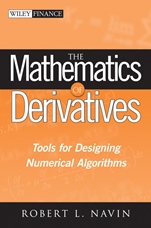
The Mathematics of Derivatives: Tools for Designing Numerical Algorithms
ISBN 9780470047255
Autor: Robert L. Navin
Wydawca: Wiley
Dostępność: 3-6 tygodni
Cena: 277,20 zł
Przed złożeniem zamówienia prosimy o kontakt mailowy celem potwierdzenia ceny.
ISBN13: |
9780470047255 |
ISBN10: |
0470047259 |
Autor: |
Robert L. Navin |
Oprawa: |
Hardback |
Rok Wydania: |
2007-01-05 |
Ilość stron: |
208 |
Wymiary: |
234x153 |
Tematy: |
KF |
Praise for The Mathematics of Derivatives
"The Mathematics of Derivatives provides a concise pedagogical discussion of both fundamental and very recent developments in mathematical finance, and is particularly well suited for readers with a science or engineering background. It is written from the point of view of a physicist focused on providing an understanding of the methodology and the assumptions behind derivative pricing. Navin has a unique and elegant viewpoint, and will help mathematically sophisticated readers rapidly get up to speed in the latest Wall Street financial innovations."
—David Montano, Managing Director JPMorgan Securities
"A stylish and practical introduction to the key concepts in financial mathematics, this book tackles key fundamentals in the subject in an intuitive and refreshing manner whilst also providing detailed analytical and numerical schema for solving interesting derivatives pricing problems. If Richard Feynman wrote an introduction to financial mathematics, it might look similar. The problem and solution sets are first rate."
—Barry Ryan, Partner Bhramavira Capital Partners, London
"This is a great book for anyone beginning (or contemplating), a career in financial research or analytic programming. Navin dissects a huge, complex topic into a series of discrete, concise, accessible lectures that combine the required mathematical theory with relevant applications to real–world markets. I wish this book was around when I started in finance. It would have saved me a lot of time and aggravation."
—Larry Magargal
Spis treści:
Preface.
Acknowledgments.
PART I The Models.
CHAPTER 1. Introduction to the Techniques of Derivative Modeling.
1.1 Introduction.
1.2 Models.
1.2.1 What Is a Derivative?
1.2.2 What Is a Model?
1.2.3 Two Initial Methods for Modeling Derivatives.
1.2.4 Price Processes.
1.2.5 The Archetypal Security Process: Normal Returns.1.2.6 Book Outline.
CHAPTER 2. Preliminary Mathematical Tools.
2.1 Probability Distributions.
2.2 n–Dimensional Jacobians and n–Form Algebra.
2.3 Functional Analysis and Fourier Transforms.
2.4 Normal (Central) Limit Theorem.
2.5 Random Walks.
2.6 Correlation.
2.7 Functions of Two/More Variables: Path Integrals.
2.8 Differential Forms.
CHAPTER 3. Stochastic Calculus.
3.1 Wiener Process.
3.2 Ito’s Lemma.
3.3 Variable Changes to Get the Martingale.
3.4 Other Processes: Multivariable Correlations.
CHAPTER 4. Applications of Stochastic Calculus to Finance.
4.1 Risk Premium Derivation.
4.2 Analytic Formula for the Expected Payoff of a European Option.
CHAPTER 5. From Stochastic Processes Formalism to Differential Equation Formalism.
5.1 Backward and Forward Kolmogorov Equations.
5.2 Derivation of Black–Scholes Equation, Risk–Neutral Pricing.
5.3 Risks and Trading Strategies.
CHAPTER 6. Understanding the Black–Scholes Equation.
6.1 Black–Scholes Equation: A Type of Backward Kolmogorov Equation.
6.1.1 Forward Price.
6.2 Black–Scholes Equation: Risk–Neutral Pricing.
6.3 Black–Scholes Equation: Relation to Risk Premium Definition.
6.4 Black–Scholes Equation Applies to Currency Options: Hidden Symmetry 1.
6.5 Black–Scholes Equation in Martingale Variables: Hidden Symmetry 2.
6.6 Black–Scholes Equation with Stock as a ‘‘Derivative’’ of Option Price: Hidden Symmetry 3.
CHAPTER 7. Interest Rate Hedging.
7.1 Euler’s Relation.
7.2 Interest Rate Dependence.
7.3 Term–Structured Rates Hedging: Duration Bucketing.
7.4 Algorithm for Deciding Which Hedging Instruments to Use.
CHAPTER 8. Interest Rate Derivatives: HJM Models.
8.1 Hull–White Model Derivation.
8.1.1 Process and Pricing Equation.
8.1.2 Analytic Zero–Coupon Bond Valuation.
8.1.3 Analytic Bond Call Option.
8.1.4 Calibration.
8.2 Arbitrage–Free Pricing for Interest Rate Derivatives: HJM.
CHAPTER 9. Differential Equations, Boundary Conditions, and Solutions.
9.1 Boundary Conditions and Unique Solutions to Differential Equations.
9.2 Solving the Black–Scholes or Heat Equation Analytically.
9.2.1 Green’s Functions.
9.2.2 Separation of Variables.
9.3 Solving the Black–Scholes Equation Numerically.
9.3.1 Finite Difference Methods: Explicit/Implicit Methods, Variable Choice.
9.3.2 Gaussian Kurtosis (and Skew = 0), Faster Convergence.
9.3.3 Call/Put Options:Grid Point Shift Factor for Higher Accuracy.
9.3.4 Dividends on the Underlying Equity.
9.3.5 American Exercise.
9.3.6 2–D Models, Correlation and Variable Changes.
CHAPTER 10. Credit Spreads.
10.1 Credit Default Swaps (CDS) and the Continuous CDS Curve.
10.2 Valuing Bonds Using the Continuous CDS Curve.
10.3 Equations of Motion for Bonds and Credit Default Swaps.
CHAPTER 11. Specific Models.
11.1 Stochastic Rates and Default.
11.2 Convertible Bonds.
11.3 Index Options versus Single Name Options: Trading Equity Correlation.
11.4 Max of n Stocks: Trading Equity Correlation.
11.5 Collateralized Debt Obligations (CDOs): Trading Credit Correlation.
11.5.1 CDO Backed by Three Bonds.
11.5.2 CDO Backed by an Arbitrary Number of Bonds.
PART II Exercises and Solutions.
CHAPTER 12. Exercises.
CHAPTER 13. Solutions.
APPENDIX A: Central Limit Theorem–Plausibility Argument.
APPENDIX B: Solving for the Green’s Function of the Black–Scholes Equation.
APPENDIX C: Expanding the von Neumann Stability Mode for the Discretized Black–Scholes Equation.
APPENDIX D: Multiple Bond Survival Probabilities Given Correlated Default Probability Rates.
References.
Index.
Nota biograficzna:
ROBERT L. NAVIN founded Real Time Risk Sy
stems LLC in July 2004. Prior to this, he helped set up a hedge fund in 2002 that grew to more than $1 billion in assets under management during its first year. Navin was previously at Highbridge Capital Management as head of quantitative analysis from 1997 to 2002. He graduated with an MS and a PhD in theoretical particle physics from the California Institute of Technology in 1993.
Okładka tylna:
Praise for The Mathematics of Derivatives
"The Mathematics of Derivatives provides a concise pedagogical discussion of both fundamental and very recent developments in mathematical finance, and is particularly well suited for readers with a science or engineering background. It is written from the point of view of a physicist focused on providing an understanding of the methodology and the assumptions behind derivative pricing. Navin has a unique and elegant viewpoint, and will help mathematically sophisticated readers rapidly get up to speed in the latest Wall Street financial innovations."
—David Montano, Managing Director JPMorgan Securities
"A stylish and practical introduction to the key concepts in financial mathematics, this book tackles key fundamentals in the subject in an intuitive and refreshing manner whilst also providing detailed analytical and numerical schema for solving interesting derivatives pricing problems. If Richard Feynman wrote an introduction to financial mathematics, it might look similar. The problem and solution sets are first rate."
—Barry Ryan, Partner Bhramavira Capital Partners, London
"This is a great book for anyone beginning (or contemplating), a career in financial research or analytic programming. Navin dissects a huge, complex topic into a series of discrete, concise, accessible lectures that combine the required mathematical theory with relevant applications to real–world markets. I wish this book was around when I started in finance. It would have saved me a lot of time and
Koszyk
Książek w koszyku: 0 szt.
Wartość zakupów: 0,00 zł
Informacje


Kontakt
Gambit
Centrum Oprogramowania
i Szkoleń Sp. z o.o.
Al. Pokoju 29b/22-24
31-564 Kraków
Siedziba Księgarni
ul. Kordylewskiego 1
31-542 Kraków
+48 12 410 5991
+48 12 410 5987
+48 12 410 5989
Subskrypcje
Administratorem danych osobowych jest firma Gambit COiS Sp. z o.o. Na podany adres będzie wysyłany wyłącznie biuletyn informacyjny.
Autoryzacja płatności

Informacje na temat autoryzacji płatności poprzez PayU.

© Copyright 2012: GAMBIT COiS Sp. z o.o. Wszelkie prawa zastrzeżone.
Projekt i wykonanie: Alchemia Studio Reklamy