


Wydawcy
Katalog tematyczny
- Archeologia (94)
- Ekonomia, finanse, business (11664)
- Filozofia (1411)
- Historia (2972)
- Języki i językoznawstwo (2311)
- Lifestyle, hobby i rozrywka (411)
- Medycyna (5054)
- Nauki humanistyczne (2)
- Nauki o Ziemi i środowisku (1033)
- Nauki ścisłe (10004)
- Nauki społeczne (6049)
- Nauki techniczne (5313)
- Prawo (160)
- Publikacje informacyjne i interdyscyplinarne (706)
- Religia i wierzenia (900)
- Technika komputerowa (2101)
- Zdrowie, relacje międzyludzkie i rozwój osobisty (632)





Informacje szczegółowe o książce
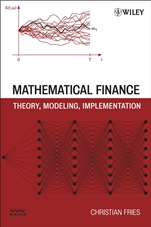
Mathematical Finance: Theory, Modeling, Implementation
ISBN 9780470047224
Autor: Christian Fries
Wydawca: Wiley
Dostępność: 3-6 tygodni
Cena: 784,35 zł
Przed złożeniem zamówienia prosimy o kontakt mailowy celem potwierdzenia ceny.
ISBN13: |
9780470047224 |
ISBN10: |
0470047224 |
Autor: |
Christian Fries |
Oprawa: |
Hardback |
Rok Wydania: |
2007-10-05 |
Ilość stron: |
544 |
Wymiary: |
239x167 |
Tematy: |
KF |
A balanced introduction to the theoretical foundations and real–world applications of mathematical finance
The ever–growing use of derivative products makes it essential for financial industry practitioners to have a solid understanding of derivative pricing. To cope with the growing complexity, narrowing margins, and shortening life–cycle of the individual derivative product, an efficient, yet modular, implementation of the pricing algorithms is necessary. Mathematical Finance is the first book to harmonize the theory, modeling, and implementation of today′s most prevalent pricing models under one convenient cover. Building a bridge from academia to practice, this self–contained text applies theoretical concepts to real–world examples and introduces state–of–the–art, object–oriented programming techniques that equip the reader with the conceptual and illustrative tools needed to understand and develop successful derivative pricing models.
Utilizing almost twenty years of academic and industry experience, the author discusses the mathematical concepts that are the foundation of commonly used derivative pricing models, and insightful Motivation and Interpretation sections for each concept are presented to further illustrate the relationship between theory and practice. In–depth coverage of the common characteristics found amongst successful pricing models are provided in addition to key techniques and tips for the construction of these models. The opportunity to interactively explore the book′s principal ideas and methodologies is made possible via a related Web site that features interactive Java experiments and exercises.
While a high standard of mathematical precision is retained, Mathematical Finance emphasizes practical motivations, interpretations, and results and is an excellent textbook for students in mathematical finance, computational finance, and derivat
ive pricing courses at the upper undergraduate or beginning graduate level. It also serves as a valuable reference for professionals in the banking, insurance, and asset management industries.
Spis treści:
1. Introduction.
1.1 Theory, Modeling and Implementation.
1.2 Interest Rate Models and Interest Rate Derivatives.
1.3 How to Read this Book.
1.3.1 Abridged Versions.
1.3.2 Special Sections.
1.3.3 Notation.
I: FOUNDATIONS.
2. Foundations.
2.1 Probability Theory.
2.2 Stochastic Processes.
2.3 Filtration.
2.4 Brownian Motion.
2.5 Wiener Measure, Canonical Setup.
2.6 Itô Calculus.
2.6.1 Itô Integral.
2.6.2 Itô Process.
2.6.3 Itô Lemma and Product Rule.
2.7 Brownian Motion with Instantaneous Correlation.
2.8 Martingales.
2.8.1 Martingale Representation Theorem.
2.9 Change of Measure (Girsanov, Cameron, Martin).
2.10 Stochastic Integration.
2.11 Partial Differential Equations (PDE).
2.11.1 Feynman–Kac Theorem .
2.12 List of Symbols.
3. Replication.
3.1 Replication Strategies.
3.1.1 Introduction.
3.1.2 Replication in a discrete Model.
3.2 Foundations: Equivalent Martingale Measure.
3.2.1 Challenge and Solution Outline.
3.2.2 Steps towards the Universal Pricing Theorem.
3.3 Excursus: Relative Prices and Risk Neutral Measures.
3.3.1 Why relative prices?
3.3.2 Risk Neutral Measure.
II: FIRST APPLICATIONS.
4. Pricing of a European Stock Option under the Black–Scholes Model.
5. Excursus: The Density of the Underlying of a European Call Option.
6. Excursus: Interpolation of European Option Prices.
6.1 No–Arbitrage Conditions for Interpolated Prices.
6.2 Arbitrage Violations through Interpolation.
6.2.1 Example (1): Interpolation of four Prices.
6.2.2 Example (2): Interpolation of two Prices.
6.3 Arbitrage–Free In
terpolation of European Option Prices.
7. Hedging in Continuous and Discrete Time and the Greeks.
7.1 Introduction.
7.2 Deriving the Replications Strategy from Pricing Theory.
7.2.1 Deriving the Replication Strategy under the Assumption of a Locally Riskless Product.
7.2.2 The Black–Scholes Differential Equation.
7.2.3 The Derivative V(t) as a Function of its Underlyings S i(t).
7.2.4 Example: Replication Portfolio and PDE under a Black–Scholes Model.
7.3 Greeks.
7.3.1 Greeks of a European Call–Option under the Black–Scholes model.
7.4 Hedging in Discrete Time: Delta and Delta–Gamma Hedging.
7.4.1 Delta Hedging.
7.4.2 Error Propagation.
7.4.3 Delta–Gamma Hedging.
7.4.4 Vega Hedging.
7.5 Hedging in Discrete Time: Minimizing the Residual Error (Bouchaud–Sornette Method).
7.5.1 Minimizing the Residual Error at Maturity T.
7.5.2 Minimizing the Residual Error in each Time Step.
III: INTEREST RATE STRUCTURES, INTEREST RATE PRODUCTS AND ANALYTIC PRICING FORMULAS.
Motivation and Overview.
8. Interest Rate Structures.
8.1 Introduction.
8.1.1 Fixing Times and Tenor Times.
8.2 Definitions.
8.3 Interest Rate Curve Bootstrapping.
8.4 Interpolation of Interest Rate Curves.
8.5 Implementation.
9. Simple Interest Rate Products.
9.1 Interest Rate Products Part 1: Products without Optionality.
9.1.1 Fix, Floating and Swap.
9.1.2 Money–Market Account.
9.2 Interest Rate Products Part 2: Simple Options.
9.2.1 Cap, Floor, Swaption.
9.2.2 Foreign Caplet, Quanto.
10. The Black Model for a Caplet.
11. Pricing of a Quanto Caplet (Modeling the FFX).
11.1 Choice of Numéraire.
12. Exotic Derivatives.
12.1 Prototypical Product Properties.
12.2 Interest Rate Products Part 3: Exotic Interest Rate Derivatives.
12.2.1 Structured Bond, Structured Swap, Zero Structure.
12.2.2 Bermudan Option.
12.2.3 Bermudan Callable and Bermudan Cancelable.
12.2.4 Compound Options.
12.2.5 Trigger Products.
12.2.6 Structured Coupons.
12.2.7 Shout Options.
12.3 Product Toolbox.
IV: DISCRETIZATION AND NUMERICAL VALUATION METHODS.
Motivation and Overview.
13. Discretization of time and state space.
13.1 Discretization of Time: The Euler and the Milstein Scheme.
13.1.1 Definitions.
13.1.2 Time–Discretization of a Lognormal Process.
13.2 Discretization of Paths (Monte–Carlo Simulation) .
13.2.1 Monte–Carlo Simulation.
13.2.2 Weighted Monte–Carlo Simulation.
13.2.3 Implementation.
13.2.4 Review.
13.3 Discretization of State Space.
13.3.1 Definitions.
13.3.2 Backward–Algorithm.
13.3.3 Review.
13.4 Path Simulation through a Lattice: Two Layers.
14. Numerical Methods for Partial Differential Equations.
15. Pricing Bermudan Options in a Monte Carlo Simulation.
15.1 Introduction.
15.2 Bermudan Options: Notation.
15.2.1 Bermudan Callable.
15.2.2 Relative Prices.
15.3 Bermudan Option as Optimal Exercise Problem.
15.3.1 Bermudan Option Value as single (unconditioned) Expectation: The Optimal Exercise Value.
15.4 Bermudan Option Pricing – The Backward Algorithm.
15.5 Re–simulation.
15.6 Perfect Foresight.
15.7 Conditional Expectation as Functional Dependence.
15.8 Binning.
15.8.1 Binning as a Least–Square Regression.
15.9 Foresight Bias.
15.10 Regression Methods – Least Square Monte–Carlo.
15.10.1 Least Square Approximation of the Conditional Expectation.
15.10.2 Example: Evaluation of a Bermudan Option on a Stock (Backward Algorithm with Conditional Expectation Estimator).
15.10.3 Example: Evaluation of a Bermudan Callable.
15.10.4 Implementation.
15.10.5 Binning as linear Least–Square Regression.
15.11 Optimization Methods.
15.11.1 A
Koszyk
Książek w koszyku: 0 szt.
Wartość zakupów: 0,00 zł
Informacje


Kontakt
Gambit
Centrum Oprogramowania
i Szkoleń Sp. z o.o.
Al. Pokoju 29b/22-24
31-564 Kraków
Siedziba Księgarni
ul. Kordylewskiego 1
31-542 Kraków
+48 12 410 5991
+48 12 410 5987
+48 12 410 5989
Subskrypcje
Administratorem danych osobowych jest firma Gambit COiS Sp. z o.o. Na podany adres będzie wysyłany wyłącznie biuletyn informacyjny.
Autoryzacja płatności

Informacje na temat autoryzacji płatności poprzez PayU.

© Copyright 2012: GAMBIT COiS Sp. z o.o. Wszelkie prawa zastrzeżone.
Projekt i wykonanie: Alchemia Studio Reklamy