


Wydawcy
Katalog tematyczny
- Archeologia (109)
- Ekonomia, finanse, business (13704)
- Filozofia (1445)
- Historia (3040)
- Języki i językoznawstwo (2356)
- Lifestyle, hobby i rozrywka (475)
- Medycyna (9704)
- Nauki humanistyczne (4)
- Nauki o Ziemi i środowisku (2638)
- Nauki ścisłe (20412)
- Nauki społeczne (8486)
- Nauki techniczne (13450)
- Prawo (1696)
- Publikacje informacyjne i interdyscyplinarne (1288)
- Religia i wierzenia (917)
- Technika komputerowa (4067)
- Zdrowie, relacje międzyludzkie i rozwój osobisty (657)





Informacje szczegółowe o książce
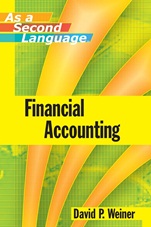
Financial Accounting as a Second Language
ISBN 9780470043882
Autor: David P. Weiner
Wydawca: Wiley
Dostępność: 3-6 tygodni
Cena: 329,70 zł
Przed złożeniem zamówienia prosimy o kontakt mailowy celem potwierdzenia ceny.
ISBN13: |
9780470043882 |
ISBN10: |
0470043881 |
Autor: |
David P. Weiner |
Oprawa: |
Paperback |
Rok Wydania: |
2008-09-16 |
Numer Wydania: |
1st Edition |
Ilość stron: |
320 |
Wymiary: |
234x160 |
Tematy: |
KF |
Get a better grade in financial accounting!
Accounting may be challenging, but with training and practice you can come out of your financial accounting class with the grade you want! With David Weiner’s Financial Accounting as a Second Language, you’ll get the practice and training you need to better understand fundamental principles, build confidence, and solve problems.
Here’s how you can get a better grade in financial accounting:
Understand the basic concepts
Financial Accounting as a Second Language describes the complete accounting cycle, from engaging in transactions to preparing a set of financial statements. You’ll learn how to prepare a statement of cash flows and accounting techniques for specific business transactions. By understanding these principles, you’ll have a coherent framework that will help you better understand your course.
Study more efficiently and effectively
Financial Accounting as a Second Language provides time–saving study tips and problem–solving strategies that will help you apply concepts to succeed in the course.
Improve your problem–solving skills
Financial Accounting as a Second Language will help you develop the skills you need to solve a variety of problem types––even unfamiliar ones!
Spis treści:
Preface.
Chapter One. Basic Accounting Concepts.
Roadmap.
Accounting As the Language of Business.
Objectives of Financial Reporting.
Basic Accounting Concepts.
Economic Entity.
Going Concern.
Stable Monetary Unit.
Accounting Periods.
Historical Cost.
Revenue Recognition.
Matching.
Full Disclosure.
Materiality.
Conservatism.
The Basic Financial Statements.
The Income Statement.
The Balance Sheet.
The Statement of Changes in Owners’ Equity.
The Statement of Cash Flows.
Using Financial Statement Informat
ion.
Frequently Asked Questions.
Practice Multiple Choice Questions.
Chapter Two. The Accounting Cycle And Accrual Accounting.
Roadmap.
Transaction Analysis.
The Account.
The Rules for Debit and Credit.
The Chart of Accounts.
The Cash basis versus the Accrual basis.
The Journal Entry.
Recording Journal Entries.
Adjusting Entries.
Prepayments and Accruals.
Depreciation.
Cost of Goods Sold and Inventory.
Closing Entries.
The Closing Process.
Balancing the Permanent Accounts.
Correcting Errors.
Correcting Out of Balance Errors.
Correcting Other Bookkeeping Errors.
Preparing the Financial Statements.
Comprehensive Example.
Frequently Asked Questions.
Practice Multiple Choice Questions.
Chapter Three. Internal Control, Cash, And Receivables.
Roadmap.
Sarbanes–Oxley and Internal Controls.
The Control Environment.
Risk Assessment.
Accounting Information System.
Control Activities.
Reporting Cash.
Petty Cash.
The Bank Reconciliation.
Accounts Receivable.
Demonstration Problem: Accounts Receivable.
Notes Receivable.
Getting Cash for Receivables.
Summary of Journal Entries.
Frequently Asked Questions.
Practice Multiple Choice Questions.
Chapter Four. Inventory.
Roadmap.
Basic Inventory Issues.
Inventory Cost.
Inventory Terminology.
Inventory Units.
Inventory Flow Assumptions.
Purchasing and Selling Inventory.
Example One: Selling inventory.
The Cost of Goods Sold Model.
The Periodic method vs. the Perpetual Method.
The Periodic Method.
The Perpetual Method.
Taking Inventory and the Cost Flow Assumptions.
Example Two: Inventory Flow Assumptions.
Example Three: Inventory Flow Assumptions.
Lower of Cost or Market.
Example Four: Lower of Cost or Market.
Impact of Inventory Errors.
Example Five: Impact of Inventory Errors.
Summary of Journal Entries.
Frequently Ask
ed Questions.
Practice Multiple Choice Questions.
Chapter Five. Long Term Assets, Intangible Assets, And Depreciation/Amortization.
Roadmap.
Non–Current Assets.
Long Term Investments.
Trading Securities.
Available for Sale Securities.
Property, Plant, and Equipment.
Demonstration Problem 1: Acquisition of Plant Assets.
Costs Subsequent to acquisition.
Depreciation.
Units of Activity.
Straight Line.
Sum of the Years Digits.
Declining Balance.
Depreciation Conventions.
Partial Year Depreciation.
Disposal of Plant Assets.
Demonstration Problem 2: Property, Plant and Equipment Transactions.
Intangible Assets.
Patents.
Legal fees.
Copyrights.
Trademarks and Trade names.
Franchises and Licenses.
Goodwill.
Example: Calculation of Goodwill.
Impairment.
Example: calculating Impairment.
Demonstration Problem 3: Assorted Intangible Assets in a Single Ledger Account.
Accounting for R and D.
Summary of Journal Entries.
Frequently Asked Questions.
Practice Multiple Choice Questions.
Chapter Six. Liabilities, Current And Non–Current.
Liabilities.
Current liabilities.
Accounts Payable.
Notes Payable.
Interest Bearing Notes.
Non Interest Bearing Notes.
Salaries Payable.
Demonstration Problem: Salaries Payable.
Interest Payable.
Sales Tax Payable.
Advances from Customers.
Current Portion of Long–Term Debt.
Estimated Liability for Warranties.
Short Term Debt Expected to be Refinanced.
Long Term Liabilities.
Bank Loans and Long Term Notes Payable.
Pensions and Other Post Retirement Benefits.
Bonds.
Bond Terminology.
Principle Amount.
Stated (Coupon) Rate of Interest.
Market Rate of Interest (yield).
Discount and Premium.
Example: Issuing Bonds.
Term Bonds versus Serial Bonds.
Mortgage Bonds versus Debentures.
Leases.
Summary of Journal Entries.
Frequently Asked Que
stions.
Practice Multiple Choice Questions.
Chapter Seven. Owners′ Equity.
Owners′ Equity.
Corporations.
Contributed Capital.
Retained Earnings.
Common and Preferred Stock.
Cash Dividends, Stock Dividends and Stock Splits.
Treasury Stock.
Example: Treasury Stock.
Statement of Owners′ Equity.
Balance Sheet Presentation.
Comprehensive Owners′ Equity Demonstration Problem.
Summary of Journal Entries.
Frequently Asked Questions.
Practice Multiple Choice Questions.
Chapter Eight. Statement Of Cash Flows.
Objectives of the Statement.
Format of the Statement.
A Step by Step Approach to Solving Statement of Cash. Flows Problems.
Preparing the Statement of Cash Flows (Direct Approach).
Demonstration Problem 1 (Direct Approach).
Preparing the Statement of Cash Flows (Indirect Approach).
Reviewing the Six Step Approach.
Demonstration Problem 2 (Indirect Approach).
Demonstration Problem 3 Comprehensive Statement of Cash.
Flows Problem (Direct and Indirect Approaches).
Frequently Asked Questions.
Practice Multiple Choice Questions.
Chapter Nine. Review Of Financial Statements And Financial Statement Analysis.
Roadmap.
Horizontal and Vertical Analysis.
DuPont Analysis.
Financial Ratio Analysis.
Liquidity Measures.
Activity Measures.
Solvency and Leverage Measures.
Profitability Measures.
Summary of Financial Ratios.
Comprehensive Demonstration Problems.
Preparation of a Partial Income Statement.
Preparation of a Balance Sheet.
Frequently Asked Questions.
Practice Multiple Choice Questions.
Appendix A. Basic College Skills.
Introduction.
College Skills.
Preparing for Class.
Reading the Textbook.
Doing Homework Problems.
What to do in Class.
Being Prepared.
Correcting Your Homework.
Forming a Study Group.
How to Select Group Members.
Activities for the Study Group.
Pra
Koszyk
Książek w koszyku: 0 szt.
Wartość zakupów: 0,00 zł
Informacje


Kontakt
Gambit
Centrum Oprogramowania
i Szkoleń Sp. z o.o.
Al. Pokoju 29b/22-24
31-564 Kraków
Siedziba Księgarni
ul. Kordylewskiego 1
31-542 Kraków
+48 12 410 5991
+48 12 410 5987
+48 12 410 5989
Subskrypcje
Administratorem danych osobowych jest firma Gambit COiS Sp. z o.o. Na podany adres będzie wysyłany wyłącznie biuletyn informacyjny.
Autoryzacja płatności

Informacje na temat autoryzacji płatności poprzez PayU.

© Copyright 2012: GAMBIT COiS Sp. z o.o. Wszelkie prawa zastrzeżone.
Projekt i wykonanie: Alchemia Studio Reklamy