


Wydawcy
Katalog tematyczny
- Archeologia (109)
- Ekonomia, finanse, business (13704)
- Filozofia (1445)
- Historia (3040)
- Języki i językoznawstwo (2356)
- Lifestyle, hobby i rozrywka (475)
- Medycyna (9704)
- Nauki humanistyczne (4)
- Nauki o Ziemi i środowisku (2638)
- Nauki ścisłe (20412)
- Nauki społeczne (8486)
- Nauki techniczne (13450)
- Budownictwo lądowe (1045)
- Chemia przemysłowa (2258)
- Elektronika i telekomunikacja (3287)
- Energetyka (1122)
- Inne nauki stosowane (363)
- Inżynieria biochemiczna (507)
- Inżynieria transportu (232)
- Mechanika i materiały (3316)
- Nauka o środowisku (321)
- Rolnictwo (507)
- Technika, ogólnie (475)
- Prawo (1696)
- Publikacje informacyjne i interdyscyplinarne (1288)
- Religia i wierzenia (917)
- Technika komputerowa (4067)
- Zdrowie, relacje międzyludzkie i rozwój osobisty (657)





Informacje szczegółowe o książce
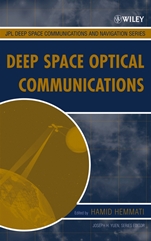
Deep Space Optical Communications
ISBN 9780470040027
Autor: Hamid Hemmati
Wydawca: Wiley
Dostępność: 3-6 tygodni
Cena: 1 071,00 zł
Przed złożeniem zamówienia prosimy o kontakt mailowy celem potwierdzenia ceny.
ISBN13: |
9780470040027 |
ISBN10: |
0470040025 |
Autor: |
Hamid Hemmati |
Oprawa: |
Hardback |
Rok Wydania: |
2006-06-13 |
Ilość stron: |
736 |
Wymiary: |
256x159 |
Tematy: |
TJ |
A quarter century of research into deep space and near Earth optical communications
This book captures a quarter century of research and development in deep space optical communications from the Jet Propulsion Laboratory (JPL). Additionally, it presents findings from other optical communications research groups from around the world for a full perspective. Readers are brought up to date with the latest developments in optical communications technology, as well as the state of the art in component and subsystem technologies, fundamental limitations, and approaches to develop and fully exploit new technologies.
The book explores the unique requirements and technologies for deep space optical communications, including:Technology overview; link and system design driversAtmospheric transmission, propagation, and reception issuesFlight and ground terminal architecture and subsystemsFuture prospects and applications, including navigational tracking and light science
This is the first book to specifically address deep space optical communications. With an increasing demand for data from planetary spacecraft and other sources, it is essential reading for all optical communications, telecommunications, and system engineers, as well as technical managers in the aerospace industry. It is also recommended for graduate students interested in deep space communications.
Spis treści:
Foreword.
Preface.
Acknowledgments.
Contributors.
Chapter 1 : Introduction (James R . Lesh).
1.1 Motivation for Increased Communications.
1.2 History of JPL Optical Communications Activities.
1.3 ComponentlSubsystem Technologies.
1.3.1 Laser Transmitters.
1.3.2 Spacecraft Telescopes.
1.3.3 Acquisition, Tracking. and Pointing.
1.3.4 Detectors.
1.3.5 Filters.
1.3.6 Error Correction Coding.
1.4 Flight Terminal Developments.
1.4.1 Optical Transceiver Package (OPTRANSPAC).
1.4.2 Opti
cal Communications Demonstrator (OCD).
1.4.3 Lasercom Test and Evaluation Station (LTES).
1.4.4 X2000 Flight Terminal.
1.4.5 International Space Station Flight Terminal.
1.5 Reception System and Network Studies.
1.5.1 Ground Telescope Cost Model.
1.5.2 Deep Space Optical Reception Antenna (DSORA).
1.5.3 Deep Space Relay Satellite System (DSRSS) Studies.
1.5.4 Ground–Based Antenna Technology Study (GBATS).
1.5.5 Advanced Communications Benefits Study (ACBS).
1.5.6 Earth Orbit Optical Reception Terminal (EOORT) Study.
1.5 .7 EOORT Hybrid Study.
1.5.8 Spherical Primary Ground Telescope.
1.5.9 Space–Based versus Ground–Based Reception Trades.
1.6 Atmospheric Transmission.
1.7 Background Studies.
1.8 Analysis Tools.
1.9 System–Level Studies.
1.9.1 Venus Radar Mapping (VRM) Mission Study.
1.9.2 Synthetic Aperture Radar–C (SIR–C) Freeflyer.
1.9.3 ER–2 to Ground Study.
1.9.4 Thousand Astronomical Unit (TAU) Mission and Interstellar Mission Studies.
1.1 0 System–Level Demonstrations.
1 .1 0. 1 Galileo Optical Experiment (GOPEX).
1.10.2 Compensated Earth–Moon–Earth Retro–Reflector Laser Link (CEMERLL).
1.1 0.3 Groundlorbiter Lasercomm Demonstration (GOLD).
1.10 .4 Ground–Ground Demonstrations.
1.11 Other Telecommunication Functions.
1.11.1 Opto–Metric Navigation.
1.11.2 Light Science.
1.12 The Future.
1.12.1 Optical Communications Telescope Facility (OCTL).
1.12.2 Unmanned Aria1 Vehicle (UAVFGround Demonstration.
1.12.3 Adaptive Optics.
1.12.4 Optical Receiver and Dynamic Detector Array.
1.1 2.5 Alternate Ground–Reception Systems.
1.13 Mars Laser Communication Demonstration.
1.14 Summary of Following Chapters.
References.
Chapter 2: Link and System Design (Chien–Chung Chen).
2.1 Overview of Deep–Space Lasercom Link.
2.2 Communications Link Design.
2.
2.1 Link Equation and Receive Signal Power.
2.2.2 Optical–Receiver Sensitivity.
2.2.2.1 Photon Detection Sensitivity.
2.2.2.2 Modulation Format.
2.2.2.3 Background Noise Control.
2.2.3 Link Design Trades.
2.2.3.1 Operating Wavelength.
2.2.3.2 Transmit Power and Size of Transmit and Receive Apertures.
2.2.3.3 Receiver Optical Bandwidth and Field of View versus Signal Throughput.
2.2.3.4 Modulation and Coding.
2.2.4 Communications Link Budget.
2.2.5 Link Availability Considerations.
2.2.5.1 Short–Term Data Outages.
2.2.5.2 Weather–Induced Outages.
2.2.5.3 Other Long–Term Outages.
2.2.5.4 Critical–Mission–Phase Coverage.
2.3 Beam Pointing and Tracking.
2.3.1 Downlink Beam Pointing.
2.3.1.1 Jitter Isolation and Rejection.
2.3.1.2 Precision Beam Pointing and Point Ahead.
2.3.2 Uplink Beam Pointing.
2.3.3 Pointing Acquisition.
2.4 Other Design Drivers and Considerations.
2.4.1 System Mass and Power.
2.4.2 Impact on Spacecraft Design.
2.4.3 Laser Safety.
2.5 Summary.
References.
Chapter 3: The Atmospheric Channel (Abhijit Biswas and Sabino Piazzolla).
3.1 Cloud Coverage Statistics.
3.1.1 National Climatic Data Center Data Set.
3.1.2 Single–Site and Two–Site Diversity Statistics.
3.1.3 Three–Site Diversity.
3.1.4 NCDC Analysis Conclusion.
3.1.5 Cloud Coverage Statistics by Satellite Data Observation.
3.2 Atmospheric Transmittance and Sky Radiance.
3.2.1 Atmospheric Transmittance.
3.2.2 Molecular Absorption and Scattering.
3.2.3 Aerosol Absorption and Scattering.
3.2.3.1 Atmospheric Attenuation Statistics.
3.2.4 Sky Radiance.
3.2.4.1 Sky Radiance Statistics.
3.2.5 Point Sources of Background Radiation.
3.3 Atmospheric Issues on Ground Telescope Site Selection for an Optical Deep Space Network.
3.3.1 Optical Deep Space Network.
3.3.2 Data RateJBER of a Mission.
3.3.3 Telescope Site Loca
tion.
3.3.4 Network Continuity and Peaks.
3.4 Laser Propagation Through the Turbulent Atmosphere.
3.4.1 Atmospheric Turbulence.
3.4.2 Atmospheric "Seeing" Effects.
3.4.3 Optical Scintillation or Irradiance Fluctuations.
3.4.4 Atmospheric Turbulence Induced Angle of Arrival.
References.
Chapter 4: Optical Modulation and Coding (Samuel J . Dolinar. Jon Hamkins. Bruce E . Moision and Victor A . Vilnrotter).
4.1 Introduction.
4.2 Statistical Models for the Detected Optical Field.
4.2.1 Quantum Models of the Optical Field.
4.2.1.1 Quantization of the Electric Field.
4.2.1.2 The Coherent State Representation of a Single Field Mode.
4.2.1.3 Quantum Representation of Thermal Noise.
4.2.1.4 Quantum Representation of Signal Plus Thermal Noise.
4.2.2 Statistical Models for Direct Detection.
4.2.2.1 The Poisson Channel Model for Ideal Photodetectors or Ideal PMTs.
4.2.2.2 The McIntyre–Conradi Model for APD Detectors.
4.2.2.3 The Webb, McIntyre, and Conradi Approximation to the McIntyre–Conradi Model.
4.2.2.4 The WMC Plus Gaussian Approximation.
4.2.2.5 Additive White Gaussian Noise Approximation.
4.2.3 Summary of Statistical Models.
4.3 Modulation Formats.
4.3.1 On–Off Keying (OOK).
4.3.2 Pulse–Position Modulation (PPM).
4.3.3 Differential PPM (DPPM).
4.3.4 Overlapping PPM (OPPM).
4.3.5 Wavelength Shift Keying (WSK).
4.3.6 Combined PPM and WSK.
4.4 Rate Limits Imposed by Constraints on Modulation.
4.4.1 Shannon Capacity.
4.4.1.1 Characterizing Capacity: Fixed Duration Edges.
4.4.1.2 Characterizing Capacity: Variable Duration Edges.
4.4.1.3 Characterizing Capacity: Probabilistic Characterization.
4.4.1.4 Characterizing Capacity: Energy Efficiency.
4.4.2 Constraints.
4.4.2.1 Dead Time.
4.4.2.2 Runlength.
4.4.3 Modulation Codes.
4.4.3.1 M–ary PPM with Deadtime.
4.4.3.2 M–ary DPPM with Deadtime.
4.4.3.3 Synchronous Variab
Koszyk
Książek w koszyku: 0 szt.
Wartość zakupów: 0,00 zł
Informacje


Kontakt
Gambit
Centrum Oprogramowania
i Szkoleń Sp. z o.o.
Al. Pokoju 29b/22-24
31-564 Kraków
Siedziba Księgarni
ul. Kordylewskiego 1
31-542 Kraków
+48 12 410 5991
+48 12 410 5987
+48 12 410 5989
Subskrypcje
Administratorem danych osobowych jest firma Gambit COiS Sp. z o.o. Na podany adres będzie wysyłany wyłącznie biuletyn informacyjny.
Autoryzacja płatności

Informacje na temat autoryzacji płatności poprzez PayU.

© Copyright 2012: GAMBIT COiS Sp. z o.o. Wszelkie prawa zastrzeżone.
Projekt i wykonanie: Alchemia Studio Reklamy