


Wydawcy
Katalog tematyczny
- Archeologia (109)
- Ekonomia, finanse, business (13704)
- Filozofia (1445)
- Historia (3040)
- Języki i językoznawstwo (2356)
- Lifestyle, hobby i rozrywka (475)
- Medycyna (9704)
- Nauki humanistyczne (4)
- Nauki o Ziemi i środowisku (2638)
- Nauki ścisłe (20412)
- Astronomia (294)
- Biologia (5119)
- Chemia (6540)
- Chemia analityczna (361)
- Chemia fizyczna (346)
- Chemia nieorganiczna (137)
- Chemia organiczna (535)
- Krystalografia (27)
- Minerologia (46)
- Fizyka (3309)
- Matematyka (4574)
- Nauki ścisłe, ogólnie (503)
- Nauki społeczne (8486)
- Nauki techniczne (13450)
- Prawo (1696)
- Publikacje informacyjne i interdyscyplinarne (1288)
- Religia i wierzenia (917)
- Technika komputerowa (4067)
- Zdrowie, relacje międzyludzkie i rozwój osobisty (657)





Informacje szczegółowe o książce
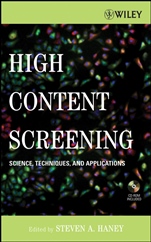
High Content Screening: Science, Techniques and Applications
ISBN 9780470039991
Autor: Steven A. Haney
Wydawca: Wiley
Dostępność: 3-6 tygodni
Cena: 795,90 zł
Przed złożeniem zamówienia prosimy o kontakt mailowy celem potwierdzenia ceny.
ISBN13: |
9780470039991 |
ISBN10: |
047003999X |
Autor: |
Steven A. Haney |
Oprawa: |
Hardback |
Rok Wydania: |
2008-02-01 |
Ilość stron: |
424 |
Wymiary: |
234x167 |
Tematy: |
PN |
The authoritative reference on HCS in biological and pharmaceutical research
High Content Screening (HCS) has been a leading methodology in toxicology studies for years. Recent advances have broadened the range of applications to encompass new areas. High Content Screening: Science, Techniques, and Applications provides comprehensive coverage of HCS in four sections:
The basics of HCS, from the definition to detailed discussions of component technologies
Examples of HCS used in biological applications and early drug discovery, with an emphasis on applications in oncology and neuroscience
The use of HCS across the drug development pipeline
Data management, data analysis, and systems biology, with guidelines for using the large datasets generated by HCS in systems–level studies
With chapters contributed by leading authorities from academia and industry, this guide covers:
A wide range of topics, including assay development, cell culture, image processing, robotics, database architecture and management, model systems for analysis, and more
Focused discussions on imaging in 3D, imaging of tissues for pharmacodynamic studies, and screening of both small molecule and RNAi libraries by HCS
The roles of bench researchers and IT personnel in implementing and maintaining HCS platforms
The challenges and advantages of using HCS today, and a look at future directions
With eighty–seven detailed figures readers can refer to in full color on the accompanying CD–ROM, this is the premier, hands–on reference on HCS for researchers in academia, biotechnology, and pharmaceutical companies. It′s also an excellent resource for lab managers and graduate students in biochemistry, cell biology, toxicology, and related fields.
Spis treści:
Preface.
Contributors.
SECTION I: ESSENTIALS OF HIGH CONTENT SC
REENING.
1. Approaching High Content Screening and Analysis: Practical Advice for Users (Scott Keefer and Joseph Zock).
1.1 Introduction.
1.2 What is HCS and Why Should I Care?
1.3 How does HCS Compare with Current Assay Methods?
1.4 The Basic Requirements to implement HCS.
1.5 The Process.
1.6 An Example Approach.
1.7 Six Considerations for HCS Assays.
References.
2. Automated High Content Screening Microscopy (Paul A. Johnston).
2.1 Introduction.
2.2 Automated HCS Imaging Requirements.
2.3 Components of Automated Imaging Platforms.
2.4 Imaging Platform Software.
2.5 Data Storage and Management.
2.6 Selecting an HCS Platform.
2.7 Comparison of a SAPK Activation HCS Assay Read on an ArrayScanw 3.1, an ArrayScanw VTi, and an IN Cell 3000 Automated Imaging Platform.
References.
3. A Primer on Image Informatics of High Content Screening (Xiaobo Zhou and Stephen T.C. Wong).
3.1 Background.
3.2 HCS Image Processing.
3.3 Validation.
3.4 Information System Management.
3.5 Data Modeling.
3.6 Conclusions.
3.7 Acknowledgements.
References.
4. Developing Robust High Content Assays (Arijit Chakravarty, Douglas Bowman, Jeffrey A. Ecsedy, Claudia Rabino, John Donovan, Natalie D’Amore, Ole Petter Veiby, Mark Rolfe, and Sudeshna Das).
4.1 Introduction.
4.2 Overview of a Typical Immunofluorescence–Based High Content Assay.
4.3 Identifying Sources of Variability in a High Content Assay.
4.4 From Immunofluorescence to High Content: Selecting the Right Metric.
4.5 Validation of High Content Assays.
4.6 Conclusion.
4.7 Acknowledgements.
References.
SECTION II: APPLICATIONS OF HCS IN BASIC SCIENCE AND EARLY DRUG DISCOVERY.
5. HCS in Cellular Oncology and Tumor Biology (Steven A. Haney, Jing Zhang, Jing Pan, and Peter LaPan).
5.1 Cancer Cell Biology and HCS.
5.2 The Cell Biology
of Cell Death.
5.3 Cell Signaling Pathways in Cancer.
5.4 HCS in Tumor Biology.
5.5 Conclusions.
References.
6. Exploring the Full Power of Combining High Throughput RNAi with High Content Readouts: From Target Discovery Screens to Drug Modifier Studies (Christoph Sachse, Cornelia Weiss–Haljiti, Christian Holz, Kathrin Regener, Francoise Halley, Michael Hannus, Corina Frenzel, Sindy Kluge, Mark Hewitson, Benjamin Bader, Amy Burd, Louise Perkins, Alexander Szewczak, Stefan Prechtl, Claudia Merz, Peter Rae, Dominik Mumberg, and Christophe J. Echeverri).
6.1 Background: The Convergence of High Content Analysis and RNAi.
6.2 Integrating HT–RNAi and HCA in Drug Discovery: The Potential.
6.3 Combining RNAi and HCA in one Assay — the Reality.
6.4 HCA–Based RNAi Studies — The Future.
6.5 Acknowledgements.
References.
7. Leveraging HCS in Neuroscience Drug Discovery (Myles Fennell, Beal McIlvain, and John Dunlop).
7.1 High Content Screening and Drug Discovery.
7.2 The Neuron and Neuronal Morphology.
7.3 Methods for Measuring Neuronal Morphology.
7.4 Small Molecule Screening for Neurite Outgrowth.
7.5 RNAi in Neuroscience and HCA.
7.6 Measurement of Signal Transduction in Neurons.
7.7 High Content Screening in Complex CNS Models.
7.8 Methods used in Neuronal HCS.
References.
8. Live Brain Slice Imaging for Ultra High Content Screening: Automated Fluorescent Microscopy to Study Neurodegenerative Diseases (O. Joseph Trask, Jr., C. Todd DeMarco, Denise Dunn, Thomas G. Gainer, Joshua Eudailey, and Donald C. Lo).
8.1 Introduction and Background.
8.2 Live Brain Slice Model to Study Huntington’s Disease.
8.3 Imaging Platforms.
8.4 Center of Well (COW) for Image Processing.
8.5 Generic Protocol for the Cellomics ArrayScan VTI.
8.6 Data and Results.
8.7 Discussion.
References.
9. High Content Analysis of Human E
mbryonic Stem Cell Growth and Differentiation (Paul J. Sammak, Vivek Abraham, Richik Ghosh, Jeff Haskins, Esther Jane, Patti Petrosko, Teresa M. Erb, Tia N. Kinney, Christopher Jefferys, Mukund Desai, and Rami Mangoubi).
9.1 Introduction.
9.2 Cell Culture Methods.
9.3 Statistical Wavelet Analysis for Stem Cell Classification.
9.4 Molecular Analysis of Pluripotency and Cell Proliferation in Undifferentiated Stem Cells.
9.5 Analysis of Cardiomyocyte Differentiation.
9.6 Analysis of Neuronal Differentiation.
References.
SECTION III: HCS IN DRUG DEVELOPMENT.
10. HCS for HTS (Ann F. Hoffman and Ralph J. Garippa).
10.1 Introduction.
10.2 HCS for Orphan GPCRS and Transfluor.
10.3 HCS for Multiparameter Cytotoxicity Screening.
10.4 Discussion.
10.5 Summary.
References.
11. The Roles of High Content Cellular Imaging in Lead Optimization (Jonathan A. Lee, Karen Cox, Aidas Kriauciunas, and Shaoyou Chu).
11.1 Introduction.
11.2 Statistical Validation of Assays.
11.3 High Content Cellular Imaging is a Diverse Assay Platform.
11.4 Use of High Content Cellular Imaging For Oncology Research at Eli Lilly.
11.5 The Future of High Content Cellular Imaging in Lead Optimization.
11.6 Acknowledgements.
References.
12. Using High Content Analysis for Pharmacodynamic Assays in Tissue (Arijit Chakravarty, Douglas Bowman, Kristine Burke, Bradley Stringer, Barbara Hibner, and Katherine Galvin).
12.1 Introduction.
12.2 Designing a High Content Assay for Use in Tissues.
12.3 Technical Challenges in Establishing High Content Assays for Tissue.
12.4 Case Study: Design and Validation of a High Content Assay for Biomarker X.
12.5 Conclusions.
12.6 Acknowledgements.
References.
13. High Content Analysis of Sublethal Cytotoxicity in Human HepG2 Hepatocytes for Assessing Potential and Mechanism for Chemicaland Drug–Induced Human Toxicity<
Koszyk
Książek w koszyku: 0 szt.
Wartość zakupów: 0,00 zł
Informacje


Kontakt
Gambit
Centrum Oprogramowania
i Szkoleń Sp. z o.o.
Al. Pokoju 29b/22-24
31-564 Kraków
Siedziba Księgarni
ul. Kordylewskiego 1
31-542 Kraków
+48 12 410 5991
+48 12 410 5987
+48 12 410 5989
Subskrypcje
Administratorem danych osobowych jest firma Gambit COiS Sp. z o.o. Na podany adres będzie wysyłany wyłącznie biuletyn informacyjny.
Autoryzacja płatności

Informacje na temat autoryzacji płatności poprzez PayU.

© Copyright 2012: GAMBIT COiS Sp. z o.o. Wszelkie prawa zastrzeżone.
Projekt i wykonanie: Alchemia Studio Reklamy