


Wydawcy
Katalog tematyczny
- Archeologia (109)
- Ekonomia, finanse, business (13704)
- Filozofia (1445)
- Historia (3040)
- Języki i językoznawstwo (2356)
- Lifestyle, hobby i rozrywka (475)
- Medycyna (9704)
- Nauki humanistyczne (4)
- Nauki o Ziemi i środowisku (2638)
- Nauki ścisłe (20412)
- Nauki społeczne (8486)
- Nauki techniczne (13450)
- Budownictwo lądowe (1045)
- Chemia przemysłowa (2258)
- Elektronika i telekomunikacja (3287)
- Energetyka (1122)
- Inne nauki stosowane (363)
- Inżynieria biochemiczna (507)
- Inżynieria transportu (232)
- Mechanika i materiały (3316)
- Nauka o środowisku (321)
- Rolnictwo (507)
- Technika, ogólnie (475)
- Prawo (1696)
- Publikacje informacyjne i interdyscyplinarne (1288)
- Religia i wierzenia (917)
- Technika komputerowa (4067)
- Zdrowie, relacje międzyludzkie i rozwój osobisty (657)





Informacje szczegółowe o książce
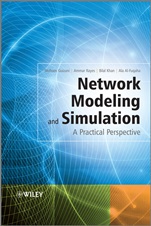
Network Modeling and Simulation: A Practical Perspective
ISBN 9780470035870
Autor: Mohsen Guizani, Ammar Rayes, Bilal Khan, Ala Al–Fuqaha
Wydawca: Wiley
Dostępność: 3-6 tygodni
Cena: 432,60 zł
Przed złożeniem zamówienia prosimy o kontakt mailowy celem potwierdzenia ceny.
ISBN13: |
9780470035870 |
ISBN10: |
0470035870 |
Autor: |
Mohsen Guizani, Ammar Rayes, Bilal Khan, Ala Al–Fuqaha |
Oprawa: |
Hardback |
Rok Wydania: |
2010-02-12 |
Ilość stron: |
304 |
Wymiary: |
251x176 |
Tematy: |
TJ |
Network Modeling and Simulation is a practical guide to using modeling and simulation to solve real–life problems. The authors give a comprehensive exposition of the core concepts in modeling and simulation, and then systematically address the many practical considerations faced by developers in modeling complex large–scale systems. The authors provide examples from computer and telecommunication networks and use these to illustrate the process of mapping generic simulation concepts to domain–specific problems in different industries and disciplines.
Key features:Provides the tools and strategies needed to build simulation models from the ground up rather than providing solutions to specific problems.Includes a new simulation tool, CASiNO built by the authors.Examines the core concepts of systems simulation and modeling.Presents code examples to illustrate the implementation process of commonly encountered simulation tasks.
Offers examples of industry–standard modeling methodology that can be applied in steps to tackle any modeling problem in practice.
Spis treści:
Preface
Acknowledgements
1 Basic Concepts and Techniques
1.1 Why Is Simulation Important?
1.2 What Is a Model?
1.3 Performance Evaluation Techniques
1.4 Development of Systems Simulation
1.5 Summary
Recommended Reading
2 Designing and Implementing a Discrete–Event Simulation Framework
2.1 The Scheduler
2.2 The Simulation Entities
2.3 The Events
2.4 Tutorial 1: Hello World
2.5 Tutorial 2: Two–Node Hello Protocol
2.6 Tutorial 3: Two–Node Hello through a Link
2.7 Tutorial 4: Two–Node Hello through a Lossy Link
2.8 Summary
Recommended Reading
3 Honeypot Communities: A Case Study with the D
iscrete–Event Simulation Framework
3.1 Background
3.2 System Architecture
3.3 Simulation Modeling
3.4 Simulation Execution
3.5 Output Analysis
3.6 Summary
Recommended Reading
4 Monte Carlo Simulation
4.1 Characteristics of Monte Carlo Simulations
4.2 The Monte Carlo Algorithm
4.3 Merits and Drawbacks
4.4 Monte Carlo Simulation for the Electric Car Charging Station
4.5 Summary
Recommended Reading
5 Network Modeling
5.1 Simulation of Networks
5.2 The Network Modeling and Simulation Process
5.3 Developing Models
5.4 Network Simulation Packages
5.5 OPNET: A Network Simulation Package
5.6 Summary
Recommended Reading
6 Designing and Implementing CASiNO: A Network Simulation Framework
6.1 Overview
6.2 Conduits
6.3 Visitors
6.4 The Conduit Repository
6.5 Behaviors and Actors
6.6 Tutorial 1: Terminals
6.7 Tutorial 2: States
6.8 Tutorial 3: Making Visitors
6.9 Tutorial 4: Muxes
6.10 Tutorial 5: Factories
6.11 Summary
Recommended Reading
7 Statistical Distributions and Random Number Generation
7.1 Introduction to Statistical Distributions
7.2 Discrete Distributions
7.3 Continuous Distributions
7.4 Augmenting CASiNO with Random Variate Generators
7.5 Random Number Generation
7.6 Frequency and Correlation Tests
7.7 Random Variate Generation
7.8 Summary
Recommended Reading
8 Network Simulation Elements: A Case Study Using CASiNO
8.1 Making a Poisson Source of Packets
8.2 Making a Protocol for Packet Processing
8.3 Bounding Protocol Resources
8.4 Making a Round–Robin (De)multiplexer
8.5 Dynamically Instantiating Protocols
8.6 Putting It All Together
8.7 Summary
9 Queuing Theory
9.1 Introduction to Stochastic Processes
9.2 Discrete–Time Markov Chains
9.3 Continuous–Time Markov Chains9.4 Basic Properties of Markov Chains
9.5 Chapman–Kolmogorov Equation
9.6 Birth–Death Process
9.7 Little’s Theorem
9.8 Delay on a Link
9.9 Standard Queuing Notation
9.10 The M/M/1 Queue
9.11 The M/M/m Queue
9.12 The M/M/1/b Queue
9.13 The M/M/m/m Queue
9.14 Summary
Recommended Reading
10 Input Modeling and Output Analysis
10.1 Data Collection
10.2 Identifying the Distribution
10.3 Estimation of Parameters for Univariate Distributions
10.4 Goodness–of–Fit Tests
10.5 Multivariate Distributions
10.6 Selecting Distributions without Data
10.7 Output Analysis
10.8 Summary
Recommended Reading
11 Modeling Network Traffic
11.1 Introduction
11.2 Network Traffic Models
11.3 Traffic Models for Mobile Networks
11.4 Global Optimization Techniques
11.5 Particle Swarm Optimization
11.6 Optimization in Mathematics
11.7 Summary
Recommended Reading
Index
Okładka tylna:
Network Modeling and Simulation is a practical guide to using modeling and simulation to solve real–life problems. The authors give a comprehensive exposition of the core concepts in modeling and simulation, and then systematically address the many practical considerations faced by developers in modeling complex large–scale systems. The authors provide examples from computer and telecommunication networks and use these to illustrate the process of mapping generic simulation concepts to domain–specific problems in different industries and disciplines.
Key features:Provides the tools and strategies needed to build simulation models from the ground up rather than providing solutions to specific problems.Includes a new simulation tool, CASiNO built by the authors.Examines the core concepts of systems simulat
ion and modeling.Presents code examples to illustrate the implementation process of commonly encountered simulation tasks.
Offers examples of industry–standard modeling methodology that can be applied in steps to tackle any modeling problem in practice.
Koszyk
Książek w koszyku: 0 szt.
Wartość zakupów: 0,00 zł
Informacje


Kontakt
Gambit
Centrum Oprogramowania
i Szkoleń Sp. z o.o.
Al. Pokoju 29b/22-24
31-564 Kraków
Siedziba Księgarni
ul. Kordylewskiego 1
31-542 Kraków
+48 12 410 5991
+48 12 410 5987
+48 12 410 5989
Subskrypcje
Administratorem danych osobowych jest firma Gambit COiS Sp. z o.o. Na podany adres będzie wysyłany wyłącznie biuletyn informacyjny.
Autoryzacja płatności

Informacje na temat autoryzacji płatności poprzez PayU.

© Copyright 2012: GAMBIT COiS Sp. z o.o. Wszelkie prawa zastrzeżone.
Projekt i wykonanie: Alchemia Studio Reklamy