


Wydawcy
Katalog tematyczny
- Archeologia (109)
- Ekonomia, finanse, business (13704)
- Filozofia (1445)
- Historia (3040)
- Języki i językoznawstwo (2356)
- Lifestyle, hobby i rozrywka (475)
- Medycyna (9704)
- Nauki humanistyczne (4)
- Nauki o Ziemi i środowisku (2638)
- Nauki ścisłe (20412)
- Astronomia (294)
- Biologia (5119)
- Chemia (6540)
- Chemia analityczna (361)
- Chemia fizyczna (346)
- Chemia nieorganiczna (137)
- Chemia organiczna (535)
- Krystalografia (27)
- Minerologia (46)
- Fizyka (3309)
- Matematyka (4574)
- Nauki ścisłe, ogólnie (503)
- Nauki społeczne (8486)
- Nauki techniczne (13450)
- Prawo (1696)
- Publikacje informacyjne i interdyscyplinarne (1288)
- Religia i wierzenia (917)
- Technika komputerowa (4067)
- Zdrowie, relacje międzyludzkie i rozwój osobisty (657)





Informacje szczegółowe o książce
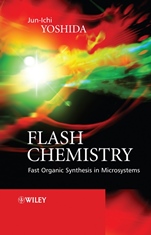
Flash Chemistry: Fast Organic Synthesis in Microsystems
ISBN 9780470035863
Autor: Jun–Ichi Yoshida
Wydawca: Wiley
Dostępność: 3-6 tygodni
Cena: 727,65 zł
Przed złożeniem zamówienia prosimy o kontakt mailowy celem potwierdzenia ceny.
ISBN13: |
9780470035863 |
ISBN10: |
0470035862 |
Autor: |
Jun–Ichi Yoshida |
Oprawa: |
Hardback |
Rok Wydania: |
2008-09-26 |
Ilość stron: |
244 |
Wymiary: |
229x165 |
Tematy: |
PN |
Have you ever wished you could speed up your organic syntheses without losing control of the reaction? Flash Chemistry is a new concept which offers an integrated scheme for fast, controlled organic synthesis. It brings together the generation of highly reactive species and their reactions in Microsystems to enable highly controlled organic syntheses on a preparative scale in timescales of a few seconds or less.
Flash Chemistry: Fast Organic Synthesis in microsystems is the first book to describe this exciting new technique, with chapters covering:an introduction to flash chemistryreaction dynamics: how fast is the act of chemical transformation, what is the rate of reaction, and what determines the selectivity of a reaction?examples of why flash chemistry is needed: the rapid construction of chemical libraries, rapid synthesis of radioactive PET probes, and on–demand rapid synthesis in industrythe generation of highly reactive species through thermal, microwave, chemical, photochemical, and electrochemical activationmicrosystems: What are microsystems and how are they made? Why is size so important? What are the characteristic features of microsystems?conduction and control of extremely fast reactions using microsystemsapplications of flash chemistry in organic synthesispolymer synthesis based on flash chemistryindustrial applications of flash chemistry
Flash Chemistry: Fast Organic Synthesis in Microsystems is an essential introduction to anyone working in organic synthesis, process chemistry, chemical engineering and physical organic chemistry concerned with fundamental aspects of chemical reactions an d synthesis and the production of organic compounds.
Spis treści:
Preface.
1. Introduction.
1.1 Flask Chemistry.
1.2 Flash Chemistry.
1.3 Flask Chemistry or Flash Chemistry.
2. The Background to Flash Chemistry.
2.1 How do Chemical Reac
tions Take Place?
3. What is Flash Chemistry?
4. Why is Flash Chemistry Needed?
4.1 Chemical Reaction, an Extremely Fast Process at Molecular Level.
4.2 Rapid Construction of Chemical Libraries.
4.3 Rapid Synthesis of Radioactive Position Emission Tomography Probes.
4.4 On–Demand Rapid Synthesis in Industry.
4.5 Conclusions.
5. Methods of Activating Molecules.
5.1 Thermal Activation of Organic Molecules.
5.2 Photochemical Activation.
5.3 Electrochemical Activation.
5.4 Chemical Activation.
5.5 Accumulation of Reactive Species.
5.6 Continuous Generation of Reactive Species in a Flow System.
5.7 Interconversion Between Reactive Species.
5.8 Conclusions.
6. Control of Extremely Fast Reactions.
6.1 Mixing.
6.2 Temperature Control.
6.3 Residence Time Control.
6.4 Conclusions.
7. Microfluidic Devices and Microflow Systems.
7.1 Brief History.
7.2 Characteristic Features of Microflow Systems.
7.3 Microstructured Fluidic Devices.
7.4 Conclusions.
8. Applications of Flash Chemistry in Organic Synthesis.
8.1 Highly Exothermic Reactions that are Difficult to Control in Macrobatch Reactors.
8.2 Reactions in Which a Reactive Intermediate Easily Decomposes in Macrobatch Reactors.
8.3 Reactions with Products of Which Easily Decompose in Macrobatch Reactors.
8.4 Reactions in Which Undesired By–products are Produced in the Subsequent Reactions In Macrobatch Reactors.
8.5 Reactions That Can Be Accelerated Using Microflow Systems.
8.6 Conclusions.
9. Polymer Synthesis Based on Flash Chemistry.
9.1 Introduction.
9.2 Chain–Growth Polymerization and Step–Growth Polymerization.
9.3 Molecular Weight and Molecular–Weight Distribution.
9.4 Cationic Polymerization.
9.5 Free–Radical Polymerization.
9.6 Conclusions.
10. Industrial Applications of Flash Chemistry.
10.1 Synthesis of
Diarylethene as Photochromic Compound (Micrometer–Size Single–Channel Reactor).
10.2 Synthesis of Pharmaceutically Interesting Spiro Lactone Fragment Of Nueropeptide Y (Millimeter–Size Channel–Single Reactor).
10.3 Grignard Exchange Process (Internal numbering–up).
10.4 Radical Polymerization Process (Numbering–up).
10.5 Other examples of Industrial Applications of Flash Chemistry .
10.6 Flash Chemistry as a Powerful Means of Sustainable Chemical Synthesis.
10.7 Conclusions.
11. Outlook of Flash Chemistry.
Index.
Okładka tylna:
Have you ever wished you could speed up your organic syntheses without losing control of the reaction? Flash Chemistry is a new concept which offers an integrated scheme for fast, controlled organic synthesis. It brings together the generation of highly reactive species and their reactions in Microsystems to enable highly controlled organic syntheses on a preparative scale in timescales of a few seconds or less.
Flash Chemistry: Fast Organic Synthesis in microsystems is the first book to describe this exciting new technique, with chapters covering:an introduction to flash chemistryreaction dynamics: how fast is the act of chemical transformation, what is the rate of reaction, and what determines the selectivity of a reaction?examples of why flash chemistry is needed: the rapid construction of chemical libraries, rapid synthesis of radioactive PET probes, and on–demand rapid synthesis in industrythe generation of highly reactive species through thermal, microwave, chemical, photochemical, and electrochemical activationmicrosystems: What are microsystems and how are they made? Why is size so important? What are the characteristic features of microsystems?conduction and control of extremely fast reactions using microsystemsapplications of flash chemistry in organic synthesispolymer synthesis based on
flash chemistryindustrial applications of flash chemistry
Flash Chemistry: Fast Organic Synthesis in Microsystems is an essential introduction to anyone working in organic synthesis, process chemistry, chemical engineering and physical organic chemistry concerned with fundamental aspects of chemical reactions an d synthesis and the production of organic compounds.
Koszyk
Książek w koszyku: 0 szt.
Wartość zakupów: 0,00 zł
Informacje


Kontakt
Gambit
Centrum Oprogramowania
i Szkoleń Sp. z o.o.
Al. Pokoju 29b/22-24
31-564 Kraków
Siedziba Księgarni
ul. Kordylewskiego 1
31-542 Kraków
+48 12 410 5991
+48 12 410 5987
+48 12 410 5989
Subskrypcje
Administratorem danych osobowych jest firma Gambit COiS Sp. z o.o. Na podany adres będzie wysyłany wyłącznie biuletyn informacyjny.
Autoryzacja płatności

Informacje na temat autoryzacji płatności poprzez PayU.

© Copyright 2012: GAMBIT COiS Sp. z o.o. Wszelkie prawa zastrzeżone.
Projekt i wykonanie: Alchemia Studio Reklamy