


Wydawcy
Katalog tematyczny
- Archeologia (109)
- Ekonomia, finanse, business (13704)
- Filozofia (1445)
- Historia (3040)
- Języki i językoznawstwo (2356)
- Lifestyle, hobby i rozrywka (475)
- Medycyna (9704)
- Nauki humanistyczne (4)
- Nauki o Ziemi i środowisku (2638)
- Nauki ścisłe (20412)
- Nauki społeczne (8486)
- Nauki techniczne (13450)
- Budownictwo lądowe (1045)
- Chemia przemysłowa (2258)
- Elektronika i telekomunikacja (3287)
- Energetyka (1122)
- Inne nauki stosowane (363)
- Inżynieria biochemiczna (507)
- Inżynieria transportu (232)
- Mechanika i materiały (3316)
- Nauka o środowisku (321)
- Rolnictwo (507)
- Technika, ogólnie (475)
- Prawo (1696)
- Publikacje informacyjne i interdyscyplinarne (1288)
- Religia i wierzenia (917)
- Technika komputerowa (4067)
- Zdrowie, relacje międzyludzkie i rozwój osobisty (657)





Informacje szczegółowe o książce
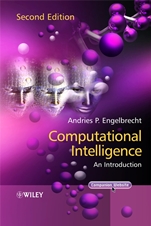
Computational Intelligence: An Introduction
ISBN 9780470035610
Autor: Andries P. Engelbrecht
Wydawca: Wiley
Dostępność: 3-6 tygodni
Cena: 459,90 zł
Przed złożeniem zamówienia prosimy o kontakt mailowy celem potwierdzenia ceny.
ISBN13: |
9780470035610 |
ISBN10: |
0470035617 |
Autor: |
Andries P. Engelbrecht |
Oprawa: |
Hardback |
Rok Wydania: |
2007-10-12 |
Numer Wydania: |
2nd Edition |
Ilość stron: |
628 |
Wymiary: |
244x168 |
Tematy: |
TJ |
Computational Intelligence: An Introduction, Second Edition offers an in–depth exploration into the adaptive mechanisms that enable intelligent behaviour in complex and changing environments. The main focus of this text is centred on the computational modelling of biological and natural intelligent systems, encompassing swarm intelligence, fuzzy systems, artificial neutral networks, artificial immune systems and evolutionary computation.
Engelbrecht provides readers with a wide knowledge of Computational Intelligence (CI) paradigms and algorithms; inviting readers to implement and problem solve real–world, complex problems within the CI development framework. This implementation framework will enable readers to tackle new problems without any difficulty through a single Java class as part of the CI library.
Key features of this second edition include:
A tutorial, hands–on based presentation of the material.
State–of–the–art coverage of the most recent developments in computational intelligence with more elaborate discussions on intelligence and artificial intelligence (AI).
New discussion of Darwinian evolution versus Lamarckian evolution, also including swarm robotics, hybrid systems and artificial immune systems.
A section on how to perform empirical studies; topics including statistical analysis of stochastic algorithms, and an open source library of CI algorithms.
Tables, illustrations, graphs, examples, assignments, Java code implementing the algorithms, and a complete CI implementation and experimental framework.
Computational Intelligence: An Introduction, Second Edition is essential reading for third and fourth year undergraduate and postgraduate students studying CI. The first edition has been prescribed by a number of overseas universities and is thus a valuable teaching tool. In addition, it will also be a useful reso
urce for researchers in Computational Intelligence and Artificial Intelligence, as well as engineers, statisticians, operational researchers, and bioinformaticians with an interest in applying AI or CI to solve problems in their domains.
Check out www.http://ci.cs.up.ac.za for examples, assignments and Java code implementing the algorithms.
Spis treści:
Figures.
Tables.
Algorithms.
Preface.
Part I INTRODUCTION.
1 Introduction to Computational Intelligence.
1.1 Computational Intelligence Paradigms.
1.2 Short History.
1.3 Assignments.
Part II ARTIFICIAL NEURAL NETWORKS.
2 The Artificial Neuron.
2.1 Calculating the Net Input Signal.
2.2 Activation Functions.
2.3 Artificial Neuron Geometry.
2.4 Artificial Neuron Learning.
2.5 Assignments.
3 Supervised Learning Neural Networks.
3.1 Neural Network Types.
3.2 Supervised Learning Rules.
3.3 Functioning of Hidden Units.
3.4 Ensemble Neural Networks.
3.5 Assignments.
4 Unsupervised Learning Neural Networks.
4.1 Background.
4.2 Hebbian Learning Rule.
4.3 Principal Component Learning Rule.
4.4 Learning Vector Quantizer–I.
4.5 Self–Organizing Feature Maps.
4.6 Assignments.
5 Radial Basis Function Networks.
5.1 Learning Vector Quantizer–II.
5.2 Radial Basis Function Neural Networks.
5.3 Assignments.
6 Reinforcement Learning.
6.1 Learning through Awards.
6.2 Model–Free Reinforcement LearningModel.
6.3 Neural Networks and Reinforcement Learning.
6.4 Assignments.
7 Performance Issues (Supervised Learning).
7.1 PerformanceMeasures.
7.2 Analysis of Performance.
7.3 Performance Factors.
7.4 Assignments.
Part III EVOLUTIONARY COMPUTATION.
8 Introduction to Evolutionary Computation.
8.1 Generic Evolutionary Algorithm.
8.2 Representation – The C
hromosome.
8.3 Initial Population.
8.4 Fitness Function.
8.5 Selection.
8.6 Reproduction Operators.
8.7 Stopping Conditions.
8.8 Evolutionary Computation versus Classical Optimization.
8.9 Assignments.
9 Genetic Algorithms.
9.1 Canonical Genetic Algorithm.
9.2 Crossover.
9.3 Mutation.
9.4 Control Parameters.
9.5 Genetic Algorithm Variants.
9.6 Advanced Topics.
9.7 Applications.
9.8 Assignments.
10 Genetic Programming.
10.1 Tree–Based Representation.
10.2 Initial Population.
10.3 Fitness Function.
10.4 Crossover Operators.
10.5 Mutation Operators.
10.6 Building Block Genetic Programming.
10.7 Applications.
10.8 Assignments.
11 Evolutionary Programming.
11.1 Basic Evolutionary Programming.
11.2 Evolutionary Programming Operators.
11.3 Strategy Parameters.
11.4 Evolutionary Programming Implementations.
11.5 Advanced Topics.
11.6 Applications.
11.7 Assignments.
12 Evolution Strategies.
12.1 (1+1)–ES.
12.2 Generic Evolution Strategy Algorithm.
12.3 Strategy Parameters and Self–Adaptation.
12.4 Evolution Strategy Operators.
12.5 Evolution Strategy Variants.
12.6 Advanced Topics.
12.7 Applications of Evolution Strategies.
12.8 Assignments.
13 Differential Evolution.
13.1 Basic Differential Evolution.
13.2 DE/x/y/z.
13.3 Variations to Basic Differential Evolution.
13.4 Differential Evolution for Discrete–Valued Problems.
13.5 Advanced Topics.
13.6 Applications.
13.7 Assignments.
14 Cultural Algorithms.
14.1 Culture and Artificial Culture.
14.2 Basic Cultural Algorithm.
14.3 Belief Space.
14.4 Fuzzy Cultural Algorithm.
14.5 Advanced Topics.
14.6 Applications.
14.7 Assignments.
15 Coevolution.
15.1 Coevolution Types.
15.2 Competitive Coevolution.
15.3 Cooperative Coevolution.
15.4 Assignments.
Part IV COMPUTATIONAL SWARM INTELLIGENCE.
16 Particle Swarm Optimization.
16.1 Basic Particle Swarm Optimization.
16.2 Social Network Structures.
16.3 Basic Variations.
16.4 Basic PSO Parameters.
16.5 Single–Solution Particle SwarmOptimization.
16.6 Advanced Topics.
16.7 Applications.
16.8 Assignments.
17 Ant Algorithms.
17.1 Ant Colony OptimizationMeta–Heuristic.
17.2 Cemetery Organization and Brood Care.
17.3 Division of Labor.
17.4 Advanced Topics.
17.5 Applications.
17.6 Assignments.
Part V ARTIFICIAL IMMUNE SYSTEMS.
18 Natural Immune System.
18.1 Classical View.
18.2 Antibodies and Antigens.
18.3 TheWhite Cells.
18.4 Immunity Types.
18.5 Learning the Antigen Structure.
18.6 The Network Theory.
18.7 The Danger Theory.
18.8 Assignments.
19 Artificial Immune Models.
19.1 Artificial Immune System Algorithm.
19.2 Classical ViewModels.
19.3 Clonal Selection TheoryModels.
19.4 Network TheoryModels.
19.5 Danger TheoryModels.
19.6 Applications and Other AIS models.
19.7 Assignments.
Part VI FUZZY SYSTEMS.
20 Fuzzy Sets.
20.1 Formal Definitions.
20.2 Membership Functions.
20.3 Fuzzy Operators.
20.4 Fuzzy Set Characteristics.
20.5 Fuzziness and Probability.
20.6 Assignments.
21 Fuzzy Logic and Reasoning.
21.1 Fuzzy Logic.
21.2 Fuzzy Inferencing.
21.3 Assignments.
22 Fuzzy Controllers.
22.1 Components of Fuzzy Controllers.
22.2 Fuzzy Controller Types.
22.3 Assignments.
23 Rough Sets.
23.1 Concept of Discernibility.
23.2 Vagueness in Rough Sets.
23.3 Uncertainty in Rough Sets.
23.4 Assignments.
References.
A Optimization Theory.
A.1 Basic Ingredients of Optimization Problems.
A.2 Optimization ProblemClassifications.
A.3 Optima Types.
A.4 OptimizationMethod Classes.
A.5 Unconstrained Optimi
Koszyk
Książek w koszyku: 0 szt.
Wartość zakupów: 0,00 zł
Informacje


Kontakt
Gambit
Centrum Oprogramowania
i Szkoleń Sp. z o.o.
Al. Pokoju 29b/22-24
31-564 Kraków
Siedziba Księgarni
ul. Kordylewskiego 1
31-542 Kraków
+48 12 410 5991
+48 12 410 5987
+48 12 410 5989
Subskrypcje
Administratorem danych osobowych jest firma Gambit COiS Sp. z o.o. Na podany adres będzie wysyłany wyłącznie biuletyn informacyjny.
Autoryzacja płatności

Informacje na temat autoryzacji płatności poprzez PayU.

© Copyright 2012: GAMBIT COiS Sp. z o.o. Wszelkie prawa zastrzeżone.
Projekt i wykonanie: Alchemia Studio Reklamy