


Wydawcy
Katalog tematyczny
- Archeologia (109)
- Ekonomia, finanse, business (13704)
- Filozofia (1445)
- Historia (3040)
- Języki i językoznawstwo (2356)
- Lifestyle, hobby i rozrywka (475)
- Medycyna (9704)
- Nauki humanistyczne (4)
- Nauki o Ziemi i środowisku (2638)
- Nauki ścisłe (20412)
- Nauki społeczne (8486)
- Nauki techniczne (13450)
- Prawo (1696)
- Publikacje informacyjne i interdyscyplinarne (1288)
- Religia i wierzenia (917)
- Technika komputerowa (4067)
- Zdrowie, relacje międzyludzkie i rozwój osobisty (657)





Informacje szczegółowe o książce
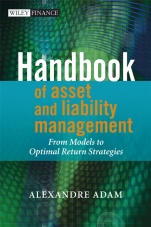
Handbook of Asset and Liability Management: From Models to Optimal Return Strategies
ISBN 9780470034965
Autor: Alexandre Adam
Wydawca: Wiley
Dostępność: 3-6 tygodni
Cena: 444,15 zł
Przed złożeniem zamówienia prosimy o kontakt mailowy celem potwierdzenia ceny.
ISBN13: |
9780470034965 |
ISBN10: |
0470034963 |
Autor: |
Alexandre Adam |
Oprawa: |
Hardback |
Rok Wydania: |
2007-10-26 |
Ilość stron: |
576 |
Wymiary: |
251x175 |
Tematy: |
KF |
The Handbook of Asset & Liability Management: From Models to Optimal Return Strategies is a Comprehensive resource for Asset and Liability Management (ALM) Professionals, providing the very latest global coverage of the topic.
Starting with a look at the history of Asset and Liability Management and the current climate, the book then examines a range of accounting and auditing obligations, including IFRS and balance sheet presentation. Balance sheet items and products modelling are then explained in detail as well as the entire associated range of financial and non–financial risks. As well as the practical issues encountered by ALM managers, the Handbook of Asset Liability Management also considers the growing quantitative aspects of the role, looking at a range of technical tools and applications including market simulations, stochastic calculations, delta equivalent computations, and traditional and non–traditional statistical tools.
The book then discusses capital requirements within the ALM context, notably the impacts of Basel II and solvency II and economic capital indicators. The final section of the book explains optimal return strategies, looking at risk perfect hedging, limits policies, income smoothing strategies and economic value management.
The accompanying CD ROM features demonstrations of some basic ALM problems such as ALM Delta Equivalent computation; FTP computation and ALM risk indicators computation. It also includes modelling examples such as demand deposits, savings and prepayment modelling; and practical examples taken from a simplified retail Banking ALM framework.
Spis treści:
Preface.
Acknowledgments.
About the author.
PART I INTRODUCTION.
1 The History of ALM.
1.1 The history of the banking industry from antiquity to the Middle Ages.
1.2 The modern banking industry and the history of ALM.
1.3 The history of the insuran
ce industry and ALM.
1.4 The history of other businesses and ALM.
2 What is Asset and Liability Management Today?
2.1 ALM and the banking industry.
2.2 Other general ALM questions.
PART II INTERNAL TRANSFER PRICING, ACCOUNTING AND AUDITING.
3 Balance Sheet Presentation.
3.1 General balance sheet presentation.
3.2 A/L manager’s balance sheet presentation.
3.3 Banking Book and Insurance Book.
3.4 Income statement and statement of cash flows.
4 “Accrued Accounting” for Interest Rate Instruments Versus “Marked–to–Market” Accounting.
4.1 General principles.
4.2 Accrued accounting examples.
5 IFRS and IAS Accounting.
5.1 IFRS, international organizations and rule presentation.
5.2 IAS 39.
5.3 Financial disclosures.
5.4 IFRS and insurance.
5.5 Other IFRS specificities.
5.6 Impact of IFRS on ALM and criticism of IFRS.
6 “Economic Accounting”: Fair Value and Full Fair Value.
7 Internal Transfer Pricing or Fund Transfer Pricing (FTP).
7.1 Principles.
7.2 Advanced transfer pricings including credit risk and expected return on economic capital.
7.3 The inclusion of implicit options inclusion in the “contract by contract” FTP rules and commercial department arbitrage opportunity.
7.4 FTP rules based on the “stock” and based on the “flows.”
7.5 Examples of FTP rules.
7.6 Perequations.
8 ALM as a Profit Centre.
8.1 One profit centre for one financial risk.
9 Optimal Organization of an ALM Team.
9.1 The usual ALM organization.
9.2 The objectives of ALM.
9.3 ALCO: the ALM committee.
9.4 The different ALM teams.
PART III BALANCE SHEET ITEMS AND PRODUCTS MODELLING.
10 Behavioural Modelling Principles.
10.1 The constitution of databases.
10.2 Event driven modelling.
10.3 Modelling the strategy of the co
mpany.
10.4 Expert advice.
10.5 Model backtesting.
11 Deposits and Savings.
11.1 Deposits, monetary aggregates, money supply and macroeconomics.
11.2 Demand deposit accounts.
11.3 Saving accounts: regulated and non–regulated savings versus super–savings.
11.4 Demand deposits models in the literature.
11.5 Deposit modelling: the solution through an approach based on customer behaviour modelling.
11.6 Deposit modelling through a customer behaviour modelling based approach: representation in risk indicators and FTP.
12 Loans.
12.1 Different types of loan.
12.2 Different definitions and formulae.
13 Prepayments.
13.1 The origins of the prepayment phenomenon.
13.2 The constitution of the database for prepayment modelling.
13.3 Different models: historical database–based approaches and MBS–based approaches.
13.4 Prepayment scoring.
13.5 Prepayment monitoring.
14 Other Examples of Products Needing Behavioural Modelling.
14.1 Pipeline risk.
14.2 Margin delay effects such as “whistle effects”
14.3 Other volume effects options.
15 Examples of Products Partially Correlated with Financial Markets.
15.1 Presence of correlation between the cash flows and financial markets: examples of credit card.
15.2 Costs and commissions correlation with financial markets.
15.3 Examples of embedded options.
16 New Production Modelling.
16.1 New contract production.
16.2 Commission and cost modelling.
16.3 Perequation modelling.
16.4 Future strategies modelling.
17 Insurance Products.
17.1 Unit of account contracts.
17.2 Mutual funds.
18 Hedging Instruments.
18.1 Derivatives.
18.2 Bond strategies.
18.3 Mortgage Backed Securities.
PART IV RISK MANAGEMENT FOR ASSET AND LIABILITY MANAGERS.
19 Financial Risks.
19.1 Liquidity risk.
19.2 Credit risk.
19.3 Interest rate
risk.
19.4 Inflation risk.
19.5 Currency risk.
19.6 Corporate stock market risk.
19.7 Real estate risk/property risk.
19.8 Other financial risks.
20 Non–Financial Risks.
20.1 Operational risks.
20.2 Model risks.
20.3 Business risk.
20.4 Risk correlations.
20.5 “Accounting risk”: the risk representation depends on the accounting scheme!
PART V TOOLS FOR ASSET AND LIABILITY MANAGERS.
21 Simulation Tools for Interest Rates and Other Financial Indexes.
21.1 Stochastic calculation.
21.2 Equity market simulation.
21.3 Interest rate simulation.
21.4 Generic models for joint simulation of inflation, stock index, interest rates, real estate, liquidity and credit spreads.
21.5 Market simulations including risk premiums.
22 Delta Equivalent Computation.
22.1 Principles.
22.2 Delta, penta, correla and courba equivalents or “Adam equivalents”
22.3 Delta equivalent associated break–even point.
22.4 Examples of delta equivalent computation.
22.5 Hedging error and gamma equivalent.
23 Technical Tools Useful in ALM.
23.1 Risk measures.
23.2 Optimization methods.
23.3 Common statistical tools in ALM.
23.4 Other statistical tools and common ALM functions.
PART VI ECONOMIC VALUE AND NEW RISK INDICATORS ASSOCIATED WITH THE BASEL II AND SOLVENCY II REGULATORY PERSPECTIVE.
24 Basel II Regulation and Solvency II.
24.1 Common regulatory risk constraints.
24.2 Basel II: normalized regulatory constraints.
24.3 Solvency II.
25 Links Between ALM and Financial Analysis.
25.1 Performance indicators in the company.
25.2 Shareholder’s equity value, economic value and risk premiums.
25.3 Capital allocation/attribution and capital consumption.
25.4 Company valuation and cost of capital with positive tax rate.
25.5 Merton’s model.
25.6 Financial analysis and ALM implications.<
Koszyk
Książek w koszyku: 0 szt.
Wartość zakupów: 0,00 zł
Informacje


Kontakt
Gambit
Centrum Oprogramowania
i Szkoleń Sp. z o.o.
Al. Pokoju 29b/22-24
31-564 Kraków
Siedziba Księgarni
ul. Kordylewskiego 1
31-542 Kraków
+48 12 410 5991
+48 12 410 5987
+48 12 410 5989
Subskrypcje
Administratorem danych osobowych jest firma Gambit COiS Sp. z o.o. Na podany adres będzie wysyłany wyłącznie biuletyn informacyjny.
Autoryzacja płatności

Informacje na temat autoryzacji płatności poprzez PayU.

© Copyright 2012: GAMBIT COiS Sp. z o.o. Wszelkie prawa zastrzeżone.
Projekt i wykonanie: Alchemia Studio Reklamy