


Wydawcy
Katalog tematyczny
- Archeologia (109)
- Ekonomia, finanse, business (13704)
- Filozofia (1445)
- Historia (3040)
- Języki i językoznawstwo (2356)
- Lifestyle, hobby i rozrywka (475)
- Medycyna (9704)
- Nauki humanistyczne (4)
- Nauki o Ziemi i środowisku (2638)
- Nauki ścisłe (20412)
- Astronomia (294)
- Biologia (5119)
- Chemia (6540)
- Fizyka (3309)
- Elektryczność i magnetyzm (90)
- Fizyka atomowa i molekularna (110)
- Fizyka cząstek elementarnych (36)
- Fizyka jądra atomowego (36)
- Fizyka kwantowa (210)
- Fizyka matematyczna (121)
- Fizyka relatywistyczna (36)
- Fizyka statystyczna (51)
- Fizyka stosowana (498)
- Mechanika klasyczna (186)
- Optyka i światło (133)
- Stany materii (202)
- Matematyka (4574)
- Nauki ścisłe, ogólnie (503)
- Nauki społeczne (8486)
- Nauki techniczne (13450)
- Prawo (1696)
- Publikacje informacyjne i interdyscyplinarne (1288)
- Religia i wierzenia (917)
- Technika komputerowa (4067)
- Zdrowie, relacje międzyludzkie i rozwój osobisty (657)





Informacje szczegółowe o książce
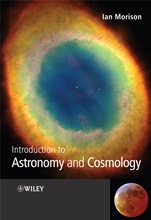
Introduction to Astronomy and Cosmology
ISBN 9780470033340
Autor: Ian Morison
Wydawca: Wiley
Dostępność: 3-6 tygodni
Cena: 267,75 zł
Przed złożeniem zamówienia prosimy o kontakt mailowy celem potwierdzenia ceny.
ISBN13: |
9780470033340 |
ISBN10: |
0470033347 |
Autor: |
Ian Morison |
Oprawa: |
Paperback |
Rok Wydania: |
2008-10-24 |
Ilość stron: |
360 |
Wymiary: |
244x170 |
Tematy: |
PH |
Introduction to Astronomy & Cosmology is based on a successful course given by the author to give first year university students a thorough grounding in modern astronomy and to describe the techniques that have given rise to many exciting discoveries. The book also aims to show that astronomy is a wonderful showcase for fundamental physics and how it determines the fabric of the Universe.
The Chapters are Organised as Follows:Astronomy, an observational scienceOur Solar System I – the SunOur Solar System II – the PlanetsExtra–solar PlanetsObserving the UniverseThe Properties of StarsStellar Evolution – the life and death of starsGalaxies and the Large Scale Structure of the UniverseCosmology – the origin and evolution of the universe
Every concept is accompanied by worked examples including problems at the end of each chapters. Complex mathematics are not required to use this book.
This highly illustrated textbook, including numerous colour images, though primarily written for undergraduates, will also be of interest to amateur astronomers and students studying astronomy in senior school.
Spis treści:
Preface.
Bibliography.
Chapter 1: Astronomy, an Observational Science.
1.1 Introduction.
1.2 Galileo Galilel’s proof of the Copernican theory of the solar system.
1.3 The celestial sphere and stellar magnitudes.
1.4 The celestial coordinate system.
1.5 Precession.
1.6 Time.
1.7 A second major observational triumph: the laws of planetary motion.
1.8 Measuring the astronomical unit.
1.9 Isaac Newton and his Universal law of Gravity.
1.10 Experimental measurements of G, the Universal constant of gravitation.
1.11 Gravity today: Einstein’s special and general theories of relativity.
1.12 Conclusion.
1.13 Questions.
Chapter 2: Our Solar System 1 – The Sun.
2.1 The formatio
n of the solar system.
2.2 The Sun.
2.3 Nuclear fusion.
2.4 The solar neutrino problem.
2.5 The solar atmosphere: photosphere, chromosphere and corona.
2.6 The solar wind.
2.7 The sun’s magnetic field and the sunspot cycle.
2.8 Prominences, flares and the interaction of the solar wind with the earth’s atmosphere.
2.9 Solar eclipses.
2.10 Questions.
Chapter 3: Our Solar System 2 – The Planets.
3.1 What is a planet?
3.2 Planetary orbits.
3.3 Planetary properties.
3.4 Planetary atmospheres.
3.5 The planets of the solar systems.
3.6 Comets.
3.7 Questions.
Chapter 4: Extra–solar Planets.
4.1 The radial velocity (Doppler wobble) method of planetary detection.
4.2 Planetary transits.
4.3 Gravitational microlensing.
4.4 Astrometry.
4.5 Discovery space.
4.6 Selection effects and the likelihood of finding solar systems like ours.
4.7 Questions.
Chapter 5: Observing the Universe.
5.1 Thinking about optics in terms of waves rather than rays.
5.2 The human eye.
5.3 The use of a telescope or pair of binoculars to see fainter objects.
5.4 Using a telescope to see more detail in an image.
5.5 The magnification of a telescope.
5.6 Image Contrast.
5.7 The classic Newtonian telescope.
5.8 The Cassegrain telescope.
5.9 Catadioptric telescopes.
5.10 Active and adaptive optics.
5.11 Some significant optical telescopes.
5.12 Radio telescopes.
5.13 Observing in other wavebands.
5.14 Observing the universe without using electromagnetic radiation.
5.15 Questions.
Chapter 6: The Properties of Stars.
6.1 Stellar luminosity.
6.2 Stellar distances.
6.3 Proper motion.
6.4 The absolute magnitude scale.
6.5 Colour and surface temperature.
6.6 Stellar photometry.
6.7 Stellar spectra.
6.8 Spectroscopic parallax.
6.9 The Hertzsprung–Russell Diagram.
6.10 The size of stars.
6.11 The masse
s and densities of stars.
6.12 The stellar mass–luminosity relationship.
6.13 Stellar lifetimes.
6.14 Questions.
Chapter 7: Stellar Evolution – The Life and Death of Stars.
7.1 Low mass stars: 0.05–0.5 solar masses.
7.2 Mid mass stars: 0.5—8 solar masses.
7.3 Variable stars.
7.4 Planetary nebula.
7.5 White dwarfs.
7.6 The evolution of a sun–like star.
7.7 Evolution in close binary systems – the Algol paradox.
7.8 High mass stars in the range >8 solar masses.
7.9 Type II supernova.
7.10 Neutron stars and black holes.
7.11 The discovery of pulsars.
7.12 Pulsars as tests for general relativity.
7.13 Black holes.
7.14 Questions.
Chapter 8: Galaxies and the Large Scale Structure of the Universe.
8.1 The Milky Way.
8.2 Other galaxies.
8.3 The universe.
8.4 Questions.
Chapter 9: Cosmology – the Origin and Evolution of the Universe.
9.1 Einstein’s blunder?
9.2 Big Bang models of the universe.
9.3 The blueshifts and redshifts observed in the spectra of galaxies.
9.4 The expansion of the universe.
9.5 The steady state model of the universe.
9.6 Big Bang or Steady State?
9.7 The cosmic microwave background.
9.8 Inflation.
9.9 The Big Bang and the formation of the primeval elements.
9.10 The ‘ripples’ in the Cosmic Microwave Background.
9.11 How dark matter effects the cosmic microwave background.
9.12 The hidden universe: dark matter and dark energy.
9.13 The makeup of the universe.
9.14 A universe fir for intelligent life.
9.15 Intelligent life in the universe.
9.16 The future of the universe.
Index.
Nota biograficzna:
Ian Morison began his love of astronomy when, at the age of 12, he made a telescope out of lenses given to him by his optician. He went on to study Physics, Mathematics and Astronomy at Oxford and in 1970 was appointed to the sta
ff of the University of Manchester where he now teaches astronomy, computing and electronics.
He is a past president of the Society for Popular Astronomy, one of the UK′s largest astronomical societies. He remains on the society′s council and holds the post of instrument advisor helping members with their choice and use of Telescopes.
He lectures wi9dely on astronomy, has co–authored books for amateur astronomers and writes regularly for the two UK astronomy magazines. He also writes a monthly sky guide for the Jodrell Bank Observatory′s web site and produces an audio version as part of the Jodrell Bank Podcast. He has contributed to many television programmes and is a regular astronomy commentator on local and national radio. Another activity he greatly enjoys to take amateur astronomers on observing trips such as those to Lapland to see the Aurora Borealis and on expeditions to Turkey and China to observe total eclipses of the Sun.
In 2003 the Minor Planets Committee of the International Astronomical Union named asteroid 15,727 in his honour, citing his work with MERLIN, the world′s largest linked array of radio telescopes, and that in searching for intelligent life beyond our Solar System in Project Phoenix. In 2007 he was appointed to the post of Gresham Professor of Astronomy. Dating from 1597, this is the oldest astronomy professorship in the world and was once held by Christopher Wren.
Okładka tylna:
Introduction to Astronomy & Cosmology is based on a successful course given by the author to give first year university students a thorough grounding in modern astronomy and to describe the techniques that have given rise to many exciting discoveries. The book also aims to show that astronomy is a wonderful showcase for fundamental physics and how it determines the fabric of the Universe.
The Chapters are Organised as Follows:Astronomy, an observational scienceOur Solar Sy
stem I – the SunOur Solar System II – the PlanetsExtra–solar PlanetsObserving the UniverseThe Properties of StarsStellar Evolution – the life and death of starsGalaxies and the Large Scale Structure of the UniverseCosmology – the origin and evolution of the universe
Every concept is accompanied by worked examples including problems at the end of each chapters. Complex mathematics are not required to use this book.
This highly illustrated textbook, including numerous colour images, though primarily written for undergraduates, will also be of interest to amateur astronomers and students studying astronomy in senior school.
Koszyk
Książek w koszyku: 0 szt.
Wartość zakupów: 0,00 zł
Informacje


Kontakt
Gambit
Centrum Oprogramowania
i Szkoleń Sp. z o.o.
Al. Pokoju 29b/22-24
31-564 Kraków
Siedziba Księgarni
ul. Kordylewskiego 1
31-542 Kraków
+48 12 410 5991
+48 12 410 5987
+48 12 410 5989
Subskrypcje
Administratorem danych osobowych jest firma Gambit COiS Sp. z o.o. Na podany adres będzie wysyłany wyłącznie biuletyn informacyjny.
Autoryzacja płatności

Informacje na temat autoryzacji płatności poprzez PayU.

© Copyright 2012: GAMBIT COiS Sp. z o.o. Wszelkie prawa zastrzeżone.
Projekt i wykonanie: Alchemia Studio Reklamy