


Wydawcy
Katalog tematyczny
- Archeologia (109)
- Ekonomia, finanse, business (13704)
- Filozofia (1445)
- Historia (3040)
- Języki i językoznawstwo (2356)
- Lifestyle, hobby i rozrywka (475)
- Medycyna (9704)
- Nauki humanistyczne (4)
- Nauki o Ziemi i środowisku (2638)
- Nauki ścisłe (20412)
- Astronomia (294)
- Biologia (5119)
- Chemia (6540)
- Chemia analityczna (361)
- Chemia fizyczna (346)
- Chemia nieorganiczna (137)
- Chemia organiczna (535)
- Krystalografia (27)
- Minerologia (46)
- Fizyka (3309)
- Matematyka (4574)
- Nauki ścisłe, ogólnie (503)
- Nauki społeczne (8486)
- Nauki techniczne (13450)
- Prawo (1696)
- Publikacje informacyjne i interdyscyplinarne (1288)
- Religia i wierzenia (917)
- Technika komputerowa (4067)
- Zdrowie, relacje międzyludzkie i rozwój osobisty (657)





Informacje szczegółowe o książce
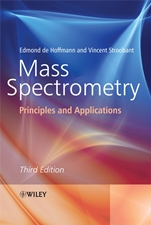
Mass Spectrometry: Principles and Applications
ISBN 9780470033104
Autor: Edmond de Hoffmann, Vincent Stroobant
Wydawca: Wiley
Dostępność: 3-6 tygodni
Cena: 855,75 zł
Przed złożeniem zamówienia prosimy o kontakt mailowy celem potwierdzenia ceny.
ISBN13: |
9780470033104 |
ISBN10: |
047003310X |
Autor: |
Edmond de Hoffmann, Vincent Stroobant |
Oprawa: |
Hardback |
Rok Wydania: |
2007-09-21 |
Numer Wydania: |
3rd Edition |
Ilość stron: |
502 |
Wymiary: |
244x168 |
Tematy: |
PN |
Mass Spectrometry: Principles and Applications, Third Edition
Edmond de Hoffmann, Université Catholique de Louvain, Belgium and Vincent Stroobant, Ludwig Institute for Cancer Research, Brussels Branch, Belgium.
Mass Spectrometry, Third Edition provides students with a complete overview of the principles, theories and key applications of modern mass spectrometry. Extensively revised and updated, the third edition of this successful textbook focuses on recent developments in techniques and applications. All instrumental aspects of mass spectrometry are clearly and concisely described. Emphasis is placed throughout the text on practical application examples. As with previous editions, it contains numerous tables of useful data, references and a series of exercises of increasing difficulty to encourage student understanding.
Provides a complete overview of the principles, theories and applications of modern mass spectrometry
An extensive revision and update including: increased coverage of MALDI and ESI, resolution and mass accuracy and activation of ions
New material about instruments such as linear traps, Orbitrap, TOF/TOF, hybrid instruments, and about new atmospheric ionisation techniques such as APPI, DESI, DART. The range of applications has been expanded and newer methods such as metabolome are included
Contains numerous examples and exercises to encourage student understanding
Mass Spectrometry: Principles and Applications, Third Edition will prove invaluable to undergraduates and postgraduates using this technique in departments of chemistry, biochemistry, medicine, pharmacology, agriculture, materials science and food science. It will also appeal to researchers looking for an overview of the latest techniques and developments.
Spis treści:
Preface.
Introduction.
Principles.Diagram of a Mass Spectrometer.
History.
Ion Free Path.
1 Ion Sources.
1.1 Electron Ionization.
1.2 Chemical Ionization.
1.2.1 Proton transfer.
1.2.2 Adduct formation.
1.2.3 Charge–transfer chemical ionization.
1.2.4 Reagent gas.
1.2.5 Negative ion formation.
1.2.6 Desorption chemical ionization (DCI).
1.3 Field Ionization.
1.4 Fast Atom Bombardment and Liquid Secondary Ion Mass Spectrometry.
1.5 Field Desorption.
1.6 Plasma Desorption.
1.7 Laser Desorption.
1.8 Matrix–Assisted Laser Desorption Ionization.
1.8.1 Principle of MALDI.
1.8.2 Practical considerations.
1.8.3 Fragmentations.
1.8.4 Atmospheric pressure matrix–assisted laser desorption ionization.
1.9 Thermospray.
1.10 Atmospheric Pressure Ionization.
1.11 Electrospray.
1.11.1 Multiply charged ions.
1.11.2 Electrochemistry and electric field as origins of multiply charged ions.
1.11.3 Sensitivity to concentration.
1.11.4 Limitation of ion current from the source by the electrochemical process.
1.11.5 Practical considerations.
1.12 Atmospheric Pressure Chemical Ionization.
1.13 Atmospheric Pressure Photoionization (APPI).
1.14 Atmospheric Pressure Secondary Ion Mass Spectrometry (APSIMS).
1.14.1 Desorption electrospray ionization (DESI).
1.14.2 Direct analysis in real time (DART).
1.15 Inorganic Ionization Sources.
1.15.1 Thermal ionization source.
1.15.2 Spark source.
1.15.3 Glow discharge source.
1.15.4 Inductively coupled plasma source.
1.15.5 Practical considerations.
1.16 Gas–Phase Ion–Molecule Reactions.
1.17 Formation and Fragmentation of Ions: Basic Rules.
1.17.1 Electron ionization and photoionization under vacuum.
1.17.2 Ionization at low pressure or at atmospheric pressure.
1.17.3 Proton transfer.
1.17.4 Adduct formation.
1.17.5 Formation of aggregates or clusters.
1.17.6 Reactions at the interface between source and
analyzer.
2 Mass Analyzers.
2.1 Quadrupole Analyzers.
2.1.1 Description.
2.1.2 Equations of motion.
2.1.3 Ion guide and collision cell.
2.1.4 Spectrometers with several quadrupoles in tandem.
2.2 Ion Trap Analyzers.
2.2.1 Three–dimensional ion trap.
2.2.2 Two–dimensional ion trap.
2.3 The Electrostatic Trap or "Orbitrap".
2.4 Time–of–Flight Analyzers.
2.4.1 Linear time–of–flight mass spectrometer.
2.4.2 Delayed pulsed extraction.
2.4.3 Reflectrons.
2.4.4 Tandem mass spectrometry with time–of–flight analyzer.
2.4.5 Orthogonal acceleration time–of–flight instruments.
2.5 Magnetic and Electromagnetic Analyzers.
2.5.1 Action of the magnetic field.
2.5.2 Electrostatic field.
2.5.3 Dispersion and resolution.
2.5.4 Practical considerations.
2.5.5 Tandem mass spectrometry in electromagnetic analyzers.
2.6 Ion Cyclotron Resonance and Fourier Transform Mass Spectrometry.
2.6.1 General principle.
2.6.2 Ion cyclotron resonance.
2.6.3 Fourier transform mass spectrometry.
2.6.4 MSn in ICR/FTMS instruments.
2.7 Hybrid Instruments.
2.7.1 Electromagnetic analyzers coupled to quadrupoles or ion trap.
2.7.2 Ion trap analyzer combined with time–of–flight or ion cyclotron resonance.
2.7.3 Hybrids including a time–of–flight with orthogonal acceleration.
3 Detectors and Computers.
3.1 Detectors.
3.1.1 Photographic plate.
3.1.2 Faraday cup.
3.1.3 Electron multipliers.
3.1.4 Electro–optical ion detectors.
3.2 Computers.
3.2.1 Functions.
3.2.2 Instrumentation.
3.2.3 Data acquisition.
3.2.4 Data conversion.
3.2.5 Data reduction.
3.2.6 Library search.
4 Tandem Mass Spectrometry (MS/MS).
4.1 Tandem Mass Spectrometry in Space or in Time.
4.2 Tandem Mass Spectrometry Scan Modes.
4.3 Collision–activated or Collision–induced Dissociati
on (CAD or CID).
4.3.1 Collision energy conversion to internal energy.
4.3.2 High–energy collision (keV).
4.3.3 Low–energy collision (between 1 and 100 eV).
4.4 Other Methods of Ion Activation.
4.5 Reactions Studied in MS/MS.
4.6 Tandem Mass Spectrometry Applications.
4.6.1 Structure elucidation.
4.6.2 Selective detection of target compound class.
4.6.3 Ion–molecule reaction.
4.6.4 The kinetic method.
5 Mass Spectrometry/Chromatography Coupling.
5.1 Elution Chromatography Coupling Techniques.
5.1.1 Gas chromatography/mass spectrometry (GC/MS).
5.1.2 Liquid chromatography/mass spectrometry (LC/MS).
5.1.3 Capillary electrophoresis/mass spectrometry (CE/MS).
5.2 Chromatography Data Acquisition Modes.
5.3 Data Recording and Treatment.
5.3.1. Data recording.
5.3.2 Instrument control and treatment of results.
6 Analytical Information.
6.1 Mass Spectrometry Spectral Collections.
6.2 High Resolution.
6.2.1 Information at different resolving powers.
6.2.2 Determination of the elemental composition.
6.3 Isotopic Abundances.
6.4 Low–mass Fragments and Lost Neutrals.
6.5 Number of Rings or Unsaturations.
6.6 Mass and Electron Parities, Closed–shell Ions and Open–shell Ions.
6.6.1 Electron parity.
6.6.2 Mass parity.
6.6.3 Relationship between mass and electron parity.
6.7 Quantitative Data.
6.7.1 Specificity.
6.7.2 Sensitivity and detection limit.
6.7.3 External standard method.
6.7.4 Sources of error.
6.7.5 Internal standard method.
6.7.6 Isotopic dilution method.
7 Fragmentation Reactions.
7.1 Electron Ionization and Fragmentation Rates.
7.2 Quasi–equilibrium and RRKM Theory.
7.3 Ionization and Appearance Energies.
7.4 Fragmentation Reactions of Positive Ions.
7.4.1 Fragmentation of odd–electron cations or radical cations (OE.+).
7.4.2 Fragmentation of cations with an even nu
Koszyk
Książek w koszyku: 0 szt.
Wartość zakupów: 0,00 zł
Informacje


Kontakt
Gambit
Centrum Oprogramowania
i Szkoleń Sp. z o.o.
Al. Pokoju 29b/22-24
31-564 Kraków
Siedziba Księgarni
ul. Kordylewskiego 1
31-542 Kraków
+48 12 410 5991
+48 12 410 5987
+48 12 410 5989
Subskrypcje
Administratorem danych osobowych jest firma Gambit COiS Sp. z o.o. Na podany adres będzie wysyłany wyłącznie biuletyn informacyjny.
Autoryzacja płatności

Informacje na temat autoryzacji płatności poprzez PayU.

© Copyright 2012: GAMBIT COiS Sp. z o.o. Wszelkie prawa zastrzeżone.
Projekt i wykonanie: Alchemia Studio Reklamy