


Wydawcy
Katalog tematyczny
- Archeologia (109)
- Ekonomia, finanse, business (13704)
- Filozofia (1445)
- Historia (3040)
- Języki i językoznawstwo (2356)
- Lifestyle, hobby i rozrywka (475)
- Medycyna (9704)
- Nauki humanistyczne (4)
- Nauki o Ziemi i środowisku (2638)
- Nauki ścisłe (20412)
- Nauki społeczne (8486)
- Nauki techniczne (13450)
- Budownictwo lądowe (1045)
- Chemia przemysłowa (2258)
- Elektronika i telekomunikacja (3287)
- Energetyka (1122)
- Inne nauki stosowane (363)
- Inżynieria biochemiczna (507)
- Inżynieria transportu (232)
- Mechanika i materiały (3316)
- Nauka o środowisku (321)
- Rolnictwo (507)
- Technika, ogólnie (475)
- Prawo (1696)
- Publikacje informacyjne i interdyscyplinarne (1288)
- Religia i wierzenia (917)
- Technika komputerowa (4067)
- Zdrowie, relacje międzyludzkie i rozwój osobisty (657)





Informacje szczegółowe o książce
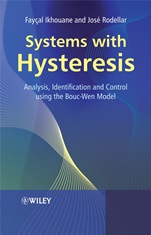
Systems with Hysteresis: Analysis, Identification and Control Using the Bouc–Wen Model
ISBN 9780470032367
Autor: Fayçal Ikhouane, José Rodellar
Wydawca: Wiley
Dostępność: 3-6 tygodni
Cena: 605,85 zł
Przed złożeniem zamówienia prosimy o kontakt mailowy celem potwierdzenia ceny.
ISBN13: |
9780470032367 |
ISBN10: |
0470032367 |
Autor: |
Fayçal Ikhouane, José Rodellar |
Oprawa: |
Hardback |
Rok Wydania: |
2007-07-06 |
Ilość stron: |
222 |
Wymiary: |
234x160 |
Tematy: |
TG |
Hysteresis is a property that is inherent to a range of engineering applications where systems have specific components whose action–response dynamics involve memory effects. The Bouc–Wen model is a well–known semi–physical model that is used extensively to describe hysteresis in the areas of smart structures and civil engineering.
The Bouc–Wen model for hysteresis has become increasingly popular in the last few years due to its capability of capturing in an analytical form a range of shapes of hysteretic cycles that match the behaviour of a wide class of hysteretic systems. Systems with Hysteresis deals with the analysis, identification and control of these systems, and offers a comprehensive and self–contained framework for the study of the Bouc–Wen model.
Provides a rigorous mathematical treatment of the subject along with practical comments and numerical solutions.Analyses the compatibility of the Bouc–Wen model with some laws of physics, and continues to cover the analytical description of the hysteresis loop, the relationship between the model parameters and hysteresis loop, the identification of the model parameters and the control of systems that include a hysteretic part described by the Bouc–Wen model.Includes the case study of magnetorheological (MR) dampers, new popular smart material actuators.
Systems with Hysteresis offers an invaluable source of information for academics and practitioners involved in the research, design and development of smart structures, structural control and related areas within automotive, mechanical, civil and aerospace engineering. It will also be of interest to readers involved in the wider disciplines of electrical & control engineering, applied mathematics, applied physics and material science.
Spis treści:
Preface.
List of Figures.
List of
Tables.
1. Introduction
1.1 Objective and contents of the book
1.2 The Bouc–Wen model: origin and literature review
2. Physical consistency of the Bouc–Wen model
2.1 Introduction
2.2 BIBO stability of the Bouc–Wen model
2.2.1 The model
2.2.2 Problem statement
2.2.3 Classi¯cation of the BIBO stable Bouc–Wen models
2.2.4 Practical remarks
2.3 Free motion of a hysteretic structural system
2.3.1 Problem statement
2.3.2 Asymptotic trajectories
2.3.3 Practical remarks
2.4 Passivity of the Bouc–Wen model
2.5 Limit cases
2.5.1 The limit case n = 1
2.5.2 The limit case ® = 1
2.5.3 The limit case ® = 0
2.5.4 The limit case ¯ + ° = 0
2.6 Conclusion
3 Forced limit cycle characterization of the Bouc–Wen model &
#160;
3.1 Introduction
3.2 Problem statement
3.2.1 The class of inputs
3.2.2 Problem statement
3.3 The normalized Bouc–Wen model
3.4 Instrumental functions
3.5 Characterization of the asymptotic behavior of the hysteretic
output
3.5.1 Technical Lemmas
3.5.2 Analytic description of the forced limit cycles for the
Bouc–Wen model
3.6 Simulation example
3.7 Conclusion
4 Variation of the hysteresis loop with the Bouc–Wen model parameters
4.1 Introduction
4.2 Background results and methodology of the analysis
4.2.1 Background results
4.2.2 Methodology of the analysis
4.3 Maximal value of the hysteretic output
4.3.1 Variation with respect to ±
4.3.2 Variation with respect to ¾
4.3.3 Variation with respect to n
4.3.4 Summary of the obtained results
4.4 Variation of the zero of the hysteretic output
4.4.1 Variation with respect to ±
4.4.2 Variation with respect to ¾
4.4.3 Variation with respect to n
4.4.4 Summary of the obtained results
4.5 Variation of the hysteretic output with the Bouc–Wen model
parameters
4.5.1 Variation with respect to ±
4.5.2 Variation with respect to ¾
4.5.3 Variation with respect to n
4.5.4 Summary of the obtained results
4.6 The four regions of the Bouc–Wen model
4.6
.1 The linear region Rl
4.6.2 The plastic region Rp
4.6.3 The transition regions Rt and Rs
4.7 Interpretation of the normalized Bouc–Wen model parameters
4.7.1 The parameters ½ and ±
4.7.2 The parameter ¾
4.7.3 The parameter n
4.8 Conclusion
5 Robust identification of the Bouc–Wen model parameters
5.1 Introduction
5.2 Parameter identi¯cation for the Bouc–Wen
model
5.2.1 Class of inputs
5.2.2 Identi¯cation methodology
5.2.3 Robustness of the identi¯cation method
5.2.4 Numerical simulation example
5.3 Modeling and identi¯cation of a magnetorheological damper
5.3.1 Some insights into the viscous + Bouc–Wen model for
shear mode MR dampers
5.3.2 Alternatives to the viscous + Bouc–Wen model for
shear mode MR dampers
5.4 Identi¯cation methodology for the viscous + Dahl model . .
5.4.1 Numerical simulations
5.5 Conclusion
6 Control of a system with a Bouc–Wen hysteresis
6.1 Introduction and problem statement
6.2 Control design and stability analysis
6.3 Numerical simulation
6.4 Conclusion
A Mathematical background
A.1 Existence and uniqueness of so
lutions
A.2 Concepts of stability
A.3 Passivity and absolute stability
A.3.1 Passivity in mechanical systems
A.3.2 Positive realness
A.3.3 Sector functions
A.3.4 Absolute stability
A.4 Input–output properties
References.
Index.
Nota biograficzna:
Fayçal Ikhouane, Universitat Politècnica de Catalunya, Departament de Matemàtica Aplicada III, Escola Universitària d’Enginyeria Tècnica Industrial de Barcelona. C/ Comte d’Urgell, 187, 08036, Barcelona, Spain.
Fayçal Ikhouane currently holds both a research and teaching post with the Control, Dynamics and Applications group at the Technical University of Catalunya, Spain. He has been in this job since 2002, after having been a visiting scholar at the University of California in Santa Barbara, and a lecturer and associate researcher with the Ecole Nationale d’Industrie Minérale and the Ecole Mohammadia d’Ingénieurs in Morocco. He also worked in industry as a control engineer at the Société des Ciments d’Agadir, Morocco. Dr Ikhouane is now conducting research on modelling, identification and control of mechanical systems and smart structures with nonlinearities such as hysteresis and friction, and is helping to set up a new research laboratory on these topics. He has co–authored around 10 journal papers and 20 papers and presentations at major conferences.
José Rodellar, Universitat Politècnica de Catalunya, Departament de Matemàtica Aplicada III, Escola Tècnica Superior d’Enginyers de Camins, Canalsi Ports, Campus Nord UPC, C2, 08034, Barcelona, Spain.
José Rodellar is currently a Professor in the School of Civil Engineering at the Technical University of Catalunya, Spain. He has been at the university since 1976, and is now Director of the Control, Dynamics and Applications group, which carries out theoretical and applied researc
h on modelling and control, with applications in structural control and smart structures. Previous to this, he has been visiting professor at the Department of Civil Engineering, at the State University of New York, Buffalo (USA), and visiting scholar at the Department of Mechanical Engineering, University of California, Berkeley. He is a member of the Board of Directors of the International Association for Structural Control and Monitoring, has co–authored and edited five books, including Adaptive Predictive Control: From the Concepts to Plant Optimization (Prentice Hall, 1995), Smart Structures and NATO Workshop (Kluwer, 1998), and co–authored around 160 journal and conference papers.
Okładka tylna:
Hysteresis is a property that is inherent to a range of engineering applications where systems have specific components whose action–response dynamics involve memory effects. The Bouc–Wen model is a well–known semi–physical model that is used extensively to describe hysteresis in the areas of smart structures and civil engineering.
The Bouc–Wen model for hysteresis has become increasingly popular in the last few years due to its capability of capturing in an analytical form a range of shapes of hysteretic cycles that match the behaviour of a wide class of hysteretic systems. Systems with Hysteresis deals with the analysis, identification and control of these systems, and offers a comprehensive and self–contained framework for the study of the Bouc–Wen model.
Provides a rigorous mathematical treatment of the subject along with practical comments and numerical solutions.Analyses the compatibility of the Bouc–Wen model with some laws of physics, and continues to cover the analytical description of the hysteresis loop, the relationship between the model parameters and hysteresis loop, the identification of the model
parameters and the control of systems that include a hysteretic part described by the Bouc–Wen model.Includes the case study of magnetorheological (MR) dampers, new popular smart material actuators.
Systems with Hysteresis offers an invaluable source of information for academics and practitioners involved in the research, design and development of smart structures, structural control and related areas within automotive, mechanical, civil and aerospace engineering. It will also be of interest to readers involved in the wider disciplines of electrical & control engineering, applied mathematics, applied physics and material science.
Koszyk
Książek w koszyku: 0 szt.
Wartość zakupów: 0,00 zł
Informacje


Kontakt
Gambit
Centrum Oprogramowania
i Szkoleń Sp. z o.o.
Al. Pokoju 29b/22-24
31-564 Kraków
Siedziba Księgarni
ul. Kordylewskiego 1
31-542 Kraków
+48 12 410 5991
+48 12 410 5987
+48 12 410 5989
Subskrypcje
Administratorem danych osobowych jest firma Gambit COiS Sp. z o.o. Na podany adres będzie wysyłany wyłącznie biuletyn informacyjny.
Autoryzacja płatności

Informacje na temat autoryzacji płatności poprzez PayU.

© Copyright 2012: GAMBIT COiS Sp. z o.o. Wszelkie prawa zastrzeżone.
Projekt i wykonanie: Alchemia Studio Reklamy