


Wydawcy
Katalog tematyczny
- Archeologia (109)
- Ekonomia, finanse, business (13704)
- Filozofia (1445)
- Historia (3040)
- Języki i językoznawstwo (2356)
- Lifestyle, hobby i rozrywka (475)
- Medycyna (9704)
- Nauki humanistyczne (4)
- Nauki o Ziemi i środowisku (2638)
- Nauki ścisłe (20412)
- Nauki społeczne (8486)
- Edukacja (229)
- Kryminologia, opieka spełeczna (284)
- Obronność (10)
- Polityka (1389)
- Psychologia (777)
- Socjologia (410)
- Społeczeństwo i kultura (187)
- Nauki techniczne (13450)
- Prawo (1696)
- Publikacje informacyjne i interdyscyplinarne (1288)
- Religia i wierzenia (917)
- Technika komputerowa (4067)
- Zdrowie, relacje międzyludzkie i rozwój osobisty (657)





Informacje szczegółowe o książce
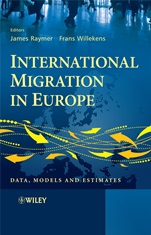
International Migration in Europe: Data, Models and Estimates
ISBN 9780470032336
Autor: James Raymer, Frans Wiilekens
Wydawca: Wiley
Dostępność: 3-6 tygodni
Cena: 575,40 zł
Przed złożeniem zamówienia prosimy o kontakt mailowy celem potwierdzenia ceny.
ISBN13: |
9780470032336 |
ISBN10: |
0470032332 |
Autor: |
James Raymer, Frans Wiilekens |
Oprawa: |
Hardback |
Rok Wydania: |
2008-02-22 |
Ilość stron: |
404 |
Wymiary: |
238x163 |
Tematy: |
JB |
International migration has huge economic, social and political consequences and as a result there is growing demand for evidence–based policies. This has long been unfeasible due to inaccuracies in migration data, caused, for example, by different data sources employing different definitions and different collection methods. However, in recent years methods involving the use of models have been developed to derive reliable estimates of migration. International Migration in Europe draws together modern statistical approaches to provide a unified treatment of these methods, allowing a consistent and dependable set of migration flows to be developed.
The book:
Uses European–based real data to demonstrate migration estimation and modelling tools, with worldwide applications.
Explores the modelling techniques from both the frequentist and Bayesian perspectives.
Discusses vital concepts in detail, such as missing data and collection methods.
Includes chapters dedicated to the key areas of modelling asylum flows and migration forecasting.
Is authored by the leading experts working in migration data and models.
Is supported by a supplementary website featuring further reading material.
International Migration in Europe is primarily aimed at academics, undergraduate and graduate students in the fields of demography, statistics, geography, sociology, economics and political science. However, this is also an important book for government statisticians responsible for publishing migration data, as well as analysts working on migration–related topics such as planning and demography at all levels, from local to international.
Spis treści:
Contributors.
Preface.
1. Introduction and Outline (James Raymer and Frans Willekens).
1.1 Introduction.
1.2 Outline.
Part I. DATA ISSUES.
2. Counting foreign
–born and Expatriates In Oecd Countries: A New Perspective (Jean–Christophe Dumont and Georges Lemaître).
2.1 Introduction.
2.2 A new database on immigrant populations.
2.3 Immigrant populations in OECD countries.
2.4 Expatriates of OECD member countries residing in other member countries.
2.5 Highly skilled expatriates from non–member countries in OECD countries.
2.6 Summary and conclusions.
3. Comparability of Statistics On International Migration flows In The European Union (Dorota Kupiszewska and Beata Nowok).
3.1 Introduction.
3.2 Empirical observations.
3.3 Data sources and definitions.
3.4 Secondary data sources and data availability.
3.5 Conclusions.
4. Evolution of International Migration Statistics in Selected Central European Countries (Beata Nowok).
4.1 Introduction.
4.2 Data sources and availability of statistics on international migration flows.
4.3 Definition of international migration in official flow statistics.
4.4 Trends in international migration flows.
4.5 Impact of migration definition on recorded volume of international migration flows.
4.6 Conclusions.
5. Foreign Migrants in Southern European Countries: Evaluation of Recent Data (Alessio Cangiano).
5.1 Introduction.
5.2 Overview of statistical sources.
5.3 The evolution of foreign populations.
5.4 Regularisation programmes.
5.5 Estimates of irregular migrants in Italy, Spain and Greece.
5.6 Final remarks.
Part II. MODELS.
6. Models of Migration: Observations and Judgment (Frans Willekens).
6.1 Introduction.
6.2 Data types and data structure.
6.3 Probability models: generalities.
6.4 Probability models of migration.
6.5 Incomplete data.
6.6 Conclusion.
7. Bayesian Estimation of Migration Flows (Matthew J Brierley, Jonathan J Forster, John W McDonald, and Peter W F Smith).
7.1 Introduction.
7.2 A modelling framework.
7.3 Results of the initial si
mulation.
7.4 Adding noise to the observations.
7.5 Introducing a contiguity parameter.
7.6 Northern European migration.
7.7 Conclusion.
8. Applying Model Migration Schedules to Represent Age–Specific Migration Flows (James Raymer and Andrei Rogers).
8.1 Introduction.
8.2 Conceptual framework: regularities in the age patterns of migration.
8.3 Fitting multi–exponential model schedules to age patterns of migration.
8.4 Modelling families of age–specific migration.
8.5 Discussion and conclusion.
9. Models for Migration Age Schedules: A Bayesian Perspective With An Application To Flows Between Scotland And England (Peter Congdon).
9.1 Introduction.
9.2 Parametric vs dynamic general linear model approaches.
9.3 Pooling strength over different schedules.
9.4 Case study: Scotland to England migration, 1990–1991.
9.5 Multivariate (multiple schedule) model estimates.
9.6 Discussion and conclusions.
Part III. CURRENT ESTIMATES.
10. Obtaining an Overall Picture of Population Movement in The European Union (James Raymer).
10.1 Introduction.
10.2 Migration data.
10.3 Modelling approach.
10.4 Estimation.
10.5 Conclusion.
11. A Simple Method for Inferring Substitution and Generation from Gross Flows: Asylum Seekers In Europe (Leo van Wissen and Roel Jennissen).
11.1 Introduction.
11.2 Asylum applications in European countries, 1985–2002.
11.3 A method for measuring generation and substitution.
11.4 Generation and substitution in twelve European countries.
11.5 Substitution and asylum policies.
11.6 Conclusions.
Part IV. FORECASTING.
12. Bayesian Methods in International Migration Forecasting (Jakub Bijak).
12.1 Introduction.
12.2 Uncertainty and subjectivity in migration forecasting and in Bayesian statistics.
12.3 Overview of forecasting methods for international migration.
12.4 Examples of simple Bayesian models
for forecasting international migration.
12.5 Conclusions.
13. Forecasting International Migration: Times Series Projections Vs. Argument–Based Forecasts (Joop de Beer).
13.1 Introduction.
13.2 Extrapolations.
13.3 Explanations.
13.4 Types of immigration.
13.5 Types of emigration.
13.6 Assumptions on future changes in immigration and emigration.
13.7 Uncertainty.
13.8 Conclusion.
Part V. DEMOGRAPHIC CONSEQUENCES.
14. International Migration Component In Population Dynamics Models (Marek Kupiszewski and Dorota Kupiszewska).
14.1 Introduction.
14.2 The increasing importance of international migration in population dynamics and population modelling.
14.3 A review of multinational population projections and forecasts in Europe
14.4 The international migration component in national and multinational population dynamics models 313
14.5 MULTIPOLES: a model with a multilevel treatment of international migration
15. What Happens When International Migrants Settle? Projections of Ethnic Groups In United Kingdom Regions (Philip Rees).
15.1 Introduction.
15.2 Issues and approaches to the projection of ethnic group populations.
15.3 A projection model for ethnic groups at region scale.
15.4 Estimation of projection inputs.
15.5 Projection assumptions.
15.6 Projection results, 2010 and 2020.
15.7 Comparisons, evaluations and adjustments.
15.8 Lessons and further research.
16. Conclusion (Frans Willekens and James Raymer).
16.1 Early concerns.
16.2 More recent concerns.
16.3 This book’s contributions.
References.
Index.
Nota biograficzna:
James Raymer, Division of Social Statistics, School of Social Sciences, University of Southampton.
Having taught or carried out extensive research in the field of migration for the last 10 years, Dr Raymer is well respected amongst the community. He has published numerous papers in a variety of inte
Koszyk
Książek w koszyku: 0 szt.
Wartość zakupów: 0,00 zł
Informacje


Kontakt
Gambit
Centrum Oprogramowania
i Szkoleń Sp. z o.o.
Al. Pokoju 29b/22-24
31-564 Kraków
Siedziba Księgarni
ul. Kordylewskiego 1
31-542 Kraków
+48 12 410 5991
+48 12 410 5987
+48 12 410 5989
Subskrypcje
Administratorem danych osobowych jest firma Gambit COiS Sp. z o.o. Na podany adres będzie wysyłany wyłącznie biuletyn informacyjny.
Autoryzacja płatności

Informacje na temat autoryzacji płatności poprzez PayU.

© Copyright 2012: GAMBIT COiS Sp. z o.o. Wszelkie prawa zastrzeżone.
Projekt i wykonanie: Alchemia Studio Reklamy