


Wydawcy
Katalog tematyczny
- Archeologia (1)
- Ekonomia, finanse, business (698)
- Filozofia (20)
- Historia (57)
- Języki i językoznawstwo (4)
- Lifestyle, hobby i rozrywka (32)
- Medycyna (1025)
- Nauki humanistyczne (2)
- Nauki o Ziemi i środowisku (430)
- Nauki ścisłe (1680)
- Nauki społeczne (1297)
- Nauki techniczne (530)
- Prawo (1437)
- Publikacje informacyjne i interdyscyplinarne (32)
- Religia i wierzenia (15)
- Technika komputerowa (237)
- Zdrowie, relacje międzyludzkie i rozwój osobisty (4)





Informacje szczegółowe o książce
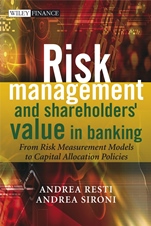
Risk Management and Shareholders Value in Banking: From Risk Measurement Models to Capital Allocation Policies
ISBN 9780470029787
Autor: Andrea Sironi, Andrea Resti
Wydawca: Wiley
Dostępność: 3-6 tygodni
Cena: 394,80 zł
Przed złożeniem zamówienia prosimy o kontakt mailowy celem potwierdzenia ceny.
ISBN13: |
9780470029787 |
ISBN10: |
0470029781 |
Autor: |
Andrea Sironi, Andrea Resti |
Oprawa: |
Hardback |
Rok Wydania: |
2007-04-04 |
Ilość stron: |
808 |
Wymiary: |
256x175 |
Tematy: |
KF |
This book presents an integrated framework for risk measurement, capital management and value creation in banks. Moving from the measurement of the risks facing a bank, it defines criteria and rules to support a corporate policy aimed at maximizing shareholders’ value.
Parts I – IV discuss different risk types (including interest rate, market, credit and operational risk) and how to assess the amount of capital they absorb by means of up–to–date, robust risk–measurement models. Part V surveys regulatory capital requirements: a special emphasis is given to the Basel II accord, discussing its economic foundations and managerial implications. Part VI presents models and techniques to calibrate the amount of economic capital at risk needed by the bank, to fine–tune its composition, to allocate it to risk–taking units, to estimate the “fair” return expected by shareholders, to monitor the value creation process. Risk Management and Shareholders′ Value in Banking includes:
Value at Risk, Monte Carlo models, Creditrisk+, Creditmetrics and much moreformulae for risk–adjusted loan pricing and risk–adjusted performance measurementextensive, hands–on Excel examples provided in the enclosed CDa complete, up–to–date introduction to Basel IIfocus on capital allocation, Raroc, EVA, cost of capital and other value–creation metrics
Spis treści:
Foreword.
Motivation and Scope of this Book: A Quick Guided Tour.
PART I INTEREST RATE RISK.
Introduction to Part I.
1 The Repricing Gap Model.
1.1 Introduction.
1.2 The gap concept.
1.3 The maturity–adjusted gap.
1.4 Marginal and cumulative gaps.
1.5 The limitations of the repricing gap model.
1.6 Some possible solutions.
1.6.1 Non–uniform rate changes: the standardized gap.
1.6.2 Changes in rates of on–demand instruments.
1.6.3 Price and quantity interaction.
1.6.4 Effects on the value of assets and liabilities.
Selected Questions and Exercises.
Appendix 1A The Term Structure of Interest Rates.
Appendix 1B Forward Rates.
2 The Duration Gap Model.
2.1 Introduction.
2.2 Towards mark–to–market accounting.
2.3 The duration of financial instruments.
2.3.1 Duration as a weighted average of maturities.
2.3.2 Duration as an indicator of sensitivity to interest rates charges.
2.3.3 The properties of duration.
2.4 Estimating the duration gap.
2.5 Problems of the duration gap model.
Selected Questions and Exercises.
Appendix 2A The Limits of Duration.
3 Models Based on Cash–Flow Mapping.
3.1 Introduction.
3.2 The objectives of cash–flow mapping and term structure.
3.3 Choosing the vertices of the term structure.
3.4 Techniques based on discrete intervals.
3.4.1 The duration intervals method.
3.4.2 The modified residual life method.
3.4.3 The Basel Committee method.
3.5 Clumping.
3.5.1 Structure of the methodology.
3.5.2 An example.
3.5.3 Clumping on the basis of price volatility.
3.6 Concluding comments.
Selected Questions and Exercises.
Appendix 3A Estimating the Zero–coupon Curve.
4 Internal Transfer Rates.
4.1 Introduction.
4.2 Building an ITR system: a simplified example.
4.3 Single and multiple ITRs.
4.4 Setting internal interest transfer rates.
4.4.1 ITRs for fixed–rate transactions.
4.4.2 ITRs for floating–rate transactions.
4.4.3 ITRs for transactions indexed at “non–market” rates.
4.5 ITRs for transactions with embedded options.
4.5.1 Option to convert from a fixed to a floating rate.
4.5.2 Floating rate loan subject to a cap.
4.5.3 Floating rate loan subject to a floor.
4.5.4 Floating rate loan subj
ect to both a floor and a cap.
4.5.5 Option for early repayment.
4.6 Summary: the ideal features of an ITR system.
Selected Questions and Exercises.
Appendix 4A Derivative Contracts on Interest Rates.
PART II MARKET RISKS.
Introduction to Part II.
5 The Variance–Covariance Approach.
5.1 Introduction.
5.2 VaR derivation assuming normal return distribution.
5.2.1 A simplified example.
5.2.2 Confidence level selection.
5.2.3 Selection of the time horizon.
5.3 Sensitivity of portfolio positions to market factors.
5.3.1 A more general example.
5.3.2 Portfolio VaR.
5.3.3 Delta–normal and asset–normal approaches.
5.4 Mapping of risk positions.
5.4.1 Mapping of foreign currency bonds.
5.4.2 Mapping of forward currency positions.
5.4.3 Mapping of forward rate agreements.
5.4.4 Mapping of stock positions.
5.4.5 Mapping of bonds.
5.5 Summary of the variance–covariance approach and main limitations.
5.5.1 The normal distribution hypothesis.
5.5.2 Serial independence and stability of the variance–covariance matrix.
5.5.3 The linear payoff hypothesis and the delta/gamma approach.
Selected Questions and Exercises.
Appendix 5A Stockmarket Betas.
6 Volatility Estimation Models.
6.1 Introduction.
6.2 Volatility estimation based upon historical data: simple moving averages.
6.3 Volatility estimation based upon historical data: exponential moving averages.
6.4 Volatility prediction: GARCH models.
6.5 Volatility prediction: implied volatility.
6.6 Covariance and correlation estimation.
Selected Questions and Exercises.
7 Simulation Models.
7.1 Introduction.
7.2 Historical simulations.
7.2.1 A first example: the VaR of a single position.
7.2.2 Estimation of a portfolio’s VaR.
7.2.3 A comparison between historical simulations and the.
variance–covariance approach.
7.2.4 Merits and limitati
ons of the historical simulation method.
7.2.5 The hybrid approach.
7.2.6 Bootstrapping and path generation.
7.2.7 Filtered historical simulations.
7.3 Monte Carlo simulations.
7.3.1 Estimating the VaR of a single position.
7.3.2 Estimating portfolio VaR.
7.3.3 Merits and limitations of Monte Carlo simulations.
7.4 Stress testing.
Selected Questions and Exercises.
8 Evaluating VaR Models.
8.1 Introduction.
8.2 An example of backtesting: a stock portfolio VaR.
8.3 Alternative VaR model backtesting techniques.
8.3.1 The unconditional coverage test.
8.3.2 The conditional coverage test.
8.3.3 Lopez test based upon a loss function.
8.3.4 Tests based upon the entire distributio.
Selected Questions and Exercises.
Appendix 8A VaR Model Backtesting According to the Basel Committee.
9 VaR Models: Summary, Applications and Limitations.
9.1 Introduction.
9.2 A summary overview of the different models.
9.3 Applications of VaR models.
9.3.1 Comparison among different risks.
9.3.2 Determination of risk taking limits.
9.3.3 The construction of risk–adjusted performance (RAP) measures.
9.4 Six “false shortcomings” of VaR.
9.4.1 VaR models disregard exceptional events.
9.4.2 VaR models disregard customer relations.
9.4.3 VaR models are based upon unrealistic assumptions.
9.4.4 VaR models generate diverging results.
9.4.5 VaR models amplify market instability.
9.4.6 VaR measures “come too late, when damage has already been done”.
9.5 Two real problems of VaR models.
9.5.1 The size of losses.
9.5.2 Non–subadditivity.
9.6 An alternative risk measure: expected shortfall (ES).
Selected Questions and Exercises.
Appendix 9A Extreme Value Theory.
PART III CREDIT RISK.
Introduction to Part III.
10 Credit–Scoring Models.
10.1 Introduction.
10.2 Linear discriminant analysis.
Koszyk
Książek w koszyku: 0 szt.
Wartość zakupów: 0,00 zł
Informacje


Kontakt
Gambit
Centrum Oprogramowania
i Szkoleń Sp. z o.o.
Al. Pokoju 29b/22-24
31-564 Kraków
Siedziba Księgarni
ul. Kordylewskiego 1
31-542 Kraków
+48 12 410 5991
+48 12 410 5987
+48 12 410 5989
Subskrypcje
Administratorem danych osobowych jest firma Gambit COiS Sp. z o.o. Na podany adres będzie wysyłany wyłącznie biuletyn informacyjny.
Autoryzacja płatności

Informacje na temat autoryzacji płatności poprzez PayU.

© Copyright 2012: GAMBIT COiS Sp. z o.o. Wszelkie prawa zastrzeżone.
Projekt i wykonanie: Alchemia Studio Reklamy