


Wydawcy
Katalog tematyczny
- Archeologia (109)
- Ekonomia, finanse, business (13704)
- Filozofia (1445)
- Historia (3040)
- Języki i językoznawstwo (2356)
- Lifestyle, hobby i rozrywka (475)
- Medycyna (9704)
- Nauki humanistyczne (4)
- Nauki o Ziemi i środowisku (2638)
- Nauki ścisłe (20412)
- Nauki społeczne (8486)
- Nauki techniczne (13450)
- Budownictwo lądowe (1045)
- Chemia przemysłowa (2258)
- Elektronika i telekomunikacja (3287)
- Energetyka (1122)
- Inne nauki stosowane (363)
- Inżynieria biochemiczna (507)
- Inżynieria transportu (232)
- Mechanika i materiały (3316)
- Nauka o środowisku (321)
- Rolnictwo (507)
- Technika, ogólnie (475)
- Prawo (1696)
- Publikacje informacyjne i interdyscyplinarne (1288)
- Religia i wierzenia (917)
- Technika komputerowa (4067)
- Zdrowie, relacje międzyludzkie i rozwój osobisty (657)





Informacje szczegółowe o książce
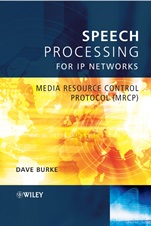
Speech Processing for IP Networks: Media Resource Control Protocol (MRCP)
ISBN 9780470028346
Autor: David Burke
Wydawca: Wiley
Dostępność: 3-6 tygodni
Cena: 533,40 zł
Przed złożeniem zamówienia prosimy o kontakt mailowy celem potwierdzenia ceny.
ISBN13: |
9780470028346 |
ISBN10: |
0470028343 |
Autor: |
David Burke |
Oprawa: |
Hardback |
Rok Wydania: |
2007-03-02 |
Ilość stron: |
368 |
Wymiary: |
249x174 |
Tematy: |
TJ |
Media Resource Control Protocol (MRCP) is a new IETF protocol, providing a key enabling technology that eases the integration of speech technologies into network equipment and accelerates their adoption resulting in exciting and compelling interactive services to be delivered over the telephone. MRCP leverages IP telephony and Web technologies such as SIP (Session Intiation Protocol), HTTP (Hypertext Transfer Protocol), and XML (Extensible Markup Language) to deliver an open standard, vendor–independent, and versatile interface to speech engines.
Speech Processing for IP Networks brings these technologies together into a single volume, giving the reader a solid technical understanding of the principles of MRCP, how it leverages other protocols and specifications for its operation, and how it is applied in modern IP–based telecommunication networks. Focusing on the MRCPv2 standard developed by the IETF SpeechSC Working Group, this book will also provide an overview of its precursor, MRCPv1.
Speech Processing for IP Networks:Gives a complete background on the technologies required by MRCP to function, including SIP, RTP (Real–time Transport Protocol), and HTTP.Covers relevant W3C data representation formats including Speech Synthesis Markup Language (SSML), Speech Recognition Grammar Specification (SRGS), Semantic Interpretation for Speech Recognition (SISR), and Pronunciation Lexicon Specification (PLS).Describes VoiceXML – the leading approach for programming cutting–edge speech applications and a key driver to the development of many of MRCP’s features.Explains advanced topics such as VoiceXML and MRCP interworking.
This text will be an invaluable resource for technical managers, product managers, software developers, and technical marketing professionals working for network equipment manufacturers, speech engine vendors, and network operators. Advanced students on computer science
and engineering courses will also find this to be an excellent guide to the topic.
Spis treści:
PART I. BACKGROUND.
1. Introduction.
1.1 Introduction to Speech Applications.
1.2 The MRCP Value Proposition.
1.3 History of MRCP Standardisation.
1.3.1 Internet Engineering Task Force.
1.3.2 World Wide Web Consortium.
1.3.3 MRCP: From Humble Beginnings Toward IETF Standard.
1.4 Summary.
2. Basic Principles of Speech Processing.
2.1 Human Speech Production.
2.1.1 Speech Sounds: Phonemics and Phonetics.
2.2 Speech Recognition.
2.2.1 Endpoint Detection.
2.2.2 Mel–Cepstrum.
2.2.3 Hidden Markov Models.
2.2.4 Language Modelling.
2.3 Speaker Verification and Identification.
2.3.1 Feature Extraction.
2.3.2 Statistical Modelling.
2.4 Speech Synthesis.
2.4.1 Front–end Processing.
2.4.2 Back–end Synthesis.
2.5 Summary.
3. Overview of MRCP.
3.1 Architecture.
3.2 Media Resource Types.
3.3 Network Scenarios.
3.3.1 VoiceXML IVR Service Node.
3.3.2 IP PBX with Voicemail.
3.3.3 Advanced Media Gateway.
3.4 Protocol Operation.
3.4.1 Establishing Communication Channels.
3.4.2 Controlling a Media Resource.
3.4.3 Walkthrough Examples.
3.5 Security.
3.6 Summary.
PART II. MEDIA AND CONTROL SESSIONS.
4. Session Initiation Protocol.
4.1 Introduction.
4.2 Walkthrough Example.
4.3 SIP URIs.
4.4 Transport.
4.5 Media Negotiation.
4.5.1 Session Description Protocol.
4.5.2 Offer/Answer Model.
4.6 SIP Servers.
4.6.1 Registrars.
4.6.2 Proxy Servers.
4.6.3 Redirect Servers.
4.7 SIP Extensions.
4.7.1 Capability Discovery.
4.8 Security.
4.8.1 Transport and Network Layer Security.
4.8.2 Authentication.
4.8.3 S/MIME.
4.9 Summary.
5. Session Initiation in MRCP.
5.1 Introduction.
5.2 Initiating the Media Session.
5
.3 Initiating the Control Session.
5.4 Session Initiation Examples.
5.4.1 Single Media Resource.
5.4.2 Adding and Removing Media Resources.
5.4.3 Distributed Media Source/Sink.
5.5 Locating Media Resource Servers.
5.5.1 Requesting Server Capabilities.
5.5.2 Media Resource Brokers.
5.6 Security.
5.7 Summary.
6. The Media Session.
6.1 Media Encoding.
6.1.1 Pulse Code Modulation (PCM).
6.1.2 Linear Predictive Coding (LPC).
6.2 Media Transport.
6.2.1 Real–Time Protocol (RTP).
6.2.2 DTMF.
6.3 Security.
6.4 Summary.
7. The Control Session.
7.1 Message Structure.
7.1.1 Request Message.
7.1.2 Response Message.
7.1.3 Event Message.
7.1.4 Message Bodies.
7.2 Generic Methods.
7.3 Generic Headers.
7.4 Security.
7.5 Summary.
PART III. DATA REPRESENTATION FORMATS.
8. Speech Synthesis Markup Language (SSML).
8.1 Introduction.
8.2 Document Structure.
8.3 Recorded Audio.
8.4 Pronunciation.
8.4.1 Phonemic/Phonetic Content.
8.4.2 Substitution.
8.4.3 Interpreting Text .
8.5 Prosody.
8.5.1 Prosodic Boundaries.
8.5.2 Emphasis.
8.5.3 Speaking Voice.
8.5.4 Prosodic Control.
8.6 Markers .
8.7 Metadata.
8.8 Summary.
9. Speech Recognition Grammar Specification (SRGS).
9.1 Introduction.
9.2 Document Structure.
9.3 Rules, Tokens, and Sequences.
9.4 Alternatives.
9.5 Rule References.
9.5.1 Special Rules.
9.6 Repeats.
9.7 DTMF Grammars.
9.8 Semantic Interpretation.
9.8.1 Semantic Literals.
9.8.2 Semantic Scripts.
9.9 Summary.
10. Natural Language Semantics Markup Language (NLSML).
10.1 Introduction.
10.2 Document Structure.
10.3 Speech Recognition Results.
10.3.1 Serialising Semantic Interpretation Results.
10.4 Voice Enrollment Results.
10.5 Speaker Verification Results.
10.6 Summary.
11. Pronunciation Lexicon Specification (PLS).
11.1 Intr
oduction.
11.2 Document Structure.
11.3 Lexical Entries.
11.4 Abbreviations and Acronyms.
11.5 Multiple Orthographies.
11.6 Multiple Pronunciations.
11.7 Summary.
PART IV. MEDIA RESOURCES.
12. Speech Synthesiser Resource.
12.1 Overview.
12.2 Methods.
12.2.1 SPEAK.
12.2.2 PAUSE.
12.2.3 RESUME.
12.2.4 STOP.
12.2.5 BARGE–IN–OCCURRED.
12.2.6 CONTROL.
12.2.7 DEFINE–LEXICON.
12.3 Events.
12.3.1 SPEECH–MARKER.
12.3.2 SPEAK–COMPLETE.
12.4 Headers.
12.5 Summary.
13. Speech Recogniser Resource.
13.1 Overview.
13.2 Recognition Methods.
13.2.1 RECOGNIZE.
13.2.2 DEFINE–GRAMMAR.
13.2.3 START–INPUT–TIMERS.
13.2.4 GET–RESULT.
13.2.5 STOP.
13.2.6 INTERPRET.
13.3 Enrollment Methods.
13.3.1 START–PHRASE–ENROLLMENT.
13.3.2 ENROLLMENT–ROLLBACK.
13.3.3 END–PHRASE–ENROLLMENT.
13.3.4 MODIFY–PHRASE.
13.3.5 DELETE–PHRASE.
13.4 Events.
13.4.1 START–OF–INPUT.
13.4.2 RECOGNITION–COMPLETE.
13.4.3 INTERPRETATION–COMPLETE.
13.5 Recognition Headers.
13.6 Enrollment Headers.
13.7 Summary.
14. Recorder Resource.
14.1 Overview.
14.2 Methods.
14.2.1 RECORD.
14.2.2 START–INPUT–TIMERS.
14.2.3 STOP.
14.3 Events.
14.3.1 START–OF–INPUT.
14.3.2 RECORD–COMPLETE.
14.4 Headers.
14.5 Summary.
15. Speaker Verification Resource.
15.1 Overview.
15.2 Methods.
15.2.1 START–SESSION.
15.2.2 END–SESSION.
15.2.3 VERIFY.
15.2.4 VERIFY–FROM–BUFFER.
15.2.5 VERIFY–ROLLBACK.
15.2.6 START–INPUT–TIMERS.
15.2.7 GET–INTERMEDIATE–RESULT.
15.2.8 STOP.
15.2.9 CLEAR–BUFFER.
15.2.10 QUERY–VOICEPRINT.
15.2.11 DELETE–VOICEPRINT.
15.3 Events.
15.3.1 START–OF–INPUT
Koszyk
Książek w koszyku: 0 szt.
Wartość zakupów: 0,00 zł
Informacje


Kontakt
Gambit
Centrum Oprogramowania
i Szkoleń Sp. z o.o.
Al. Pokoju 29b/22-24
31-564 Kraków
Siedziba Księgarni
ul. Kordylewskiego 1
31-542 Kraków
+48 12 410 5991
+48 12 410 5987
+48 12 410 5989
Subskrypcje
Administratorem danych osobowych jest firma Gambit COiS Sp. z o.o. Na podany adres będzie wysyłany wyłącznie biuletyn informacyjny.
Autoryzacja płatności

Informacje na temat autoryzacji płatności poprzez PayU.

© Copyright 2012: GAMBIT COiS Sp. z o.o. Wszelkie prawa zastrzeżone.
Projekt i wykonanie: Alchemia Studio Reklamy