


Wydawcy
Katalog tematyczny
- Archeologia (109)
- Ekonomia, finanse, business (13704)
- Filozofia (1445)
- Historia (3040)
- Języki i językoznawstwo (2356)
- Lifestyle, hobby i rozrywka (475)
- Medycyna (9704)
- Nauki humanistyczne (4)
- Nauki o Ziemi i środowisku (2638)
- Nauki ścisłe (20412)
- Nauki społeczne (8486)
- Nauki techniczne (13450)
- Budownictwo lądowe (1045)
- Chemia przemysłowa (2258)
- Elektronika i telekomunikacja (3287)
- Energetyka (1122)
- Inne nauki stosowane (363)
- Inżynieria biochemiczna (507)
- Inżynieria transportu (232)
- Mechanika i materiały (3316)
- Nauka o środowisku (321)
- Rolnictwo (507)
- Technika, ogólnie (475)
- Prawo (1696)
- Publikacje informacyjne i interdyscyplinarne (1288)
- Religia i wierzenia (917)
- Technika komputerowa (4067)
- Zdrowie, relacje międzyludzkie i rozwój osobisty (657)





Informacje szczegółowe o książce
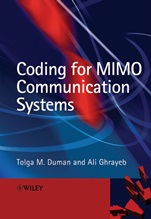
Coding for MIMO Communication Systems
ISBN 9780470028094
Autor: Tolga M. Duman, Ali Ghrayeb
Wydawca: Wiley
Dostępność: 3-6 tygodni
Cena: 605,85 zł
Przed złożeniem zamówienia prosimy o kontakt mailowy celem potwierdzenia ceny.
ISBN13: |
9780470028094 |
ISBN10: |
0470028092 |
Autor: |
Tolga M. Duman, Ali Ghrayeb |
Oprawa: |
Hardback |
Rok Wydania: |
2007-10-26 |
Ilość stron: |
366 |
Wymiary: |
249x165 |
Tematy: |
TJ |
Coding for MIMO Communication Systems is a comprehensive introduction and overview to the various emerging coding techniques developed for MIMO communication systems. The basics of wireless communications and fundamental issues of MIMO channel capacity are introduced and the space–time block and trellis coding techniques are covered in detail. Other signaling schemes for MIMO channels are also considered, including spatial multiplexing, concatenated coding and iterative decoding for MIMO systems, and space–time coding for non–coherent MIMO channels. Practical issues including channel correlation, channel estimation and antenna selection are also explored, with problems at the end of each chapter to clarify many important topics.
A comprehensive book on coding for MIMO techniques covering main strategiesTheories and practical issues on MIMO communications are examined in detailEasy to follow and accessible for both beginners and experienced practitioners in the fieldReferences at the end of each chapter for further readingCan be used with ease as a research book, or a textbook on a graduate or advanced undergraduate level course
This book is aimed at advanced undergraduate and postgraduate students, researchers and practitioners in industry, as well as individuals working for government, military, science and technology institutions who would like to learn more about coding for MIMO communication systems.
Spis treści:
About the Authors.
Preface.
List of Figures.
List of Tables.
Notation.
Abbreviations.
1 Overview.
1.1 Need for MIMO Systems.
1.2 MIMO Communications in Wireless Standards .
1.3 Organization of the Book.
1.4 Other Topics in MIMO Systems.
2 Fading Channels and Diversity Techniques.
2.1 Wireless Channels.
2.1.1 Path Loss, Shadowing and
Small Scale Fading.
2.1.2 Fading Channel Models.
2.2 Error/Outage Probabilities over Fading Channels.
2.2.1 Outage Probability for Rayleigh Fading Channels.
2.2.2 Average Error Probabilities over Rayleigh Fading Channels.
2.2.3 Extensions to Other Fading Channels.
2.2.4 Performance over Frequency Selective Fading Channels.
2.3 Diversity Techniques.
2.3.1 Types of Diversity.
2.3.2 System Model for Lth Order Diversity.
2.3.3 Maximal Ratio Combining (MRC).
2.3.4 Suboptimal Combining Algorithms.
2.3.5 Selection Combining.
2.3.6 Examples.
2.4 Channel Coding as a Means of Time Diversity.
2.4.1 Block Coding over a Fully Interleaved Channel.
2.4.2 Convolutional Coding.
2.5 Multiple Antennas in Wireless Communications.
2.5.1 Receive Diversity.
2.5.2 Smart Antennas and Beamforming.
2.6 Chapter Summary and Further Reading .
3 Capacity and Information Rates of MIMO Channels.
3.1 Capacity and Information Rates of Noisy Channels.
3.2 Capacity and Information Rates of AWGN and Fading Channels.
3.2.1 AWGN Channels.
3.2.2 Fading Channels.
3.3 Capacity of MIMO Channels.
3.3.1 Deterministic MIMO Channels.
3.3.2 Ergodic MIMO Channels.
3.3.3 Non–Ergodic MIMO Channels and Outage Capacity.
3.3.4 Transmit CSI for MIMO Fading Channels.
3.4 Constrained Signaling for MIMO Communications.
3.5 Discussion: Why Use MIMO Systems?
3.6 Chapter Summary and Further Reading.
4 Space–Time Block Codes.
4.1 Transmit Diversity with Two Antennas: The Alamouti Scheme.
4.1.1 Transmission Scheme.
4.1.2 Optimal Receiver for the Alamouti Scheme.
4.1.3 Performance Analysis of the Alamouti Scheme.
4.1.4 Examples.
4.2 Orthogonal Space–Time Block Codes.
4.2.1 Linear Orthogonal Designs.
4.2.2 Decoding of General Space–Time Block Codes.
4.2.3 Performance Analysis of Space–Time Block Codes.
4.2.4 Examples.
4.3 Quasi–O
rthogonal Space–Time Block Codes.
4.4 Linear Dispersion Codes.
4.5 Chapter Summary and Further Reading.
5 Space–Time Trellis Codes.
5.1 A Simple Space–Time Trellis Code.
5.2 General Space–Time Trellis Codes.
5.2.1 Notation and Preliminaries.
5.2.2 Decoding of Space–Time Trellis Codes.
5.3 Basic Space–Time Code Design Principles.
5.3.1 Pairwise Error Probability.
5.3.2 Space–Time Code Design Principles.
5.3.3 Examples of Good Space–Time Codes.
5.3.4 Space–Time Trellis Codes for Fast Fading Channels.
5.4 Representation for Space–Time Trellis Codes for PSK Constellations.
5.4.1 Generator Matrix Representation.
5.4.2 Improved Space–Time Code Design.
5.5 Performance Analysis for Space–Time Trellis Codes.
5.5.1 Union Bound for Space–Time Trellis Codes.
5.5.2 Useful Performance Bounds for Space–Time Trellis Codes.
5.5.3 Examples.
5.6 Comparison of Space–Time Block and Trellis Codes.
5.7 Chapter Summary and Further Reading.
6 Layered Space–Time Codes.
6.1 Basic Bell Labs Layered Space–Time (BLAST) Architectures.
6.1.1 VBLAST/HBLAST/SCBLAST.
6.1.2 Detection Algorithms for Basic BLAST Architectures.
6.1.3 Examples.
6.2 Diagonal BLAST (DBLAST).
6.2.1 Detection Algorithms for DBLAST.
6.2.2 Examples.
6.3 Multilayered Space–Time Coding.
6.3.1 Encoder Structure.
6.3.2 Group Interference Cancellation Detection.
6.3.3 Example.
6.4 Threaded Space–Time Codes.
6.4.1 Layering Approach.
6.4.2 Threaded Space–Time Code Design.
6.4.3 Example.
6.4.4 Detection of Threaded Space–Time Codes.
6.5 Other Detection Algorithms for Spatial Multiplexing Systems.
6.5.1 Greedy Detection.
6.5.2 Belief Propagation Detection.
6.5.3 Turbo–BLAST Detection.
6.5.4 Reduced Complexity ZF/MMSE Detection.
6.5.5 Sphere Decoding.<
br>6.6 Diversity/Multiplexing Gain Trade–off .
6.7 Chapter Summary and Further Reading.
7 Concatenated Codes and Iterative Decoding.
7.1 Development of Concatenated Codes.
7.2 Concatenated Codes for AWGN Channels.
7.2.1 Encoder Structures.
7.2.2 Iterative Decoder Structures.
7.2.3 The SOVA Decoder.
7.2.4 Performance with Maximum Likelihood Decoding.
7.2.5 Examples.
7.3 Concatenated Codes for MIMO Channels.
7.3.1 Concatenated Space–Time Turbo Coding Scheme.
7.3.2 Turbo Space–Time Trellis Coding Scheme.
7.3.3 Turbo Space–Time Coding Scheme.
7.4 Turbo Coded Modulation for MIMO Channels.
7.4.1 Encoder Structure.
7.4.2 Decoder Structure.
7.4.3 Examples.
7.5 Concatenated Space–Time Block Coding.
7.5.1 Encoder Structure.
7.5.2 Decoder Structure.
7.5.3 Performance Analysis.
7.5.4 Examples.
7.6 Chapter Summary and Further Reading.
8 Unitary and Differential Space–Time Codes.
8.1 Capacity of Noncoherent MIMO Channels.
8.1.1 Channel Capacity.
8.1.2 Capacity Achieving Signals.
8.2 Unitary Space–Time Codes.
8.2.1 USTC Encoder.
8.2.2 ML Detection of USTCs.
8.2.3 Performance Analysis.
8.2.4 Construction of Unitary Space–Time Signals.
8.2.5 Examples.
8.3 Differential Space–Time Codes.
8.3.1 Differential Space–Time Coding for Single Antenna Systems.
8.3.2 Differential Space–Time Coding for MIMO Systems.
8.4 Turbo Coded Unitary Space–Time Codes.
8.4.1 Encoder Structure.
8.4.2 Noncoherent Iterative Decoder.
8.4.3 Example.
8.5 Trellis Coded Unitary Space–Time Codes.
8.6 Turbo Coded Differential Space–Time Codes.
8.6.1 Encoder Structure.
8.6.2 Iterative Detectors.
8.7 Chapter Summary and Further Reading.
9 Space–Time Coding for Frequency Selective Fading Channels.
9.1 MIMO Frequency Selective Channels.
9.2 Capacity and Info
Koszyk
Książek w koszyku: 0 szt.
Wartość zakupów: 0,00 zł
Informacje


Kontakt
Gambit
Centrum Oprogramowania
i Szkoleń Sp. z o.o.
Al. Pokoju 29b/22-24
31-564 Kraków
Siedziba Księgarni
ul. Kordylewskiego 1
31-542 Kraków
+48 12 410 5991
+48 12 410 5987
+48 12 410 5989
Subskrypcje
Administratorem danych osobowych jest firma Gambit COiS Sp. z o.o. Na podany adres będzie wysyłany wyłącznie biuletyn informacyjny.
Autoryzacja płatności

Informacje na temat autoryzacji płatności poprzez PayU.

© Copyright 2012: GAMBIT COiS Sp. z o.o. Wszelkie prawa zastrzeżone.
Projekt i wykonanie: Alchemia Studio Reklamy