


Wydawcy
Katalog tematyczny
- Archeologia (109)
- Ekonomia, finanse, business (13704)
- Filozofia (1445)
- Historia (3040)
- Języki i językoznawstwo (2356)
- Lifestyle, hobby i rozrywka (475)
- Medycyna (9704)
- Nauki humanistyczne (4)
- Nauki o Ziemi i środowisku (2638)
- Nauki ścisłe (20412)
- Nauki społeczne (8486)
- Nauki techniczne (13450)
- Budownictwo lądowe (1045)
- Chemia przemysłowa (2258)
- Elektronika i telekomunikacja (3287)
- Energetyka (1122)
- Inne nauki stosowane (363)
- Inżynieria biochemiczna (507)
- Inżynieria transportu (232)
- Mechanika i materiały (3316)
- Nauka o środowisku (321)
- Rolnictwo (507)
- Technika, ogólnie (475)
- Prawo (1696)
- Publikacje informacyjne i interdyscyplinarne (1288)
- Religia i wierzenia (917)
- Technika komputerowa (4067)
- Zdrowie, relacje międzyludzkie i rozwój osobisty (657)





Informacje szczegółowe o książce
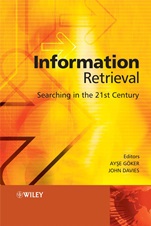
Information Retrieval: Searching in the 21st Century
ISBN 9780470027622
Autor: Ayse Goker, John Davies
Wydawca: Wiley
Dostępność: 3-6 tygodni
Cena: 496,65 zł
Przed złożeniem zamówienia prosimy o kontakt mailowy celem potwierdzenia ceny.
ISBN13: |
9780470027622 |
ISBN10: |
0470027622 |
Autor: |
Ayse Goker, John Davies |
Oprawa: |
Hardback |
Rok Wydania: |
2009-10-23 |
Ilość stron: |
320 |
Wymiary: |
253x174 |
Tematy: |
TJ |
This book is an essential reference to cutting–edge issues and future directions in information retrieval
Information retrieval (IR) can be defined as the process of representing, managing, searching, retrieving, and presenting information. Good IR involves understanding information needs and interests, developing an effective search technique, system, presentation, distribution and delivery. The increased use of the Web and wider availability of information in this environment led to the development of Web search engines. This change has brought fresh challenges to a wider variety of users’ needs, tasks, and types of information.
Today search engines are seen in enterprises, on laptops, in individual websites, in library catalogues, and elsewhere. Information Retrieval: Searching in the 21st Century
Information Retrieval Focuses on:
•Information Retrieval Models
•User–centred Evaluation of Information Retrieval Systems
•Multimedia Resource Discovery
•Image Users’ Needs and Searching Behaviour
•Web Information Retrieval
•Mobile Search
•Context and Information Retrieval
•Text Categorisation and Genre in Information Retrieval
•Semantic Search
•The Role of Natural Language Processing in Information Retrieval: Search for Meaning and Structure
•Cross–language Information Retrieval
•Performance Issues in Parallel Computing for Information Retrieval
This book is an invaluable reference for graduate students on IR courses or courses in related disciplines (e.g. computer science, information science, human–computer interaction, and knowledge management), academic and industrial researchers, and industrial personnel tracking information search technology developments to understand the business implications. Intermediate–advanced level undergraduate students on IR or related courses will also fin
d this text insightful. Chapters are supplemented with exercises to stimulate further thinking.
Spis treści:
Foreword.
Preface.
About the Editors.
List of Contributors.
Introduction.
1 Information Retrieval Models (Djoerd Hiemstra).
1.1 Introduction.
1.2 Exact Match Models.
1.3 Vector Space Approaches.
1.4 Probabilistic Approaches.
1.5 Summary and Further Reading.
Exercises.
References.
2 User–centred Evaluation of Information Retrieval Systems (Pia Borlund).
2.1 Introduction.
2.2 The MEDLARS Test.
2.3 The Okapi Project.
2.4 The Interactive IR Evaluation Model.
2.5 Summary.
Exercises.
References.
3 Multimedia Resource Discovery (Stefan Rüger).
3.1 Introduction.
3.2 Basic Multimedia Search Technologies.
3.3 Challenges of Automated Visual Indexing.
3.4 Added Services.
3.5 Browsing: Lateral and Geotemporal.
3.6 Summary.
Exercises.
References.
4 Image Users’ Needs and Searching Behaviour (Stina Westman).
4.1 Introduction.
4.2 Image Attributes and Users’ Needs.
4.3 Image Searching Behaviour.
4.4 New Directions for Image Access.
4.5 Summary.
Exercises.
References.
5 Web Information Retrieval (Nick Craswell and David Hawking).
5.1 Introduction.
5.2 Distinctive Characteristics of the Web.
5.3 Three Ranking Problems.
5.4 Other Web IR Issues.
5.5 Evaluation of Web Search Effectiveness.
5.6 Summary.
Exercises.
References.
6 Mobile Search (David Mountain, Hans Myrhaug and Ayşe Göker).
6.1 Introduction: Mobile Search – Why Now?
6.2 Information for Mobile Search.
6.3 Designing for Mobile Search.
6.4 Case Studies.
6.5 Summary.
Exercises.
References.
7 Context and Information Retrieval (
Ayşe Göker, Hans Myrhaug and Ralf Bier).
7.1 Introduction.
7.2 What is Context?
7.3 Context in Information Retrieval.
7.4 Context Modelling and Representation.
7.5 Context and Content.
7.6 Related Topics.
7.7 Evaluating Context–aware IR Systems.
7.8 Summary.
Exercises.
References.
8 Text Categorisation and Genre in Information Retrieval (Stuart Watt).
8.1 Introduction: What is Text Categorisation?
8.2 How to Build a Text Categorisation System.
8.3 Evaluating Text Categorisation Systems.
8.4 Genre: Text Structure and Purpose.
8.5 Related Techniques: Information Filtering.
8.6 Applications of Text Categorisation.
8.7 Summary and the Future of Text Categorisation.
Exercises.
References.
9 Semantic Search (John Davies, Alistair Duke and Atanas Kiryakov).
9.1 Introduction.
9.2 Semantic Web.
9.3 Metadata and Annotations.
9.4 Semantic Annotations: the Fibres of the Semantic Web.
9.5 Semantic Annotation of Named Entities.
9.6 Semantic Indexing and Retrieval.
9.7 Semantic Search Tools.
9.8 Summary.
Exercises.
References.
10 The Role of Natural Language Processing in Information Retrieval: Searching for Meaning and Structure (Tony Russell–Rose and Mark Stevenson).
10.1 Introduction.
10.2 Natural Language Processing Techniques.
10.3 Applications of Natural Language Processing in Information Retrieval.
10.4 Discussion.
10.5 Summary.
Exercises.
References.
11 Cross–Language Information Retrieval (Daqing He and Jianqiang Wang).
11.1 Introduction.
11.2 Major Approaches and Challenges in CLIR.
11.3 Identifying Translation Units.
11.4 Obtaining Translation Knowledge.
11.5 Using Translation Knowledge.
11.6 Interactivity in CLIR.
11.7 Evaluation of CLIR Systems.
11.8 Summary and Future Directions.
Exercises.
R
eferences.
12 Performance Issues in Parallel Computing for Information Retrieval (Andrew MacFarlane).
12.1 Introduction.
12.2 Why Parallel IR?
12.3 Review of Previous Work.
12.4 Distribution Methods for Inverted File Data.
12.5 Tasks in Information Retrieval.
12.6 A Synthetic Model of Performance for Parallel Information Retrieval.
12.7 Empirical Examination of Synthetic Model.
12.8 Summary and Further Research.
Exercises.
References.
Solutions to Exercises.
Index.
Nota biograficzna:
Ayse Goker
Dr. Ayse Goker is a senior academic at City University London. Her research since the early 90s has focused on developing novel search techniques and environments, with an emphasis on personalised and context–sensitive information retrieval and management systems. These occur particularly within mobile and wireless computing, and also in bibliographic and web environments. Her skills are in identifying user needs and developing innovative systems that meet them. In international collaborations she has also been successful, with extensive experience in designing projects and managing teams to implement them. On the teaching side, Ayse has developed course modules in information systems on several degree programmes at both postgraduate and undergraduate levels.
Ayse is also a company co–founder of AmbieSense Ltd, a mobile information system company. This project began as the AmbieSense EU–IST project at Robert Gordon University, Aberdeen where she was a Reader and project leader. She holds a lifetime Enterprise Fellowship from the Royal Society of Edinburgh and Scottish Enterprise. More recently she was selected for and completed the Massachusetts Institute of Technology (MIT) Entrepreneurship Development Program in Boston, USA.
In her profession, she has been the Chair of the British Computing Society′s Specialist Group in Information Retrieval (BCS IRSG
) (2000–2005). She was recognised for the totality of her endeavours by becoming a finalist in the Blackberry Women & technology Awards (2005) for Best Woman in Technology (Academia).
John Davies
Dr John Davies leads the Semantic Technology research group at BT. Current interests centre around the application of semantic web technology to business intelligence, information integration, knowledge management and service–oriented environments. He is Project Director of the 12m ACTIVE EU integrated project. He co–founded the European Semantic Web conference series. He is also chairman of the European Semantic Technology Conference and a Vice–President of the Semantic Technology Institute. He chairs the NESSI Semantic Technology working group. He has written and edited many papers and books in the areas of the semantic technology, web–based information management and knowledge management; and has served on the program committee of numerous conferences in these and related ar4eas. He is a Fellow of the British Computer Society and a Chartered Engineer. Earlier research at BT let to the development of a set of knowledge management tools which are the subject of a number of patents. These tools were spun out of BT and are now marketed by infonic Ltd, of which Dr Davies is Group Technical Advisor. Dr Davies received the BT Award for Technology Entrepreneurship for his contribution to the creation of infonic.
Okładka tylna:
This book is an essential reference to cutting–edge issues and future directions in information retrieval
Information retrieval (IR) can be defined as the process of representing, managing, searching, retrieving, and presenting information. Good IR involves understanding information needs and interests, developing an effective search technique, system, presentation, distribution and delivery. The increased use of the Web and wider availability of information in t
his environment led to the development of Web search engines. This change has brought fresh challenges to a wider variety of users’ needs, tasks, and types of information.
Today search engines are seen in enterprises, on laptops, in individual websites, in library catalogues, and elsewhere. Information Retrieval: Searching in the 21st Century
Information Retrieval Focuses on:
•Information Retrieval Models
•User–centred Evaluation of Information Retrieval Systems
•Multimedia Resource Discovery
•Image Users’ Needs and Searching Behaviour
•Web Information Retrieval
•Mobile Search
•Context and Information Retrieval
•Text Categorisation and Genre in Information Retrieval
•Semantic Search
•The Role of Natural Language Processing in Information Retrieval: Search for Meaning and Structure
•Cross–language Information Retrieval
•Performance Issues in Parallel Computing for Information Retrieval
This book is an invaluable reference for graduate students on IR courses or courses in related disciplines (e.g. computer science, information science, human–computer interaction, and knowledge management), academic and industrial researchers, and industrial personnel tracking information search technology developments to understand the business implications. Intermediate–advanced level undergraduate students on IR or related courses will also find this text insightful. Chapters are supplemented with exercises to stimulate further thinking.
Koszyk
Książek w koszyku: 0 szt.
Wartość zakupów: 0,00 zł
Informacje


Kontakt
Gambit
Centrum Oprogramowania
i Szkoleń Sp. z o.o.
Al. Pokoju 29b/22-24
31-564 Kraków
Siedziba Księgarni
ul. Kordylewskiego 1
31-542 Kraków
+48 12 410 5991
+48 12 410 5987
+48 12 410 5989
Subskrypcje
Administratorem danych osobowych jest firma Gambit COiS Sp. z o.o. Na podany adres będzie wysyłany wyłącznie biuletyn informacyjny.
Autoryzacja płatności

Informacje na temat autoryzacji płatności poprzez PayU.

© Copyright 2012: GAMBIT COiS Sp. z o.o. Wszelkie prawa zastrzeżone.
Projekt i wykonanie: Alchemia Studio Reklamy