


Wydawcy
Katalog tematyczny
- Archeologia (109)
- Ekonomia, finanse, business (13704)
- Filozofia (1445)
- Historia (3040)
- Języki i językoznawstwo (2356)
- Lifestyle, hobby i rozrywka (475)
- Medycyna (9704)
- Nauki humanistyczne (4)
- Nauki o Ziemi i środowisku (2638)
- Nauki ścisłe (20412)
- Nauki społeczne (8486)
- Nauki techniczne (13450)
- Budownictwo lądowe (1045)
- Chemia przemysłowa (2258)
- Elektronika i telekomunikacja (3287)
- Energetyka (1122)
- Inne nauki stosowane (363)
- Inżynieria biochemiczna (507)
- Inżynieria transportu (232)
- Mechanika i materiały (3316)
- Nauka o środowisku (321)
- Rolnictwo (507)
- Technika, ogólnie (475)
- Prawo (1696)
- Publikacje informacyjne i interdyscyplinarne (1288)
- Religia i wierzenia (917)
- Technika komputerowa (4067)
- Zdrowie, relacje międzyludzkie i rozwój osobisty (657)





Informacje szczegółowe o książce
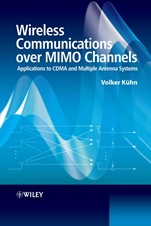
Wireless Communications over MIMO Channels: Applications to CDMA and Multiple Antenna Systems
ISBN 9780470027165
Autor: Volker Kuhn
Wydawca: Wiley
Dostępność: 3-6 tygodni
Cena: 605,85 zł
Przed złożeniem zamówienia prosimy o kontakt mailowy celem potwierdzenia ceny.
ISBN13: |
9780470027165 |
ISBN10: |
0470027169 |
Autor: |
Volker Kuhn |
Oprawa: |
Hardback |
Rok Wydania: |
2006-06-30 |
Ilość stron: |
388 |
Wymiary: |
252x185 |
Tematy: |
TJ |
Wireless Communications over MIMO Channels covers both CDMA and multiple antenna systems as well as state–of–the–art channel coding concepts, a combination rarely found in other books on the subject. A multitude of numerical and simulation results are provided, illuminating many different aspects of the discussed techniques. Two specific examples of MIMO systems studied are Code Division Multiple Access (CDMA) and multiple antenna systems.
An information theoretical analysis of these concepts illuminates ultimate limits and demonstrates their high potential. The use of multiple transmit antennas in order to improve the link reliability by diversity concepts (space–time coding) is described, along with Space Division Multiplexing (SDM) increasing the achievable data rate. A unified description using vector notations makes the similarity between CDMA and SDM systems obvious allowing the joint deployment of detection algorithms.
Besides a unified description using vector notations, detection algorithms are derived that make the similarity of both systems obvious.Addresses the application of error control coding in mobile radio communicationsThe text and mathematical derivations are well supported by figures and numerical examplesFor the example of a CDMA uplink, it is demonstrated that strong codes are an appropriate means to achieve high spectral efficiencies even in the presence of severe multi–user interferenceAccompanying appendices include: basic derivations, tables of frequently used channel models, chain rules for entropy and information, data processing theorem, basics of linear algebra, Householder reflection and Givens rotation, and the LLL algorithm for lattice reduction
This book will be an essential resource for undergraduate and postgraduate students, scientists and engineers in the fields of advanced digital communications, digital signal pro
cessing, communication networks and information theory.
Spis treści:
Preface.
Acknowledgements.
List of Abbreviations.
List of Symbols.
1. Introduction to Digital Communications.
1.1 Basic System Model.
1.2 Characteristics of Mobile Radio Channels.
1.3 Signal Detection.
1.3.1 Optimal Decision Criteria.
1.4 Digital Linear Modulation.
1.5 Diversity.
1.6 Summary.
2. Information Theory.
2.1 Basic Definitions.
2.2 Channel Coding Theorem for SISO Channels.
2.3 Channel Capacity of MIMO Systems.
2.4 Channel Capacity for Multi–User Communications.
2.5 Summary.
3. Forward Error Correction Coding.
3.1 Introduction.
3.2 Linear Block Codes.
3.3 Convolutional Codes.
3.4 Soft–Output Decoding of Binary Codes.
3.5 Performance Evaluation of Linear Codes.
3.6 Concatenated Codes.
3.7 Low Density Parity Check (LDPC) Codes.
3.8 Summary.
4. Code Division Multiple Access.
4.1 Fundamentals.
4.2 OFDM–CDMA.
4.3 Low Rate Channel Coding in CDMA Systems.
4.4 Uplink Capacity of CDMA Systems.
4.5 Summary.
5. Multi–User Detection in CDMA Systems.
5.1 Optimum Detection.
5.2 Linear Multi–User Detection.
5.3 Nonlinear Iterative Multi–User Detection.
5.4 Combining Linear MUD and Nonlinear SIC.
5.5 Summary.
6. Multiple Antenna Systems.
6.1 Introduction .
6.2 Spatial Diversity Concepts.
6.3 Multi–Layer Transmission.
6.4 Linear Dispersion Codes.
6.5 Information Theoretic Analysis.
6.6 Summary.
Appendix A: Channel Models.
A.1 Equivalent Baseband Representation.
A.2 Typical Propagation Profiles for Outdoor Mobile Radio Channels.
A.3 Moment Generating Function for Ricean Fading.
Appendix B: Derivations for Information Theory.
B.1 Chain Rule for Entropies.
B.2 Chain Rule for Information.
B.3 Data Processing Theorem.
Appendix C:
Linear Algebra.
C.1 Selected Basics.
C.2 Householder Reflections and Givens Rotation.
C.3 LLL Lattice–Reduction.
Bibliography.
Index.
Nota biograficzna:
Volker Kühn is Assistant Professor, at the Department of Communications Engineering, University of Bremen, Germany. He completed his Ph.D. at the University of Paderborn, Germany (1994–1998). He has also undertaken consultation work for Siemens AG and Infineon Technologies, and is a member of the IEEE.
Okładka tylna:
Wireless Communications over MIMO Channels covers both CDMA and multiple antenna systems as well as state–of–the–art channel coding concepts, a combination rarely found in other books on the subject. A multitude of numerical and simulation results are provided, illuminating many different aspects of the discussed techniques. Two specific examples of MIMO systems studied are Code Division Multiple Access (CDMA) and multiple antenna systems.
An information theoretical analysis of these concepts illuminates ultimate limits and demonstrates their high potential. The use of multiple transmit antennas in order to improve the link reliability by diversity concepts (space–time coding) is described, along with Space Division Multiplexing (SDM) increasing the achievable data rate. A unified description using vector notations makes the similarity between CDMA and SDM systems obvious allowing the joint deployment of detection algorithms.
Besides a unified description using vector notations, detection algorithms are derived that make the similarity of both systems obvious.Addresses the application of error control coding in mobile radio communicationsThe text and mathematical derivations are well supported by figures and numerical examplesFor the example of a CDMA uplink, it is demonstrated that strong codes are an appropriate
means to achieve high spectral efficiencies even in the presence of severe multi–user interferenceAccompanying appendices include: basic derivations, tables of frequently used channel models, chain rules for entropy and information, data processing theorem, basics of linear algebra, Householder reflection and Givens rotation, and the LLL algorithm for lattice reduction
This book will be an essential resource for undergraduate and postgraduate students, scientists and engineers in the fields of advanced digital communications, digital signal processing, communication networks and information theory.
Koszyk
Książek w koszyku: 0 szt.
Wartość zakupów: 0,00 zł
Informacje


Kontakt
Gambit
Centrum Oprogramowania
i Szkoleń Sp. z o.o.
Al. Pokoju 29b/22-24
31-564 Kraków
Siedziba Księgarni
ul. Kordylewskiego 1
31-542 Kraków
+48 12 410 5991
+48 12 410 5987
+48 12 410 5989
Subskrypcje
Administratorem danych osobowych jest firma Gambit COiS Sp. z o.o. Na podany adres będzie wysyłany wyłącznie biuletyn informacyjny.
Autoryzacja płatności

Informacje na temat autoryzacji płatności poprzez PayU.

© Copyright 2012: GAMBIT COiS Sp. z o.o. Wszelkie prawa zastrzeżone.
Projekt i wykonanie: Alchemia Studio Reklamy