


Wydawcy
Katalog tematyczny
- Archeologia (109)
- Ekonomia, finanse, business (13704)
- Filozofia (1445)
- Historia (3040)
- Języki i językoznawstwo (2356)
- Lifestyle, hobby i rozrywka (475)
- Medycyna (9704)
- Nauki humanistyczne (4)
- Nauki o Ziemi i środowisku (2638)
- Nauki ścisłe (20412)
- Astronomia (294)
- Biologia (5119)
- Chemia (6540)
- Fizyka (3309)
- Elektryczność i magnetyzm (90)
- Fizyka atomowa i molekularna (110)
- Fizyka cząstek elementarnych (36)
- Fizyka jądra atomowego (36)
- Fizyka kwantowa (210)
- Fizyka matematyczna (121)
- Fizyka relatywistyczna (36)
- Fizyka statystyczna (51)
- Fizyka stosowana (498)
- Mechanika klasyczna (186)
- Optyka i światło (133)
- Stany materii (202)
- Matematyka (4574)
- Nauki ścisłe, ogólnie (503)
- Nauki społeczne (8486)
- Nauki techniczne (13450)
- Prawo (1696)
- Publikacje informacyjne i interdyscyplinarne (1288)
- Religia i wierzenia (917)
- Technika komputerowa (4067)
- Zdrowie, relacje międzyludzkie i rozwój osobisty (657)





Informacje szczegółowe o książce
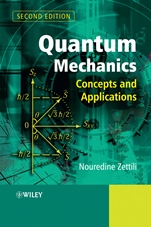
Quantum Mechanics: Concepts and Applications
ISBN 9780470026786
Autor: Nouredine Zettili
Wydawca: Wiley
Dostępność: 3-6 tygodni
Cena: 876,75 zł
Przed złożeniem zamówienia prosimy o kontakt mailowy celem potwierdzenia ceny.
ISBN13: |
9780470026786 |
ISBN10: |
0470026782 |
Autor: |
Nouredine Zettili |
Oprawa: |
Hardback |
Rok Wydania: |
2009-01-16 |
Numer Wydania: |
2nd Edition |
Ilość stron: |
688 |
Wymiary: |
252x177 |
Tematy: |
PH |
Quantum mechanics was developed in the first part of the twentieth century to help explain the behavior of matter at the microscopic level, ranging from molecular to subnuclear levels. It is the bedrock upon which modern physics rests; additionally, it provides a mathematical framework for many of the physical science fields and forms the basis of contemporary theories on matter and energy at the atomic and subatomic levels. This book provides a clear, balanced and modern treatment of the field and is aimed at undergraduate and first–year graduate students. Quantum Mechanics: Concepts and Applications – Second Edition takes an innovative approach to quantum mechanics by seamlessly combining the ingredients of both the textbook and a problem–solving book.
The textbook begins with the origins of quantum physics and then continues with the mathematical tools of quantum mechanics and the postulates of quantum mechanics. The next chapters cover one–dimensional problems, angular momentum, and three–dimensional problems. Subsequent chapters deals with rotations and addition of angular momenta, identical particles, approximation methods for stationary states, time–dependent perturbation theory, and scattering theory. The text contains many worked examples and numerous comprehensive problems with step–by–step solutions designed to help the reader master the machinery of quantum mechanics.
Quantum Mechanics: Concepts and Applications – Second Edition:Provides a comprehensive introduction to quantum mechanics, combining both a theoretical and practical approach.Offer an in–depth treatment of the practical mathematical tools of quantum mechanics and how to harness them to master the formalism of the theory.Includes numerous solved examples integrated throughout the text and each chapter concludes with an extensive collection of solved problems.
This text aimed
at undergraduates and graduate students needing a textbook for a comprehensive treatment of quantum mechanics that is backed by an abundance of examples and fully solved, multistep problems. The book may also be useful for researchers needing a quick, practical guide covering the various techniques that are highly useful to manipulate the formalism of quantum mechanics.
Spis treści:
Preface to the Second Edition.
Preface to the First Edition.
Note to the Student.
1. Origins of Quantum Physics.
1.1 Historical Note.
1.2 Particle Aspect of Radiation.
1.3 Wave Aspect of Particles.
1.4 Particles versus Waves.
1.5 Indeterministic Nature of the Microphysical World.
1.6 Atomic Transitions and Spectroscopy.
1.7 Quantization Rules.
1.8 Wave Packets.
1.9 Concluding Remarks.
1.10 Solved Problems.
1.11 Exercises.
2. Mathematical Tools of Quantum Mechanics.
2.1 Introduction.
2.2 The Hilbert Space and Wave Functions.
2.3 Dirac Notation.
2.4 Operators.
2.5 Representation in Discrete Bases.
2.6 Representation in Continuous Bases.
2.7 Matrix and Wave Mechanics.
2.8 Concluding Remarks.
2.9 Solved Problems.
2.10 Exercises.
3. Postulates of Quantum Mechanics.
3.1 Introduction.
3.2 The Basic Postulates of Quantum Mechanics.
3.3 The State of a System.
3.4 Observables and Operators.
3.5 Measurement in Quantum Mechanics.
3.6 Time Evolution of the System’s State.
3.7 Symmetries and Conservation Laws.
3.8 Connecting Quantum to Classical Mechanics.
3.9 Solved Problems.
3.10 Exercises.
4. One–Dimensional Problems.
4.1 Introduction.
4.2 Properties of One–Dimensional Motion.
4.3 The Free Particle: Continuous States.
4.4 The Potential Step.
4.5 The Potential Barrier and Well.
4.6 The Infinite Square Well Potential.
4.7 The Finite Square Well Potential.
4.8 The Harmonic Oscillator.
4.9 Num
erical Solution of the Schrödinger Equation.
4.10 Solved Problems.
4.11 Exercises.
5. Angular Momentum.
5.1 Introduction.
5.2 Orbital Angular Momentum.
5.3 General Formalism of Angular Momentum.
5.4 Matrix Representation of Angular Momentum.
5.5 Geometrical Representation of Angular Momentum.
5.6 Spin Angular Momentum.
5.7 Eigen functions of Orbital Angular Momentum.
5.8 Solved Problems.
5.9 Exercises.
6. Three–Dimensional Problems.
6.1 Introduction.
6.2 3D Problems in Cartesian Coordinates.
6.3 3D Problems in Spherical Coordinates.
6.4 Concluding Remarks.
6.5 Solved Problems.
6.6 Exercises.
7. Rotations and Addition of Angular Momenta.
7.1 Rotations in Classical Physics.
7.2 Rotations in Quantum Mechanics.
7.3 Addition of Angular Momenta.
7.4 Scalar, Vector and Tensor Operators.
7.5 Solved Problems.
7.6 Exercises.
8. Identical Particles.
8.1 Many–Particle Systems.
8.2 Systems of Identical Particles.
8.3 The Pauli Exclusion Principle.
8.4 The Exclusion Principle and the Periodic Table.
8.5 Solved Problems.
8.6 Exercises.
9. Approximation Methods for Stationary States.
9.1 Introduction.
9.2 Time–Independent Perturbation Theory.
9.3 The Variational Method.
9.4 The Wentzel–Kramers–Brillou in Method.
9.5 Concluding Remarks.
9.6 Solved Problems.
9.7 Exercises.
10. Time–Dependent Perturbation Theory.
10.1 Introduction.
10.2 The Pictures of Quantum Mechanics.
10.3 Time–Dependent Perturbation Theory.
10.4 Adiabatic and Sudden Approximations.
10.5 Interaction of Atoms with Radiation.
10.6 Solved Problems.
10.7 Exercises.
11. Scattering Theory.
11.1 Scattering and Cross Section.
11.2 Scattering Amplitude of Spinless Particles.
11.3 The Born Approximation.
11.4 Partial Wave Analysis.
11.5 Scattering of Identical Particles.
11.6 Solved Problems.
11.7 Exercises.
A. The Delta Function.
A.1 One–Dimensional Delta Function.
A.2 Three–Dimensional Delta Function.
B. Angular Momentum in Spherical Coordinates.
B.1 Derivation of Some General Relations.
B.2 Gradient and Laplacianin Spherical Coordinates.
B.3 Angular Momentum in Spherical Coordinates.
C. C++ Code for Solving the Schrödinger Equation.
Index.
Okładka tylna:
Quantum mechanics was developed in the first part of the twentieth century to help explain the behavior of matter at the microscopic level, ranging from molecular to subnuclear levels. It is the bedrock upon which modern physics rests; additionally, it provides a mathematical framework for many of the physical science fields and forms the basis of contemporary theories on matter and energy at the atomic and subatomic levels. This book provides a clear, balanced and modern treatment of the field and is aimed at undergraduate and first–year graduate students. Quantum Mechanics: Concepts and Applications – Second Edition takes an innovative approach to quantum mechanics by seamlessly combining the ingredients of both the textbook and a problem–solving book.
The textbook begins with the origins of quantum physics and then continues with the mathematical tools of quantum mechanics and the postulates of quantum mechanics. The next chapters cover one–dimensional problems, angular momentum, and three–dimensional problems. Subsequent chapters deals with rotations and addition of angular momenta, identical particles, approximation methods for stationary states, time–dependent perturbation theory, and scattering theory. The text contains many worked examples and numerous comprehensive problems with step–by–step solutions designed to help the reader master the machinery of quantum mechanics.
Quantum Mechanics: Concepts and A
Koszyk
Książek w koszyku: 0 szt.
Wartość zakupów: 0,00 zł
Informacje


Kontakt
Gambit
Centrum Oprogramowania
i Szkoleń Sp. z o.o.
Al. Pokoju 29b/22-24
31-564 Kraków
Siedziba Księgarni
ul. Kordylewskiego 1
31-542 Kraków
+48 12 410 5991
+48 12 410 5987
+48 12 410 5989
Subskrypcje
Administratorem danych osobowych jest firma Gambit COiS Sp. z o.o. Na podany adres będzie wysyłany wyłącznie biuletyn informacyjny.
Autoryzacja płatności

Informacje na temat autoryzacji płatności poprzez PayU.

© Copyright 2012: GAMBIT COiS Sp. z o.o. Wszelkie prawa zastrzeżone.
Projekt i wykonanie: Alchemia Studio Reklamy