


Wydawcy
Katalog tematyczny
- Archeologia (109)
- Ekonomia, finanse, business (13704)
- Filozofia (1445)
- Historia (3040)
- Języki i językoznawstwo (2356)
- Lifestyle, hobby i rozrywka (475)
- Medycyna (9704)
- Nauki humanistyczne (4)
- Nauki o Ziemi i środowisku (2638)
- Nauki ścisłe (20412)
- Nauki społeczne (8486)
- Nauki techniczne (13450)
- Budownictwo lądowe (1045)
- Chemia przemysłowa (2258)
- Elektronika i telekomunikacja (3287)
- Energetyka (1122)
- Inne nauki stosowane (363)
- Inżynieria biochemiczna (507)
- Inżynieria transportu (232)
- Mechanika i materiały (3316)
- Nauka o środowisku (321)
- Rolnictwo (507)
- Technika, ogólnie (475)
- Prawo (1696)
- Publikacje informacyjne i interdyscyplinarne (1288)
- Religia i wierzenia (917)
- Technika komputerowa (4067)
- Zdrowie, relacje międzyludzkie i rozwój osobisty (657)





Informacje szczegółowe o książce
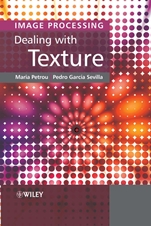
Image Processing: Dealing with Texture
ISBN 9780470026281
Autor: Maria M. P. Petrou, Pedro Garcia Sevilla
Wydawca: Wiley
Dostępność: 3-6 tygodni
Cena: 384,30 zł
Przed złożeniem zamówienia prosimy o kontakt mailowy celem potwierdzenia ceny.
ISBN13: |
9780470026281 |
ISBN10: |
0470026286 |
Autor: |
Maria M. P. Petrou, Pedro Garcia Sevilla |
Oprawa: |
Hardback |
Rok Wydania: |
2006-01-27 |
Ilość stron: |
634 |
Wymiary: |
247x178 |
Tematy: |
TJ |
Self–contained text covering practical image processing methods and theory for image texture analysis.
Techniques for the analysis of texture in digital images are essential to a range of applications in areas as diverse as robotics, defence, medicine and the geo–sciences. In biological vision, texture is an important cue allowing humans to discriminate objects. This is because the brain is able to decipher important variations in data at scales smaller than those of the viewed objects. In order to deal with texture in digital data, many techniques have been developed by image processing researchers.
With a wholly practical approach and many worked examples, Image Processing: Dealing with Texture is a comprehensive guide to these techniques, including chapters on mathematical morphology, fractals, Markov random fields, Gabor functions and wavelets. Structured around a series of questions and answers, enabling readers to easily locate information on specific problems, this book also:provides detailed descriptions of methods used to analyse binary as well as grey texture imagespresents information on two levels: an easy–to–follow narrative explaining the basics, and an advanced, in–depth study of mathematical theorems and conceptslooks at ‘good’ and ‘bad’ image processing practice, with wrongly designed algorithms illustrating ‘what not to do’includes accompanying website, setting out all algorithms discussed within the text.
An ideal self–teaching aid for senior undergraduate and Masters students taking courses in image processing and pattern recognition, this book is also an ideal reference for PhD students, electrical and biomedical engineers, mathematicians, and informatics researchers designing image processing applications.
Spis treści:
Preface.
1 Introduction.
What is texture?
Why
are we interested in texture?
How do we cope with texture when texture is a nuisance?
How does texture give us information about the material of the imaged object?
Are there non–optical images?
What is the meaning of texture in non–optical images?
What is the albedo of a surface?
Can a surface with variable albedo appear non–textured?
Can a rough surface of uniform albedo appear non–textured?
What are the problems of texture which image processing is trying to solve?
What are the limitations of image processing in trying to solve the above problems?
How may the limitations of image processing be overcome for recognising textures?
What is this book about?
Box 1.1. An algorithm for the isolation of textured regions.
2 Binary textures.
Why are we interested in binary textures?
What is this chapter about?
Are there any generic tools appropriate for all types of texture?
Can we at least distinguish classes of texture?
Which are the texture classes?
Which tools are appropriate for each type of texture?
2.1 Shape grammars.
What is a shape grammar?
Box 2.1. Shape grammars.
What happens if the placement of the primitive pattern is not regular?
What happens if the primitive pattern itself is not always the same?
What happens if the primitive patterns vary in a continuous way?
2.2 Boolean models.
What is a 2D Boolean model?
Box 2.2. How can we draw random numbers according to a given probability density function?
Box 2.3. What is a Poisson process?
How can we use the 2D Boolean model to describe a binary texture?
How can we estimate some aggregate parameters of the 2D Boolean model?
How can we estimate some individual parameters of the 2D Boolean model?
Box 2.4. How can we relate the individual parameters to the aggregate parameters of the 2D Boolean model?
What is the simplest possible primitive pattern we may have in a Boolean m
odel?
What is a 1D Boolean model?
How may the 1D Boolean model be used to describe textures?
How can we create 1D strings from a 2D image?
Box 2.5. Hilbert curves.
How can we estimate the parameters of the 1D Boolean model?
Box 2.6. Parameter estimation for the discrete 1D Boolean model.
What happens if the primitive patterns are very irregular ?
2.3 Mathematical morphology.
What is mathematical morphology ?
What is dilation?
What is erosion?
Is there any way to lose details smaller than a certain size but leave the size of larger details unaffected?
What is opening?
What is closing?
How do we do morphological operations if the structuring element is not symmetric about its centre?
Since the structuring element looks like a small image, can we exchange the roles of object and structuring element?
Is closing a commutative operation?
Can we use different structuring elements for the erosion and the dilation parts of the opening and closing operators?
Can we apply morphological operators to the white pixels of an image instead of applying them to the black pixels?
Can we apply more than one morphological operator to the same image?
Is erosion an associative operation as well?
How can we use morphological operations to characterise a texture?
Box 2.7. Formal definitions inmathematical morphology.
What is the “take home” message of this chapter?
3 Stationary grey texture images 81
What is a stationary texture image?
What is this chapter about?
Are any of the methods appropriate for classifying binary textures useful for the analysis of grey textures?
3.1 Image binarisation.
How may a grey image be analysed into a set of binary images by thresholding?
How may a grey image be analysed into a set of binary images by bit–slicing?
Is there any relationship between the binary planes produced by thresholding and the bit planes?
3.2
Grey scale mathematical morphology.
How does mathematica lmorphology generalise for grey images?
How is the complement of an image defined for grey images?
What is a non–flat structuring element?
What is the relationship between the morphological operations applied to an image and those applied to its complement?
What is the purpose of using a non–flat structuring element?
How can we perform granulometry with a grey image?
Can we extract in one go the details of a signal, peaks or valleys, smaller than a certain size?
How can we use the pattern spectrum to classify textures?
3.3 Fractals.
What is a fractal?
What is the fractal dimension?
Which statistical properties remain the same at all scales in non–deterministic fractals?
Box 3.1. What is self–affine scaling?
Box 3.2. What is the relationship between the fractal dimension and exponent H?
Box 3.3. What is the range of values of H?
What is a fractional Brownian motion?
Box 3.4. Prove that the range of values of H for a fractional Brownian motion is (0,1)
Box 3.5. What is the correlation between two increments of a fractional Brownian motion?
Box 3.6. What is the power spectrum of a fractal?
Box 3.7. Robust line fitting using the Ransac method.
Box 3.8. What is the autocorrelation function of a fractal?
Is fractal dimension a good texture descriptor?
Is there a way to enrich the description of textures offered by fractal models?
What is lacunarity?
3.4 Markov random fields.
What is a Markov random field?
Which are the neighbouring pixels of a pixel?
How can we use MRFs to characterise textures?
What is texture synthesis by analysis?
How can we apply the Markov model to create textures?
Can we apply the method discussed in the previous section to create images with 256 grey levels?
What is the auto–normal Markov random field model?
How can we
Koszyk
Książek w koszyku: 0 szt.
Wartość zakupów: 0,00 zł
Informacje


Kontakt
Gambit
Centrum Oprogramowania
i Szkoleń Sp. z o.o.
Al. Pokoju 29b/22-24
31-564 Kraków
Siedziba Księgarni
ul. Kordylewskiego 1
31-542 Kraków
+48 12 410 5991
+48 12 410 5987
+48 12 410 5989
Subskrypcje
Administratorem danych osobowych jest firma Gambit COiS Sp. z o.o. Na podany adres będzie wysyłany wyłącznie biuletyn informacyjny.
Autoryzacja płatności

Informacje na temat autoryzacji płatności poprzez PayU.

© Copyright 2012: GAMBIT COiS Sp. z o.o. Wszelkie prawa zastrzeżone.
Projekt i wykonanie: Alchemia Studio Reklamy