


Wydawcy
Katalog tematyczny
- Archeologia (109)
- Ekonomia, finanse, business (13704)
- Filozofia (1445)
- Historia (3040)
- Języki i językoznawstwo (2356)
- Lifestyle, hobby i rozrywka (475)
- Medycyna (9704)
- Nauki humanistyczne (4)
- Nauki o Ziemi i środowisku (2638)
- Nauki ścisłe (20412)
- Nauki społeczne (8486)
- Nauki techniczne (13450)
- Budownictwo lądowe (1045)
- Chemia przemysłowa (2258)
- Elektronika i telekomunikacja (3287)
- Energetyka (1122)
- Inne nauki stosowane (363)
- Inżynieria biochemiczna (507)
- Inżynieria transportu (232)
- Mechanika i materiały (3316)
- Nauka o środowisku (321)
- Rolnictwo (507)
- Technika, ogólnie (475)
- Prawo (1696)
- Publikacje informacyjne i interdyscyplinarne (1288)
- Religia i wierzenia (917)
- Technika komputerowa (4067)
- Zdrowie, relacje międzyludzkie i rozwój osobisty (657)





Informacje szczegółowe o książce
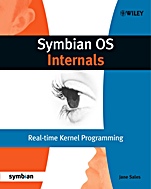
Symbian OS Internals: Real–time Kernel Programming
ISBN 9780470025246
Autor: Jane Sales
Wydawca: Wiley
Dostępność: 3-6 tygodni
Cena: 327,60 zł
Przed złożeniem zamówienia prosimy o kontakt mailowy celem potwierdzenia ceny.
ISBN13: |
9780470025246 |
ISBN10: |
0470025247 |
Autor: |
Jane Sales |
Oprawa: |
Paperback |
Rok Wydania: |
2005-10-14 |
Ilość stron: |
936 |
Wymiary: |
235x192 |
Tematy: |
TJ |
Symbian OS is the advanced, customizable operating systems licensed by the world′s leading mobile phone manufacturers. It is designed for the specific requirements of advanced 2.5G and 3G mobile phones.
Symbian OS has a new, real–time kernel. This book will help you get up to speed on this exciting new technology. Symbian OS Internals is written by Symbian′s kernel engineers, and will give a privileged look inside the world′s most popular mobile phone operating system.
If you want to know what really makes the kernel tick, then this is the book for you. Symbian OS Internals describes in great detail the workings of the system layers of Symbian OS, covering a wide range of topics, such as:Processes, threads and librariesinterrupts and exceptionsdevice driversthe file and window serverspower managementensuring high performanceplatform security
If you are developing drivers and servers for Symbian OS, porting the kernel of performing pre–market mobile phone OS analysis, then this book will give you a deeper understanding of the new Symbian OS real–time kernel.
Spis treści:
Symbian Press Acknowledgments.
About this Book.
About the Authors.
1 Introducing EKA2.
1.1 The history of EKA2.
1.2 Basic OS concepts.
1.3 Symbian OS design.
1.4 Summary.
2 Hardware for Symbian OS.
2.1 Inside a Symbian OS phone.
2.2 System–on–Chip (SoC).
2.3 Random Access Memory (RAM).
2.4 Flash memory.
2.5 Interrupts.
2.6 Timers.
2.7 Direct Memory Access (DMA).
2.8 Liquid Crystal Display (LCD).
2.9 Audio.
2.10 Power management.
2.11 Summary.
3 Threads, Processes and Libraries.
3.1 What is a thread?
3.2 Nanokernel threads.
3.3 Symbian OS threads.
3.4 What is a process?
3.5 DProcess class.
3.6 Scheduling.
3.7 Dynamically loaded libraries.
3.8 Summary.
<
b>4 Inter–thread Communication.
4.1 Client–server ITC.
4.2 Asynchronous message queues.
4.3 Kernel–side messages.
4.4 Publish and subscribe.
4.5 Shared chunks and shared I/O buffers.
4.6 Summary.
5 Kernel Services.
5.1 Objects and handles.
5.2 Services provided to user threads.
5.3 Example user–accessible services.
5.4 Services provided by the kernel to the kernel.
5.5 Timers.
5.6 Summary.
6 Interrupts and Exceptions.
6.1 Exception types.
6.2 Exceptions on real hardware.
6.3 Interrupts.
6.4 Aborts, traps and faults.
6.5 Summary.
7 Memory Models.
7.1 The memory model.
7.2 MMUs and caches.
7.3 The memory model interface.
7.4 The memory models.
7.5 Programmer APIs.
7.6 Memory allocation.
7.7 Low memory.
7.8 Summary.
8 Platform Security.
8.1 Introduction.
8.2 Unit of trust.
8.3 Capability model.
8.4 Data caging.
8.5 Summary.
9 The File Server.
9.1 Overview.
9.2 The file server client API.
9.3 The file server.
9.4 File systems.
9.5 Summary.
10 The Loader.
10.1 E32 image file format.
10.2 ROM image file format.
10.3 The loader server.
10.4 Kernel–side code management.
10.5 Summary.
11 The Window Server.
11.1 The kernel’s event handler.
11.2 Different types of events.
11.3 How WSERV processes events.
11.4 Processing key events.
11.5 Processing pointer events.
11.6 Client queues.
11.7 A simple handwriting animation DLL.
11.8 Window objects and classes.
11.9 Properties of windows.
11.10 Drawing to windows.
11.11 Direct screen access.
11.12 Platform security in WSERV.3
11.13 Summary.
12 Device Drivers and Extensions.
12.1 Device drivers and extensions in Symbian OS.
12.2 Kernel extensions.
12.3 The hardware abstraction layer.
12.4 Device drivers.
12.5 Differences between EKA1 and EKA2.<
br>12.6 Summary.
13 Peripheral Support.
13.1 DMA.
13.2 Shared chunks.
13.3 Media drivers and the local media sub–system.
13.4 Peripheral bus controllers.
13.5 MultiMediaCard support.
13.6 USB device support.
13.7 Summary.
14 Kernel–Side Debug.
14.1 Overview.
14.2 Architecture.
14.3 The kernel debug interface.
14.4 Target debugger agents.
14.5 Stop–mode debug API.
14.6 Kernel trace channel.
14.7 Summary.
15 Power Management.
15.1 Power states.
15.2 Power framework.
15.3 Typical power management.
15.4 Managing idle time.
15.5 Advanced power management.
15.6 Summary.
16 Boot Processes.
16.1 Operating system startup.
16.2 Alternative startup scenarios.
16.3 Operating system shutdown.
16.4 Operating system sleep and wakeup events.
16.5 Summary.
17 Real Time.
17.1 What is real time?
17.2 Real time operating systems.
17.3 EKA2 and real time.
17.4 Real time application – GSM.
17.5 Personality layers.
17.6 Summary.
18 Ensuring Performance.
18.1 Writing efficient code.
18.2 Maintaining real–time performance.
18.3 Summary.
Appendix 1: Glossary.
Appendix 2: The E32ImageHeader.
Appendix 3: The TRomImageHeader.
Appendix 4: Bibliography.
Index.
Nota biograficzna:
Jane Sales, Lead Author
Jane joined Symbian (then Psion) in 1995 to lad the team whose goal was to create a new 32–bit operating system, now known as EKA1. This goal was realized two years later, when the Psion Series 5 was released. Since then, Jane has taken on variety of roles within Symbian, Including product management, systems architecture and setting up a small product –focused research group in Japan.
Jane Studied at Jesus college, Oxford, where she gained an NA in mathematics in 1982. After that, she became part of a small team building a m
icrocomputer to which they ported CCPIM, It was he start of a long–lasting love of systems programming.
In 2003, Jane Moved to the South of France and Began work on this book She would like to thank her husband, Roger, for his moral and financial support over the Succeeding 18 months.
Corinne Dive–Reclus
Corinne joined Symbian in 2001 after several years at Baltimore Ltd, where she designed the embedded software of ACCE ( Advanced Configurable Crypto Environment), a cryptographic hardware module certified FIPS 140–1 Level 4.
In 1987, her first job was as a presales engineer at Sun Microsystems France where she was exposed to the concept of Network Computing & Internet and to its very first remote attacks – at a time when this was still confidential. Being more interested in development than presales, she subsequently worked as a software engineer for Concepts and Implicit, developing an RAD )Rapid Application Development) Programming Language for the creation of distributed data–oriented applications. Since joining Symbian, Corinne has been the Platform Security System Architect, and has worked on the platform security architecture from its initial design to its implementation in Symbain V9. To ensure that all layers of the operating system will contribute to its overall security, she worked extensively with Andrew Thoelke and Dennis May to validate the security features of EKA2, design new services such as Publish & Subscribe and Capability Model, as well as defining the new behavior of the file server, known as Data Caging. For this work, Corinne received the Symbian Technical Innovation award in 2003.
Fulfilling an early passion for Prehistoric Archaeology & Computing, Corinne graduate from the Ecole National Superieure de Geologie, a unique French Institution combining a five–year curriculum in Engineering and Earth Science.
Douglas Feather
Douglas Joined Symbian (then Psion) in 19
Koszyk
Książek w koszyku: 0 szt.
Wartość zakupów: 0,00 zł
Informacje


Kontakt
Gambit
Centrum Oprogramowania
i Szkoleń Sp. z o.o.
Al. Pokoju 29b/22-24
31-564 Kraków
Siedziba Księgarni
ul. Kordylewskiego 1
31-542 Kraków
+48 12 410 5991
+48 12 410 5987
+48 12 410 5989
Subskrypcje
Administratorem danych osobowych jest firma Gambit COiS Sp. z o.o. Na podany adres będzie wysyłany wyłącznie biuletyn informacyjny.
Autoryzacja płatności

Informacje na temat autoryzacji płatności poprzez PayU.

© Copyright 2012: GAMBIT COiS Sp. z o.o. Wszelkie prawa zastrzeżone.
Projekt i wykonanie: Alchemia Studio Reklamy