


Wydawcy
Katalog tematyczny
- Archeologia (109)
- Ekonomia, finanse, business (13704)
- Filozofia (1445)
- Historia (3040)
- Języki i językoznawstwo (2356)
- Lifestyle, hobby i rozrywka (475)
- Medycyna (9704)
- Chirurgia (272)
- Inne gałęzie medycyny (1871)
- Medycyna kliniczna (4187)
- Medycyna niekonwencjonalna (14)
- Medycyna przedkliniczna (269)
- Medycyna, ogólnie (1740)
- Historia medycyny (3)
- Lekarze, sprawy zawodowe (8)
- Medycyna, aspekty prawne (10)
- Służba zdrowia (36)
- Wyposażenie medyczne (157)
- Zdrowie publiczne (460)
- Medyczne służby pomocnicze (745)
- Studia medyczne (16)
- Weterynaria (548)
- Nauki humanistyczne (4)
- Nauki o Ziemi i środowisku (2638)
- Nauki ścisłe (20412)
- Nauki społeczne (8486)
- Nauki techniczne (13450)
- Prawo (1696)
- Publikacje informacyjne i interdyscyplinarne (1288)
- Religia i wierzenia (917)
- Technika komputerowa (4067)
- Zdrowie, relacje międzyludzkie i rozwój osobisty (657)





Informacje szczegółowe o książce
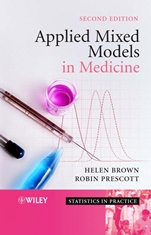
Applied Mixed Models in Medicine
ISBN 9780470023563
Autor: Helen Brown, Robin Prescott
Wydawca: Wiley
Dostępność: 3-6 tygodni
Cena: 575,40 zł
Przed złożeniem zamówienia prosimy o kontakt mailowy celem potwierdzenia ceny.
ISBN13: |
9780470023563 |
ISBN10: |
0470023562 |
Autor: |
Helen Brown, Robin Prescott |
Oprawa: |
Hardback |
Rok Wydania: |
2006-04-07 |
Numer Wydania: |
2nd Edition |
Ilość stron: |
478 |
Wymiary: |
238x160 |
Tematy: |
MB |
A mixed model allows the incorporation of both fixed and random variables within a statistical analysis. This enables efficient inferences and more information to be gained from the data. The application of mixed models is an increasingly popular way of analysing medical data, particularly in the pharmaceutical industry. There have been many recent advances in mixed modelling, particularly regarding the software and applications. This new edition of a groundbreaking text discusses the latest developments, from updated SAS techniques to the increasingly wide range of applications.Presents an overview of the theory and applications of mixed models in medical research, including the latest developments and new sections on bioequivalence, cluster randomised trials and missing data.Easily accessible to practitioners in any area where mixed models are used, including medical statisticians and economists.Includes numerous examples using real data from medical and health research, and epidemiology, illustrated with SAS code and output.Features new version of SAS, including the procedure PROC GLIMMIX and an introduction to other available software.Supported by a website featuring computer code, data sets, and further material, available at: http://www.chs.med.ed.ac.uk/phs/mixed/.
This much–anticipated second edition is ideal for applied statisticians working in medical research and the pharmaceutical industry, as well as teachers and students of statistics courses in mixed models. The text will also be of great value to a broad range of scientists, particularly those working the medical and pharmaceutical areas.
Spis treści:
Preface to Second Edition.
Mixed Model Notations.
1 Introduction.
1.1 The Use of Mixed Models.
1.2 Introductory Example.
1.3 A Multi–Centre Hypertension Trial.
1.4 Repeated Measures Data.
1.5 More aboutMixed Models.
1.6 Some Useful Definitions.
2 NormalMixed Models.
2.1 Model Definition.
2.2 Model Fitting Methods.
2.3 The Bayesian Approach.
2.4 Practical Application and Interpretation.
2.5 Example.
3 Generalised Linear MixedModels.
3.1 Generalised Linear Models.
3.2 Generalised Linear Mixed Models.
3.3 Practical Application and Interpretation.
3.4 Example.
4 Mixed Models for Categorical Data.
4.1 Ordinal Logistic Regression (Fixed Effects Model).
4.2 Mixed Ordinal Logistic Regression.
4.3 Mixed Models for Unordered Categorical Data.
4.4 Practical Application and Interpretation.
4.5 Example.
5 Multi–Centre Trials and Meta–Analyses.
5.1 Introduction to Multi–Centre Trials.
5.2 The Implications of using Different Analysis Models.
5.3 Example: A Multi–Centre Trial.
5.4 Practical Application and Interpretation.
5.5 Sample Size Estimation.
5.6 Meta–Analysis.
5.7 Example: Meta–analysis.
6 RepeatedMeasures Data.
6.1 Introduction.
6.2 Covariance Pattern Models.
6.3 Example: Covariance Pattern Models for Normal Data.
6.4 Example: Covariance Pattern Models for Count Data.
6.5 Random Coefficients Models.
6.6 Examples of Random Coefficients Models.
6.7 Sample Size Estimation.
7 Cross–Over Trials.
7.1 Introduction.
7.2 Advantages of Mixed Models in Cross–Over Trials.
7.3 The AB/BA Cross–Over Trial.
7.4 Higher Order Complete Block Designs.
7.5 Incomplete Block Designs.
7.6 Optimal Designs.
7.7 Covariance Pattern Models.
7.8 Analysis of Binary Data.
7.9 Analysis of Categorical Data.
7.10 Use of Results from Random Effects Models in Trial Design.
7.11 General Points.
8 Other Applications of MixedModels.
8.1 Trials with Repeated Measurements within Visits.
8.2 Multi–Centre Trials with Repeated Measurements.
8.3 Multi–Centre Cross–Over Trials.
8.4 Hierarchi
cal Multi–Centre Trials and Meta–Analysis.
8.5 Matched Case–Control Studies.
8.6 Different Variances for Treatment Groups in a Simple Between–Patient Trial.
8.7 Estimating Variance Components in an Animal Physiology Trial.
8.8 Inter– and Intra–Observer Variation in Foetal Scan Measurements.
8.9 Components of Variation and Mean Estimates in a Cardiology Experiment.
8.10 Cluster Sample Surveys.
8.11 Small AreaMortality Estimates.
8.12 Estimating Surgeon Performance.
8.13 Event History Analysis.
8.14 A Laboratory Study Using aWithin–Subject 4 × 4 Factorial Design.
8.15 Bioequivalence Studies with Replicate Cross–Over Designs.
8.16 Cluster Randomised Trials.
9 Software for Fitting MixedModels.
9.1 Packages for Fitting Mixed Models.
9.2 Basic use of PROC MIXED.
9.3 Using SAS to Fit Mixed Models to Non–Normal Data.
Glossary.
References.
Index.
Nota biograficzna:
Helen Brown, Principal Statistician, NHS Scotland, Edinburgh, UK
Robin Prescott, Medical Statistics Unit, University of Edinburgh Medical School, UK
Okładka tylna:
A mixed model allows the incorporation of both fixed and random variables within a statistical analysis. This enables efficient inferences and more information to be gained from the data. The application of mixed models is an increasingly popular way of analysing medical data, particularly in the pharmaceutical industry. There have been many recent advances in mixed modelling, particularly regarding the software and applications. This new edition of a groundbreaking text discusses the latest developments, from updated SAS techniques to the increasingly wide range of applications.Presents an overview of the theory and applications of mixed models in medical research, including the latest developments and new sections on bioequivalence, cluster randomised trials a
nd missing data.Easily accessible to practitioners in any area where mixed models are used, including medical statisticians and economists.Includes numerous examples using real data from medical and health research, and epidemiology, illustrated with SAS code and output.Features new version of SAS, including the procedure PROC GLIMMIX and an introduction to other available software.Supported by a website featuring computer code, data sets, and further material, available at: http://www.chs.med.ed.ac.uk/phs/mixed/.
This much–anticipated second edition is ideal for applied statisticians working in medical research and the pharmaceutical industry, as well as teachers and students of statistics courses in mixed models. The text will also be of great value to a broad range of scientists, particularly those working the medical and pharmaceutical areas.
Koszyk
Książek w koszyku: 0 szt.
Wartość zakupów: 0,00 zł
Informacje


Kontakt
Gambit
Centrum Oprogramowania
i Szkoleń Sp. z o.o.
Al. Pokoju 29b/22-24
31-564 Kraków
Siedziba Księgarni
ul. Kordylewskiego 1
31-542 Kraków
+48 12 410 5991
+48 12 410 5987
+48 12 410 5989
Subskrypcje
Administratorem danych osobowych jest firma Gambit COiS Sp. z o.o. Na podany adres będzie wysyłany wyłącznie biuletyn informacyjny.
Autoryzacja płatności

Informacje na temat autoryzacji płatności poprzez PayU.

© Copyright 2012: GAMBIT COiS Sp. z o.o. Wszelkie prawa zastrzeżone.
Projekt i wykonanie: Alchemia Studio Reklamy