


Wydawcy
Katalog tematyczny
- Archeologia (109)
- Ekonomia, finanse, business (13704)
- Filozofia (1445)
- Historia (3040)
- Języki i językoznawstwo (2356)
- Lifestyle, hobby i rozrywka (475)
- Medycyna (9704)
- Nauki humanistyczne (4)
- Nauki o Ziemi i środowisku (2638)
- Nauki ścisłe (20412)
- Nauki społeczne (8486)
- Nauki techniczne (13450)
- Prawo (1696)
- Publikacje informacyjne i interdyscyplinarne (1288)
- Religia i wierzenia (917)
- Technika komputerowa (4067)
- Zdrowie, relacje międzyludzkie i rozwój osobisty (657)





Informacje szczegółowe o książce
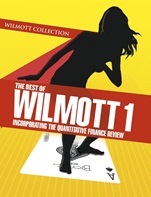
The Best of Wilmott 1: Incorporating the Quantitative Finance Review
ISBN 9780470023518
Autor: Paul Wilmott
Wydawca: Wiley
Dostępność: 3-6 tygodni
Cena: 557,55 zł
Przed złożeniem zamówienia prosimy o kontakt mailowy celem potwierdzenia ceny.
ISBN13: |
9780470023518 |
ISBN10: |
0470023511 |
Autor: |
Paul Wilmott |
Oprawa: |
Hardback |
Rok Wydania: |
2004-10-27 |
Ilość stron: |
458 |
Wymiary: |
252x198 |
Tematy: |
KF |
November 11th 2003 saw a landmark event take place in London. As the first conference designed for quants by quants the Quantitative Finance Review 2003, moved away from the anonymous bazaars that have become the norm, and instead delivered valuable information to market practitioners with the greatest interest. The roster of speakers was phenomenal, ranging from founding fathers to bright young things, discussing the latest developments, with a specific emphasis on the burgeoning field of credit derivatives. You really had to be there. Until now, at least.
The Best of Wilmott 1: Incorporating the Quantitative Finance Review contains these first–class articles, originally presented at the QFR 2003, along with a collection of selected technical papers from Wilmott magazine. In publishing this book we hope to share some of the great insights that, until now, only delegates at QFR 2003 were privy to, and give you some idea why Wilmott magazine is the most talked about periodical in the market.
Including articles from luminaries such as Ed Thorp, Jean–Philippe Bouchaud, Philipp Schoenbucher, Pat Hagan, Ephraim Clark, Marc Potters, Peter Jaeckel and Paul Wilmott, this collection is a must for anyone working in the field of quantitative finance. The articles cover a wide range of topics:
Psychology in Financial MarketsMeasuring Country Risk as Implied VolatilityThe Equity–to–Credit ProblemIntroducing Variety in Risk ManagementThe Art and Science of Curve BuildingNext Generation Models for Convertible Bonds with Credit RiskStochastic Volatility and Mean–variance AnalysisCliquet Options and Volatility Models
And as they say at the end of (most) Bond movies The Best of Wilmott… will return on an annual basis.
Spis treści:
Introduction (Paul Wilmott).
I. Education in Quantitative Finance (Riaz Ahmad).II. FinancialCAD (Owen Walsh).
III, Quantitative Finance Review 2003 (Dan Tudball).
Chapter 1: Rewind (Dan Tudball)
Chapter 2: In for the Count (Dan Tudball).
Chapter 3: A Perspective on Quantitative Finance: Models for Beating the Market (Ed Thorp).
Chapter 4: Psychology in Financial Markets (Henriëtte Prast).
Chapter 5: Credit Risk Appraisal: From the Firm Structural Approach to Modern Probabilistic Methodologies (Hugues E. Pirotte Spéder).
Chapter 6: Modelling and Measuring Sovereign Credit Risk (Ephraim Clark).
Chapter 7: The Equity–to–credit Problem (or the Story of Calibration, Co–calibration and Re–calibration) (Elie Ayache).
Chapter 8: Measuring Country Risk as Implied Volatility (Ephraim Clark).
Chapter 9: Next Generation Models for Convertible Bonds with Credit Risk (E. Ayache, P. A. Forsyth and K. R. Vetzal).
Chapter 10: First to Default Swaps (Antony Penaud and James Selfe).
Chapter 11: Taken to the Limit: Simple and Not–so–simple Loan Loss Distributions (Philipp J. Schönbucher)
Chapter 12: Sovereign Debt Default Risk: Quantifying the (Un)Willingness to Pay (Ephraim Clark).
Chapter 13: Chord of Association (Aaron Brown).
Chapter 14: Introducing Variety in Risk Management (Fabrizio Lillo, Rosario N. Mantegna, Jean–Philippe Bouchaud and Marc Potters).
Chapter 15: Alternative Large Risks Hedging Strategies for Options (F. Selmi and Jean–Philippe Bouchaud).
Chapter 16: On Exercising American Options: The Risk of Making More Money than You Expected (Hyungsok Ahn and Paul Wilmott).
Chapter 17: Phi–alpha Optimal Portfolios and Extreme Risk Management (R. Douglas Martin, Svetlozar (Zari) Rachev, and Frederic Siboulet).
Chapter 18: Managing Smile Risk (Patrick S. Hagan, Deep Kumar, Andrew S. Lesniewski and Diana E. Woodward).
Chapter 19: Adjusters: Turning Good Prices into Great Prices (Patrick S. Hagan).
Chapter 20: Convexity Conundrums: Pricing CMS Swaps, Caps, and Floors (Patrick S. Hagan).
Chapter 21: Mind the Cap (Peter Jäckel).
Chapter 22: The Art and Science of Curve Building (Owen Walsh).
Chapter 23: Stochastic Volatility Models: Past, Present and Future (Peter Jäckel).
Chapter 24: Cliquet Options and Volatility Models (Paul Wilmott).
Chapter 25: Long Memory and Regime Shifts in Asset Volatility (Jonathan Kinlay).
Chapter 26: Heston’s Stochastic Volatility Model: Implementation, Calibration and Some Extensions (Sergei Mikhailov and Ulrich Nögel).
Chapter 27: Forward–start Options in Stochastic Volatility Models (Vladimir Lucic).
Chapter 28: Stochastic Volatility and Mean–variance Analysis (Hyungsok Ahn and Paul Wilmott).
Index.
Nota biograficzna:
Dr Paul Wilmott has been described by the Financial Times as the cult derivatives lecturer.
He has for many years been a financial consultant specializing in derivatives, risk management and quantitative finance. He is the author of the best–selling Paul Wilmott Introduces Quantitative Finance (Wiley 2000) and Paul Wilmott on Quantitative Finance (Wiley 2001). He has written over 100 research articles on finance and mathematics.
Dr Wilmott runs www.wilmott.com, the popular quantitative finance community website, the quant magazine Wilmott, and is the Course Director for the Certificate in Quantitative Finance, www.7city.com/cqf.
Paul Wilmott is a partner in a statistical arbitrage hedge fund.
Okładka tylna:
November 11th 2003 saw a landmark event take place in London. As the first conference designed for quants by quants the Quantitative Finance Review 2003, moved away from the anonymous bazaars that have become the norm, and instead delivered valuable information to market practitioners with the greatest interest. The roster of speakers was
phenomenal, ranging from founding fathers to bright young things, discussing the latest developments, with a specific emphasis on the burgeoning field of credit derivatives. You really had to be there. Until now, at least.
The Best of Wilmott 1: Incorporating the Quantitative Finance Review contains these first–class articles, originally presented at the QFR 2003, along with a collection of selected technical papers from Wilmott magazine. In publishing this book we hope to share some of the great insights that, until now, only delegates at QFR 2003 were privy to, and give you some idea why Wilmott magazine is the most talked about periodical in the market.
Including articles from luminaries such as Ed Thorp, Jean–Philippe Bouchaud, Philipp Schoenbucher, Pat Hagan, Ephraim Clark, Marc Potters, Peter Jaeckel and Paul Wilmott, this collection is a must for anyone working in the field of quantitative finance. The articles cover a wide range of topics:
Psychology in Financial MarketsMeasuring Country Risk as Implied VolatilityThe Equity–to–Credit ProblemIntroducing Variety in Risk ManagementThe Art and Science of Curve BuildingNext Generation Models for Convertible Bonds with Credit RiskStochastic Volatility and Mean–variance AnalysisCliquet Options and Volatility Models
And as they say at the end of (most) Bond movies The Best of Wilmott… will return on an annual basis.
Koszyk
Książek w koszyku: 0 szt.
Wartość zakupów: 0,00 zł
Informacje


Kontakt
Gambit
Centrum Oprogramowania
i Szkoleń Sp. z o.o.
Al. Pokoju 29b/22-24
31-564 Kraków
Siedziba Księgarni
ul. Kordylewskiego 1
31-542 Kraków
+48 12 410 5991
+48 12 410 5987
+48 12 410 5989
Subskrypcje
Administratorem danych osobowych jest firma Gambit COiS Sp. z o.o. Na podany adres będzie wysyłany wyłącznie biuletyn informacyjny.
Autoryzacja płatności

Informacje na temat autoryzacji płatności poprzez PayU.

© Copyright 2012: GAMBIT COiS Sp. z o.o. Wszelkie prawa zastrzeżone.
Projekt i wykonanie: Alchemia Studio Reklamy