


Wydawcy
Katalog tematyczny
- Archeologia (109)
- Ekonomia, finanse, business (13704)
- Filozofia (1445)
- Historia (3040)
- Języki i językoznawstwo (2356)
- Lifestyle, hobby i rozrywka (475)
- Medycyna (9704)
- Nauki humanistyczne (4)
- Nauki o Ziemi i środowisku (2638)
- Nauki ścisłe (20412)
- Nauki społeczne (8486)
- Nauki techniczne (13450)
- Prawo (1696)
- Publikacje informacyjne i interdyscyplinarne (1288)
- Religia i wierzenia (917)
- Technika komputerowa (4067)
- Zdrowie, relacje międzyludzkie i rozwój osobisty (657)





Informacje szczegółowe o książce
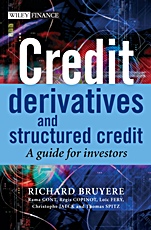
Credit Derivatives and Structured Credit: A Guide for Investors
ISBN 9780470018798
Autor: Richard Bruyere, Rama Cont, Regis Copinot, Loic Fery, Christophe Jaeck, Thomas Spitz, Gabrielle
Wydawca: Wiley
Dostępność: 3-6 tygodni
Cena: 341,25 zł
Przed złożeniem zamówienia prosimy o kontakt mailowy celem potwierdzenia ceny.
ISBN13: |
9780470018798 |
ISBN10: |
0470018798 |
Autor: |
Richard Bruyere, Rama Cont, Regis Copinot, Loic Fery, Christophe Jaeck, Thomas Spitz, Gabrielle |
Oprawa: |
Hardback |
Rok Wydania: |
2005-12-02 |
Ilość stron: |
294 |
Wymiary: |
251x181 |
Tematy: |
KF |
Credit derivatives and structured credit A Guide for Investors
Richard Bruyere with Rama Cont, Rgis Copinot, Loc Fery, Christophe Jaeck and Thomas Spitz
Over the past decade, credit derivatives have emerged as the key financial innovation in global capital markets. At end 2004, the market size hit $6.4 billion (in notional amounts) from virtually nothing in 1995. This rise has been spurred by the imperative for banks to better manage their risks, not least credit risks, and the appetite shown by institutional investors and hedge funds for innovative, high yielding structured investment products. As a result, growth in collateralized debt obligations and other second–generation products, such as credit indices, is currently phenomenal. It is enabled by the standardization and increased liquidity in credit default swaps – the building block of the credit derivatives market.
Written by market practitioners and specialists, this book covers the fundamentals of the credit derivatives and structured credit market, including in–depth product descriptions, analysis of real transactions, market overview, pricing models, banks business models. It is recommended reading for students in business schools and financial courses, academics, and professionals working in investment and asset management, banking, corporate treasury and the capital markets.
Highlights include:Written by market practitioners and specialists with first–hand experience in the credit derivatives and structured credit marketA clearly–written, pedagogical book with numerous illustrationsDetailed review of real–case transactionsA comprehensive historical perspective on market developments including up–to–date analysis of the latest trends
Spis treści:
Foreword.
Introduction.
1 Credit Risk and the Emergence of Credit Derivatives.
1.1 Credit Risk.
1.1.1 Defin
ition and Typology of Credit Risk.
1.1.2 Characteristics of Credit Risk.
1.1.3 The Importance of Credit Risk in Capital Markets.
1.2 Assessment and Measurements of Credit Risk.
1.2.1 Bank Capital Adequacy Standards (Basel I).
1.2.2 Credit Risk Analyzed by Rating Agencies.
1.2.3 Credit Risk Measured in the Financial Markets: Credit Spread.
1.3 Traditional Methods of Credit Risk Management and the Emergence of Credit Derivatives.
1.3.1 Traditional Methods for Managing Credit Risk (Issuer Risk).
1.3.2 Counterparty Risk Management in Derivatives Markets.
1.3.3 Emergence and Advantages of Credit Derivatives.
2 Typology of Credit Derivatives and their Main Applications.
2.1 Credit Default Swaps.
2.1.1 Description of Credit Default Swaps.
2.1.2 Comparison Between the CDS Market and the Cash Market: Basis.
2.1.3 Main Variations on CDSs.
2.2 Other Credit Derivatives.
2.2.1 Credit Spread Derivatives.
2.2.2 Synthetic Replication Products.
2.3 Main applications of Credit Derivatives.
2.3.1 Applications for Institutional Investors and Other Capital Market players.
2.3.2 Credit Derivative Applications in Bank Management.
2.3.3 Credit Derivative Applications for Corporates.
3 Second–Generation Credit Derivatives.
3.1 Basket Credit Default Swaps.
3.1.1 First–to–Default Credit Swaps.
3.1.2 Concrete Example.
3.1.3 Extension of the First–to–Default Principle: i to j–to–Default Products.
3.2 Hybrid Products.
3.2.1 Capital–Guaranteed/Protected Products.
3.2.2 Other Hybrid Products.
3.2.3 Concrete Example of a Transaction.
3.3 Credit Indices.
3.3.1 Introduction to Credit Indices.
3.3.2 Credit Index Mechanism, Pricing and Construction.
3.3.3 iTraxx Indices: a True Innovation to Benefit Investors.
4 Collateralized Debt Obligations.
4.1 Cash–Flow CDOs (Arbitrage CBOs and CLOs).
4.1.1 Origin
of Arbitrage CBOs/CLOs.
4.1.2 Description of a CDO Structure.
4.1.3 Overview of the CBO/CLO Market and Recent Developments.
4.2 Balance Sheet–Driven CDOs.
4.2.1 Securitization of Bank Loans.
4.2.2 The Impact of Credit Derivatives: Synthetic CLOs.
4.2.3 Balance Sheet–Driven CDOs and Regulatory Arbitrage.
4.3 Arbitrage–Driven Synthetic CDOs.
4.3.1 The First Arbitrage–Driven Synthetic CDOs.
4.3.2 Actively Managed Arbitrage–Driven Synthetic CDOs.
4.3.3 On–Demand CDOs (Correlation Products).
5 The Credit Derivatives and Structured Credit Products Market.
5.1 Overview of the Market.
5.1.1 Main Stages in the Development of the Credit Derivatives Market.
5.1.2 Size, Growth and Structure of the Credit Derivatives Market.
5.1.3 Size, Growth and Structure of the CDO Market.
5.2 Main Players.
5.2.1 Banks.
5.2.2 Insurance, Reinsurance Companies and Financial Guarantors.
5.2.3 Hedge Funds and Traditional Asset Managers.
5.2.4 Corporates.
5.3 At the Heart of the Market: The Investment Banks.
5.3.1 Position of the Investment Banks in the Credit Derivatives Market.
5.3.2 Position of the Investment Banks in the CDO Market.
5.3.3 Functions and Organization of Investment Banks.
6 Pricing Models for Credit Derivatives.
6.1 Structural Models.
6.1.1 The Black–Scholes Option Pricing Model.
6.1.2 Merton’s Structural Model of Default Risk (1976).
6.1.3 Limitations and Extensions of the Merton Model (1976).
6.1.4 Pricing and Hedging Credit Derivatives in Structural Models.
6.2 Reduced–Form Models.
6.2.1 Hazard Rate and Credit Spreads.
6.2.2 Pricing and Hedging of Credit Derivatives in Reduced–Form Models.
6.2.3 Accounting for the Volatility of Credit Spreads.
6.2.4 Accounting for Interest Rate Risk.
6.3 Pricing Models for Multi–Name Credit Derivatives.
6.3.1 Correlation, Dependence and Copulas.
6.3.2
The Gaussian Copula Model.
6.3.3 Multi–Asset Structural Models.
6.3.4 Dependent Defaults in Reduced–Form Models.
6.4 Discussion.
6.4.1 Comparing Structural and Reduced–Form Modeling Approaches.
6.4.2 Complex Models, Sparse Data Sets.
6.4.3 Stand–alone Pricing Versus Marginal Pricing.
7 The Impact of the Development in Credit Derivatives.
7.1 The Impact of the Growth in Credit Derivatives on Banking Institutions.
7.1.1 Far–Reaching Changes in the Capital Markets.
7.1.2 An Economic Approach to Credit Risk Management.
7.1.3 Overview of the Banks of the Twenty–First Century: the Effect of Credit Derivatives on Banks’ Strategy, Organization and Culture.
7.2 Credit Derivatives and Financial Regulations.
7.2.1 Credit Derivatives and the New Basel II Regulations.
7.2.2 Credit Derivatives and the Instability of the Financial System.
7.2.3 A More Rounded Picture.
7.3 Credit Derivatives: A Financial Revolution?
7.3.1 Introduction to Particle Finance Theory.
7.3.2 Implications of ‘Particle Finance Theory’ for the Capital Markets.
7.3.3 An Innovation that Heralds Others.
Conclusion.
References.
Further Reading.
Index.
Nota biograficzna:
RICHARD BRUYERE, a partner of Finance Concepts (capital markets and risk management consulting), is a former credit derivatives professional with experience in marketing, trading and structuring credit derivatives with SG and Credit Suisse First Boston. He is the author of Produits drivs de crdit (Economical: 1998, 2004).
RAMA CONT is a research scientist at Centre de Mathématiques Appliques, Ecole Polytechnique (France) and founding partner of Finance Concepts. He is the author of several research articles in quantitative finance and co–author of Financial modelling with jump processes (CRC Press, 2003) and Produits driv
Koszyk
Książek w koszyku: 0 szt.
Wartość zakupów: 0,00 zł
Informacje


Kontakt
Gambit
Centrum Oprogramowania
i Szkoleń Sp. z o.o.
Al. Pokoju 29b/22-24
31-564 Kraków
Siedziba Księgarni
ul. Kordylewskiego 1
31-542 Kraków
+48 12 410 5991
+48 12 410 5987
+48 12 410 5989
Subskrypcje
Administratorem danych osobowych jest firma Gambit COiS Sp. z o.o. Na podany adres będzie wysyłany wyłącznie biuletyn informacyjny.
Autoryzacja płatności

Informacje na temat autoryzacji płatności poprzez PayU.

© Copyright 2012: GAMBIT COiS Sp. z o.o. Wszelkie prawa zastrzeżone.
Projekt i wykonanie: Alchemia Studio Reklamy