


Wydawcy
Katalog tematyczny
- Archeologia (109)
- Ekonomia, finanse, business (13704)
- Filozofia (1445)
- Historia (3040)
- Języki i językoznawstwo (2356)
- Lifestyle, hobby i rozrywka (475)
- Medycyna (9704)
- Chirurgia (272)
- Inne gałęzie medycyny (1871)
- Medycyna kliniczna (4187)
- Choroby wewnętrzne (514)
- Dermatologia (51)
- Diagnostyka medyczna (3)
- Endokrynologia (144)
- Gastroenterologia (27)
- Geriatria (50)
- Ginekologia i położnictwo (134)
- Hematologia (46)
- Hepatologia (10)
- Kardiologia (71)
- Laryngologia (12)
- Nefrologia (10)
- Neurologia (500)
- Oftalmologia (50)
- Pediatria (33)
- Pulmunologia (32)
- Reumatologia (14)
- Terapia genowa (1)
- Układ mięśniowo-szkieletowy (1)
- Urologia (14)
- Medycyna niekonwencjonalna (14)
- Medycyna przedkliniczna (269)
- Medycyna, ogólnie (1740)
- Medyczne służby pomocnicze (745)
- Studia medyczne (16)
- Weterynaria (548)
- Nauki humanistyczne (4)
- Nauki o Ziemi i środowisku (2638)
- Nauki ścisłe (20412)
- Nauki społeczne (8486)
- Nauki techniczne (13450)
- Prawo (1696)
- Publikacje informacyjne i interdyscyplinarne (1288)
- Religia i wierzenia (917)
- Technika komputerowa (4067)
- Zdrowie, relacje międzyludzkie i rozwój osobisty (657)





Informacje szczegółowe o książce
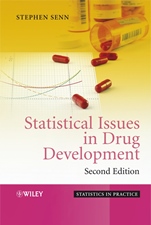
Statistical Issues in Drug Development
ISBN 9780470018774
Autor: Stephen S. Senn
Wydawca: Wiley
Dostępność: 3-6 tygodni
Cena: 575,40 zł
Przed złożeniem zamówienia prosimy o kontakt mailowy celem potwierdzenia ceny.
ISBN13: |
9780470018774 |
ISBN10: |
0470018771 |
Autor: |
Stephen S. Senn |
Oprawa: |
Hardback |
Rok Wydania: |
2008-01-04 |
Numer Wydania: |
2nd Edition |
Ilość stron: |
524 |
Wymiary: |
257x179 |
Tematy: |
MJ |
Drug development is the process of finding and producing therapeutically useful pharmaceuticals, turning them into safe and effective medicine, and producing reliable information regarding the appropriate dosage and dosing intervals. With regulatory authorities demanding increasingly higher standards in such developments, statistics has become an intrinsic and critical element in the design and conduct of drug development programmes.
Statistical Issues in Drug Development presents an essential and thought provoking guide to the statistical issues and controversies involved in drug development.
This highly readable second edition has been updated to include:Comprehensive coverage of the design and interpretation of clinical trials.Expanded sections on missing data, equivalence, meta–analysis and dose finding.An examination of both Bayesian and frequentist methods.A new chapter on pharmacogenomics and expanded coverage of pharmaco–epidemiology and pharmaco–economics.Coverage of the ICH guidelines, in particular ICH E9, Statistical Principles for Clinical Trials.
It is hoped that the book will stimulate dialogue between statisticians and life scientists working within the pharmaceutical industry. The accessible and wide–ranging coverage make it essential reading for both statisticians and non–statisticians working in the pharmaceutical industry, regulatory bodies and medical research institutes. There is also much to benefit undergraduate and postgraduate students whose courses include a medical statistics component.
Spis treści:
Preface to the Second Edition.
Preface to the First Edition.
Acknowledgements.
1. Introduction.
1.1 Drug development.
1.2 The role of statistics in drug development.
1.3 The object of this book.
1.4 The author’s knowledge of statistics in drug development.
1.5 The reader and his or her knowledge
of statistics.
1.6 How to use the book.
Part 1: Four Views of Statistics in Drug Development: Historical, Methodological, Technical and Professional.
2. A Brief and Superficial History of Statistics for Drug Developers.
2.1 Introduction.
2.2 Early Probabilists.
2.3 James Bernoulli (1654–1705).
2.4 John Arbuthnott (1667–1753).
2.5 The mathematics of probability in the late 17th, the 18th and early 19th centuries.
2.6 Thomas Bayes (1701–1761).
2.7 Adolphe Quetelet (1796–1874).
2.8 Francis Galton (1822–1911).
2.9 Karl Pearson (1857–1936).
2.10 ‘Student’ (1876–1937).
2.11 R.A. Fisher (1890–1962).
2.12 Modern mathematical statistics.
2.13 Medical statistics.
2.14 Statistics in clinical trials today.
2.15 The current debate.
2.16 A living science.
2.17 Further reading.
3. Design and Interpretation of Clinical Trials as Seen by a Statistician.
3.1 Prefatory warning.
3.2 Introduction.
3.3 Defining effects.
3.4 Practical problems in using the counterfactual argument.
3.5 Regression to the mean.
3.6 Control in clinical trials.
3.7 Randomization.
3.8 Blinding.
3.9 Using concomitant observations.
3.10 Measuring treatment effects.
3.11 Data generation models.
3.12 In conclusion.
3.13 Further reading.
4. Probability, Bayes, P–values, Tests of Hypotheses and Confidence Intervals.
4.1 Introduction.
4.2 An example.
4.3 Odds and sods.
4.4 The Bayesian solution to the example.
4.5 Why don’t we regularly use the Bayesian approach in clinical trials?
4.6 A frequentist approach.
4.7 Hypothesis testing in controlled clinical trials.
4.8 Significance tests and P–values.
4.9 Confidence intervals and limits and credible intervals.
4.10 Some Bayesian criticism of the frequentist approach.
4.11 Decision theory.
4.12 Conclusion.
4.13 Further reading .
5. The Wo
rk of the Pharmaceutical Statistician.
5.1 Prefatory remarks.
5.2 Introduction.
5.3 In the beginning.
5.4 The trial protocol.
5.5 The statistician’s role in planning the protocol.
5.6 Sample size determination.
5.7 Other important design issues.
5.8 Randomization.
5.9 Data collection preview.
5.10 Performing the trial.
5.11 Data analysis preview.
5.12 Analysis and reporting.
5.13 Other activities.
5.14 Statistical research.
5.15 Further reading.
Part 2: Statistical Issues: Debatable and Controversial Topics in Drug Development.
6. Allocating Treatments to Patients in Clinical Trials.
6.1 Background.
6.2 Issues.
References.
6.A Technical appendix.
7. Baselines and Covariate Information.
7.1 Background.
7.2 Issues.
7.A Technical appendix.
8. The Measurement of Treatment Effects.
8.1 Background.
8.2 Issues.
8.A Technical appendix.
9. Demographic Subgroups: Representation and Analysis.
9.1 Background.
9.2 Issues.
9.A Technical appendix.
10. Multiplicity.
10.1 Background.
10.2 Issues.
10.A Technical appendix.
11. Intention to Treat, Missing Data and Related Matters.
11.1 Background.
11.2 Issues.
11.A Technical appendix.
12. One–sided and Two–sided Tests and Other Issues to Do with Significance and P–values.
12.1 Background.
12.2 Issues.
13. Determining the Sample Size.
13.1 Background.
13.2 Issues.
14. Multicentre Trials.
14.1 Background.
14.2 Issues.
14.A Technical appendix.
15. Active Control Equivalence Studies.
15.1 Background.
15.2 Issues.
15.A Technical appendix.
16. Meta–Analysis.
16.1 Background.
16.2 Issues.
16.A Technical appendix.
17. Cross–over Trials.
17.1 Background.
17.2 Issues.
18. n–of–1 Trials.
18.1 Background.
18.2 Issues.
19. Sequential Tr4ials.
19.1 Background.
19.2
Issues.
20. Dose–finding.
20.1 Background.
20.2 Issues.
21. Concerning Pharmacokinetics and Pharmacodynamics.
21.1 Background.
21.2 Issues.
22. Bioequivalence Studies.
22.1 Background.
22.2 Issues.
23. Safety Data, Harms, Drug Monitoring and Pharmaco–epidemiology.
23.1 Background.
23.2 Issues.
24. Pharmaco–economics and Portfolio Management.
24.1 Background.
24.2 Issues.
25. Concerning Pharmacogenetics, Pharmacogenomics and Related Matters.
25.1 Background.
25.2 Issues.
25.A Technical appendix.
Glossary.
Index.
Nota biograficzna:
Stephen Senn has worked for the NHS in England, as a lecturer in Scotland and in drug development in Switzerland (with CIBA–Geigy). Until recently he was Professor of Pharmaceutical and Health Statistics at University College London but since September 2003 he has been Professor of Statistics at Glasgow University. His books, Cross–over Trials in Clinical Research (1993, 2nd edition 2002) and Statistical Issues in Drug Development (1997) are published by Wiley and his latest book, Dicing with Death (2003) by Cambridge University Press. In 2001, he was the first recipient of the George C Challis award for biostatistics of the University of Florida. He is a member of the editorial boards of Statistics in Medicine, Statistical Methods in Medical Research, Pharmaceutical Statistics and Applied Clinical Trials and is a section editor for the Wiley Statistics in Practice series.
Okładka tylna:
Drug development is the process of finding and producing therapeutically useful pharmaceuticals, turning them into safe and effective medicine, and producing reliable information regarding the appropriate dosage and dosing intervals. With regulatory authorities demanding increasingly higher standards in such developments, statistics has beco
Koszyk
Książek w koszyku: 0 szt.
Wartość zakupów: 0,00 zł
Informacje


Kontakt
Gambit
Centrum Oprogramowania
i Szkoleń Sp. z o.o.
Al. Pokoju 29b/22-24
31-564 Kraków
Siedziba Księgarni
ul. Kordylewskiego 1
31-542 Kraków
+48 12 410 5991
+48 12 410 5987
+48 12 410 5989
Subskrypcje
Administratorem danych osobowych jest firma Gambit COiS Sp. z o.o. Na podany adres będzie wysyłany wyłącznie biuletyn informacyjny.
Autoryzacja płatności

Informacje na temat autoryzacji płatności poprzez PayU.

© Copyright 2012: GAMBIT COiS Sp. z o.o. Wszelkie prawa zastrzeżone.
Projekt i wykonanie: Alchemia Studio Reklamy