


Wydawcy
Katalog tematyczny
- Archeologia (109)
- Ekonomia, finanse, business (13704)
- Filozofia (1445)
- Historia (3040)
- Języki i językoznawstwo (2356)
- Lifestyle, hobby i rozrywka (475)
- Medycyna (9704)
- Nauki humanistyczne (4)
- Nauki o Ziemi i środowisku (2638)
- Nauki ścisłe (20412)
- Nauki społeczne (8486)
- Nauki techniczne (13450)
- Budownictwo lądowe (1045)
- Chemia przemysłowa (2258)
- Elektronika i telekomunikacja (3287)
- Energetyka (1122)
- Inne nauki stosowane (363)
- Inżynieria biochemiczna (507)
- Inżynieria transportu (232)
- Mechanika i materiały (3316)
- Nauka o środowisku (321)
- Rolnictwo (507)
- Technika, ogólnie (475)
- Prawo (1696)
- Publikacje informacyjne i interdyscyplinarne (1288)
- Religia i wierzenia (917)
- Technika komputerowa (4067)
- Zdrowie, relacje międzyludzkie i rozwój osobisty (657)





Informacje szczegółowe o książce
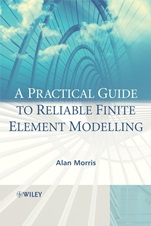
A Practical Guide to Reliable Finite Element Modelling
ISBN 9780470018323
Autor: Alan Morris
Wydawca: Wiley
Dostępność: 3-6 tygodni
Cena: 639,45 zł
Przed złożeniem zamówienia prosimy o kontakt mailowy celem potwierdzenia ceny.
ISBN13: |
9780470018323 |
ISBN10: |
0470018321 |
Autor: |
Alan Morris |
Oprawa: |
Hardback |
Rok Wydania: |
2008-01-11 |
Ilość stron: |
380 |
Wymiary: |
241x166 |
Tematy: |
TG |
Many books have been written about the finite element method; little however has been written about procedures that assist a practicing engineer in undertaking an analysis in such a way that errors and uncertainties can be controlled. In A Practical Guide to Reliable Finite Element Modelling, Morris addresses this important area. His book begins by introducing the reader to finite element analysis (FEA), covering the fundamental principles of the method, whilst also outlining the potential problems involved. He then establishes consistent methods for carrying out analyses and obtaining accurate and reliable results, concluding with a new method for undertaking error control led analyses.
The book addresses a number of topics that:
Systematically cover an introduction to FEA, how computers build linear–static and linear–dynamic finite element models, the identification of error sources, error control methods and error–control led analyses.
Enable the reader to support the design of complex structures with reliable, repeatable analyses using the finite element method.
Provide a basis for establishing good practice, thereby providing a legal grounding for the structural reliability of a product.
Demonstrate the method with a final case study involving two illustrative problems.
A Practical Guide to Reliable Finite Element Modelling will hold appeal to practising engineers engaged in conducting regular finite element analyses, particularly those new to the field of FE analysis. It will also be a resource for postgraduate students and researchers addressing problems associated with errors in the finite element method.
Spis treści:
Preface.
Chapter 1. Introduction.
1.1 Aim of the book.
1.2 Finite Element Types – a Brief Overview.
1.3 Finite Element Analysis and Finite Element Representations.
1.4 Multi–Model Analyses.
1.5 Consistency, Logic and Error Contro
l.
1.6 Chapter Contents.
Chapter 2 Overview of Static Finite Element Analysis.
2.1 Introduction.
2.2 The Direct Method for Static Analyses.
2.3 Reducing the Problem Size.
Chapter 3: Overview of Dynamic Analysis
3.1 Introduction
3.2 Element Mass Matrix.
3.3 Additional Information that can be Extracted to Support a Dynamic Finite Element Analysis.
3.4 Forced Responses.
3.5 Damped Forced Responses.
3.6 Reducing the Problem Size.
Chapter 4: What′s Energy Got to Do with It?
4.1 Introduction .
4.2 Strain Energy.
4.3 Potential Energy.
4.4 Simple Bar.
4.5 General Case.
4.6 Minimum Potential Energy.
4.7 The Principle of Minimum Potential Energy Applied to a Simple Finite Element Problem.
4.8 Finite Element Formulation.
4.9 Direct Application to an Axial Bar Element.
4.10 Convergence in Energy and Convergence in Stress.
4.11 Results Interpretation.
4.12 Kinetic Energy.
4.13 Final Remark.
Chapter 5. Preliminary Review of Errors and Error Control.
5.1 Introduction.
5.2 The Finite Element Process.
5.3 Error and Uncertainty.
5.4 Novelty, Complexity and Experience.
5.5 Role of Testing.
5.6 Initial Steps.
5.7 Analysis Validation Plan (AVP).
5.8 Applied Common Sense.
5.9 The Process.
Chapter 6. Discretisation: Elements and Meshes or Some Ways to Avoid Generated Error.
6.1 Introduction.
6.2 Element Delivery.
6.3 Mesh Grading and Mesh Distortion.
6.4 The Accuracy Ladder.
Chapter 7. Idealisation Error Types and Sources.
7.1 Design Reduction and Idealisation Errors.
7.2 Analysis Features.
7.3 The Domain.
7.4 Levels of Abstraction.
7.5 Boundary Conditions.
7.6 Material Properties.
7.7 Loads and Masses.
Chapter 8. Error Control.
8.1 Introduction.
8.2 Approach and Techniques.
8.3 Accumulation of Errors and Uncertainties.
8.4 The Role of Testing.
Chapter 9. Error Controlled Analyses.
9.1 Introduction.
9.2 Is the Fin
ite Element System Fit for Purpose.
9.3 Quality Report.
9.4 The Error and Uncertainty Control Method.
Chapter 10 FEMEC Walkthrough Example.
10.1 Introduction.
10.2 FEMEC Static Analysis Illustrative Problem.
10.3 A Brief Look at the Dynamic FEMEC World.
Index.
Nota biograficzna:
Alan Morris has recently retired from his post at Cranfield University in the UK as Professor of Structural Analysis. His range of expertise covers the development and application of optimal design and analysis systems, with special emphasis on the finite element methods and structural optimisation programs. Previously, he was a Principal Research Officer in the Royal Aircraft Establishment (now QinetiQ) at Farnborough and was head of the Structures and Optimization Sections at the Advanced Concepts Section.
Okładka tylna:
Many books have been written about the finite element method; little however has been written about procedures that assist a practicing engineer in undertaking an analysis in such a way that errors and uncertainties can be controlled. In A Practical Guide to Reliable Finite Element Modelling, Morris addresses this important area. His book begins by introducing the reader to finite element analysis (FEA), covering the fundamental principles of the method, whilst also outlining the potential problems involved. He then establishes consistent methods for carrying out analyses and obtaining accurate and reliable results, concluding with a new method for undertaking error control led analyses.
The book addresses a number of topics that:
Systematically cover an introduction to FEA, how computers build linear–static and linear–dynamic finite element models, the identification of error sources, error control methods and error–control led analyses.
Enable the reader to support the design of complex structures with reliable, repeatable analyses using the finite element metho
d.
Provide a basis for establishing good practice, thereby providing a legal grounding for the structural reliability of a product.
Demonstrate the method with a final case study involving two illustrative problems.
A Practical Guide to Reliable Finite Element Modelling will hold appeal to practising engineers engaged in conducting regular finite element analyses, particularly those new to the field of FE analysis. It will also be a resource for postgraduate students and researchers addressing problems associated with errors in the finite element method.
Koszyk
Książek w koszyku: 0 szt.
Wartość zakupów: 0,00 zł
Informacje


Kontakt
Gambit
Centrum Oprogramowania
i Szkoleń Sp. z o.o.
Al. Pokoju 29b/22-24
31-564 Kraków
Siedziba Księgarni
ul. Kordylewskiego 1
31-542 Kraków
+48 12 410 5991
+48 12 410 5987
+48 12 410 5989
Subskrypcje
Administratorem danych osobowych jest firma Gambit COiS Sp. z o.o. Na podany adres będzie wysyłany wyłącznie biuletyn informacyjny.
Autoryzacja płatności

Informacje na temat autoryzacji płatności poprzez PayU.

© Copyright 2012: GAMBIT COiS Sp. z o.o. Wszelkie prawa zastrzeżone.
Projekt i wykonanie: Alchemia Studio Reklamy