


Wydawcy
Katalog tematyczny
- Archeologia (109)
- Ekonomia, finanse, business (13704)
- Filozofia (1445)
- Historia (3040)
- Języki i językoznawstwo (2356)
- Lifestyle, hobby i rozrywka (475)
- Medycyna (9704)
- Nauki humanistyczne (4)
- Nauki o Ziemi i środowisku (2638)
- Nauki ścisłe (20412)
- Nauki społeczne (8486)
- Nauki techniczne (13450)
- Budownictwo lądowe (1045)
- Chemia przemysłowa (2258)
- Elektronika i telekomunikacja (3287)
- Energetyka (1122)
- Inne nauki stosowane (363)
- Inżynieria biochemiczna (507)
- Inżynieria transportu (232)
- Mechanika i materiały (3316)
- Nauka o środowisku (321)
- Rolnictwo (507)
- Technika, ogólnie (475)
- Prawo (1696)
- Publikacje informacyjne i interdyscyplinarne (1288)
- Religia i wierzenia (917)
- Technika komputerowa (4067)
- Zdrowie, relacje międzyludzkie i rozwój osobisty (657)





Informacje szczegółowe o książce
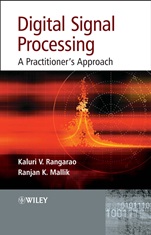
Digital Signal Processing: A Practitioners Approach
ISBN 9780470017692
Autor: Kaluri V. Rangarao, Ranjan K. Mallik
Wydawca: Wiley
Dostępność: 3-6 tygodni
Cena: 572,25 zł
Przed złożeniem zamówienia prosimy o kontakt mailowy celem potwierdzenia ceny.
ISBN13: |
9780470017692 |
ISBN10: |
0470017694 |
Autor: |
Kaluri V. Rangarao, Ranjan K. Mallik |
Oprawa: |
Hardback |
Rok Wydania: |
2005-11-18 |
Ilość stron: |
210 |
Wymiary: |
234x181 |
Tematy: |
TJ |
Digital signal processing is essential for improving the accuracy and reliability of a range of engineering systems, including communications, networking, and audio and video applications. Using a combination of programming and mathematical techniques, it clarifies, or standardizes the levels or states of a signal, in order to meet the demands of designing high performance digital hardware.
Written by authors with a wealth of practical experience working with digital signal processing, this text is an excellent step–by–step guide for practitioners and researchers needing to understand and quickly implement the technology. Split into six, self–contained chapters, Digital Signal Processing: A Practitioner’s Approach covers:basic principles of signal processing such as linearity, stability, convolution, time and frequency domains, and noise;descriptions of digital filters and their realization, including fixed point implementation, pipelining, and field programmable gate array (FGPA) implementation;Fourier transforms, especially discrete (DFT), and fast Fourier transforms (FFT);case studies demonstrating difference equations, direction of arrival (DoA), and electronic rotating elements, and MATLAB programs to accompany each chapter.
A valuable reference for engineers developing digital signal processing applications, this book is also a useful resource for electrical and computer engineering graduates taking courses in signal processing.
Spis treści:
Foreword.
Preface.
Acknowledgements.
1. Processing of Signals.
1.1 Organisation of the Book.
1.2 Classification of Signals.
1.3 Transformations.
1.4 Signal Characterisation.
1.5 Converting Analogue Signals to Digital.
1.6 Signal Seen by the Computing Engine.
1.7 It Is Only Numbers.
1.8 Summary.
References.
2. Revisiting the Basics.
2.1 Linearity.
2.2 Linear System Representation.2.3 Random Variables.
2.4 Noise.
2.5 Propagation of Noise in Linear Systems.
2.6 Multivariate Functions.
2.7 Number Systems.
2.8 Summary.
References.
3. Digital Filters.
3.1 How to Specify a Filter.
3.2 Moving–Average Filters.
3.3 Infinite Sequence Generation.
3.4 Unity–Gain Narrowband Filter.
3.5 All–Pass Filter.
3.6 Notch Filter.
3.7 Other Autoregressive Filters.
3.8 Adaptive Filters.
3.9 Demodulating via Adaptive Filters.
3.10 Phase Shift via Adaptive Filter.
3.11 Inverse Problems.
3.12 Kalman Filter.
3.13 Summary.
References.
4. Fourier Transform and Signal Spectrum.
4.1 Heterodyne Spectrum Analyser.
4.2 Discrete Fourier Transform.
4.3 Decimating the Given Sequence.
4.4 Fast Fourier Transform.
4.5 Fourier Series Coefficients.
4.6 Convolution by DFT.
4.7 DFT in Real Time.
4.8 Frequency Estimation via DFT.
4.9 Parametric Spectrum in RF Systems.
4.10 Summary.
References.
5. Realisation of Digital Filters.
5.1 Evolution.
5.2 Development Process.
5.3 Analogue–to–Digital Converters.
5.4 Second–Order BPF.
5.5 Pipelining Filters.
5.6 Real–Time Applications.
5.7 Frequency Estimator on the DSP5630X.
5.8 FPGA Implementation of a Kalman Filter.
5.9 Summary.
References.
6. Case Studies.
6.1 Difference Equation to Program.
6.2 Estimating Direction of Arrival.
6.3 Electronic Rotating Elements.
6.4 Summary.
References.
Appendix: MATLAB and C Programs.
A.1 Chapter 1 MATLAB Programs.
A.2 Chapter 2 MATLAB Programs.
A.3 Chapter 3 MATLAB Programs.
A.4 Chapter 4 MATLAB Programs.
A.5 Chapter 5 Programs.
A.6 Chapter 6 MATLAB Programs.
A.7 Library of Subroutines.
A.8 Some Useful Programs.
Index.
Nota biograficzna:
Dr Kaluri V. Rangarao, Satyam Computer Services Ltd, Satyam Technology Center, Bahadurpa
lly, RR District 500043, Andhra Pradesh, India.
Dr Rangarao is currently Vice President of Satyam Computer Services, Ltd, India working in the areas of embedded software development and telecoms. Before this post, he has had 14 years experience in industry working with applications of digital signal processing, software engineering, real–time systems, digital image processing and product development. He is also a senior member of IEEE, Chairman of the Computer Society of India and has had over 10 journal and conference papers published on the subjects of signal processing and software development.
Dr Ranjan K. Mallik, Associate Professor, Department of Electrical Engineering, Indian Institute of Technology – Delhi, Hauz Khas, New Delhi 11016, India.
Dr Mallik is currently an Associate Professor in the Department of Electrical Engineering at the Indian Institute of Technology, Delhi. He has been teaching at the Institute since 1994 and is now conducting research in the areas of communication theory and systems, difference equations and linear algebra. He has had industry experience in the Defence Electronics Research Laboratory in India and has written over 60 journal and conference papers on digital signal processing and communication theory.
Okładka tylna:
Digital signal processing is essential for improving the accuracy and reliability of a range of engineering systems, including communications, networking, and audio and video applications. Using a combination of programming and mathematical techniques, it clarifies, or standardizes the levels or states of a signal, in order to meet the demands of designing high performance digital hardware.
Written by authors with a wealth of practical experience working with digital signal processing, this text is an excellent step–by–step guide for practitioners and researchers needing to understand and quickly implement the technology. Split into six, self
–contained chapters, Digital Signal Processing: A Practitioner’s Approach covers:basic principles of signal processing such as linearity, stability, convolution, time and frequency domains, and noise;descriptions of digital filters and their realization, including fixed point implementation, pipelining, and field programmable gate array (FGPA) implementation;Fourier transforms, especially discrete (DFT), and fast Fourier transforms (FFT);case studies demonstrating difference equations, direction of arrival (DoA), and electronic rotating elements, and MATLAB programs to accompany each chapter.
A valuable reference for engineers developing digital signal processing applications, this book is also a useful resource for electrical and computer engineering graduates taking courses in signal processing.
Koszyk
Książek w koszyku: 0 szt.
Wartość zakupów: 0,00 zł
Informacje


Kontakt
Gambit
Centrum Oprogramowania
i Szkoleń Sp. z o.o.
Al. Pokoju 29b/22-24
31-564 Kraków
Siedziba Księgarni
ul. Kordylewskiego 1
31-542 Kraków
+48 12 410 5991
+48 12 410 5987
+48 12 410 5989
Subskrypcje
Administratorem danych osobowych jest firma Gambit COiS Sp. z o.o. Na podany adres będzie wysyłany wyłącznie biuletyn informacyjny.
Autoryzacja płatności

Informacje na temat autoryzacji płatności poprzez PayU.

© Copyright 2012: GAMBIT COiS Sp. z o.o. Wszelkie prawa zastrzeżone.
Projekt i wykonanie: Alchemia Studio Reklamy